
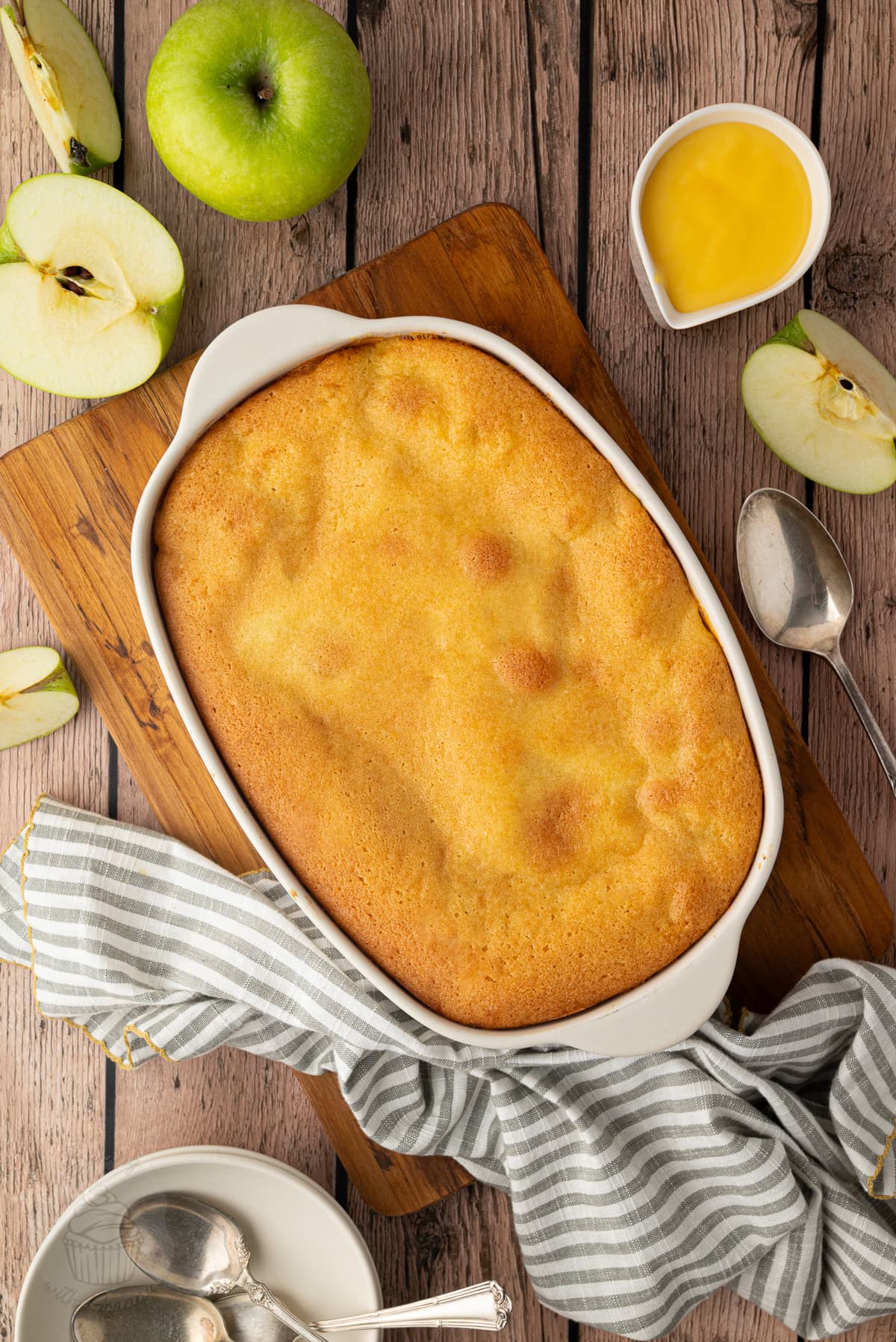
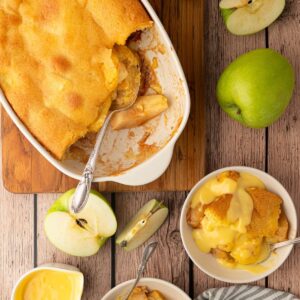
This traditional Eve’s Pudding is a simple British apple sponge pudding, with softly cooked apples beneath a light, golden Victoria sponge topping. The apples are only briefly stewed so they keep a little texture as they finish cooking in the oven – perfect served warm with plenty of custard.

Eve’s Pudding Recipe Snapshot
- Recipe Type: Traditional British apple sponge pudding.
- Texture: Soft apples with a little bite beneath a light, fluffy sponge.
- Difficulty: Easy.
- Prep Time: 20 minutes.
- Bake Time: 35 minutes.
- Serves: 8 portions.
- Dish Size: Deep 2 litre ovenproof dish.
- Best Apples: Virtually any variety you have to hand.
- Sponge: Simple Victoria sponge-style topping.
- What Makes It Traditional: Apples gently stewed with sugar, lemon and cinnamon before being topped with sponge.
- Best Served: Warm with custard, cream or ice cream.
Summarise & Save this Recipe on:
What Is Eve’s Pudding?
Eve’s Pudding is a traditional British apple sponge pudding made with a layer of softly cooked apples topped with a light sponge mixture and baked until golden. It’s sometimes simply described as an apple sponge pudding – essentially soft, lightly spiced apples underneath something very similar to a Victoria Sponge Cake.
Unlike an easy Apple Crumble recipe, where the fruit is covered with a crumbly flour, sugar, and butter topping, or homemade Apple Pie, where the apples are encased in rich shortcrust pastry, Eve’s Pudding is finished with cake batter instead. As it bakes, the sponge rises above the apples while some of those lovely apple juices soak into the bottom of the cake.
I only stew the apples briefly before they go into the baking dish. You want them to start softening, but not become completely mushy, because they’ll continue cooking underneath the sponge when in the oven. I like the finished apples to still have a little texture rather than becoming an apple sauce at the bottom of the pudding.
The sponge-to-apple ratio is deliberately quite generous on the fruit too. After testing it this way, I find 1kg of apples with a 170g sponge mixture gives a good balance – plenty of apple in every spoonful without the sponge disappearing altogether.
Why Is It Called Eve’s Pudding?
Eve’s Pudding – historically also known as Mother Eve’s Pudding – gets its name from the association between the biblical Eve and apples. The Bible doesn’t actually specify that the forbidden fruit was apples, but over time an apple became closely associated with that story, which is where this old-fashioned British pudding is believed to get its name.
From My Granny’s Recipe Collection
Eve’s Pudding wasn’t one of the recipes I grew up eating, but it was one that kept appearing when I worked my way through my own Granny’s old recipe collection.
And when I say recipe collection, I don’t just mean cookbooks. My Granny had everything from proper baking books to church recipe pamphlets, handwritten notes and old magazine cuttings – the sort of collection where you can find several slightly different versions of the same traditional bake tucked away in different places. In no particular order either, making it fun to find exactly what you are looking for! Saying that, it’s also where I discovered other great recipes like Spotted Dick Pudding and Jam Roly Poly.
I developed this Eve’s Pudding recipe using those older recipes as my starting point, taking the traditional elements that appeared time and again and then testing the quantities and method until I had a version I was happy with.
That includes gently stewing the apples with a little sugar, lemon juice and water before adding the sponge. The lemon juice in particular appeared throughout the older recipes I worked from, so I’ve kept it here as part of that traditional flavour combo.
The result is this lovely simple old-fashioned pudding – plenty of softly cooked apple with just a little bit of texture left, topped with a light Victoria sponge-style cake and baked until golden.
When You Have More Apples Than You Know What to Do With
If there’s one thing my family knows all too well, it’s having way too many apples!
My parents have a wee apple tree in their garden that somehow manages to produce hundreds of apples every year, despite never becoming particularly big. Come late summer and autumn, there are apples everywhere – and they’re certainly not the only ones with that problem. Around here, you’ll often see boxes of homegrown apples left outside houses for people to help themselves to.
There have even been years when our local food bank has had to turn away more apple donations because they already had so many!
Recipes like Eve’s Pudding are perfect for those times when you suddenly have a pile of apples that need using. And you really don’t need to worry too much about which variety you have. Some apples will soften more, some will stay firmer, some will be sweeter and others sharper, but virtually any apple can be turned into a lovely apple sponge pudding.
That’s one of the reasons I love these old-fashioned apple recipes – they were made for using what you had, rather than going out to buy a particular variety of fruit. My recipe for Plum Cake and the best Rhubarb Crumble recipe are also great for using up any excess homegrown fruit you have.
Key Ingredients
Eve’s Pudding is made with very simple ingredients, but there are a few that make a real difference to the texture and flavour of the finished pudding.
See the recipe card for a full ingredients list, required quantities and cup conversions.
Substitutions & Additions
Apples: You can use eating apples, cooking apples or a mixture of both. Different varieties will naturally give slightly different flavours and textures, but pretty much any apples will work well in Eve’s Pudding.
Sugar: The amount of sugar used with the apples can be adjusted depending on how sweet or tart your fruit is. The sponge topping is already sweet, so the standard amount will work well in most cases, but particularly sharp apples may benefit from a little extra.
Cinnamon: Feel free to adjust the cinnamon to suit your own taste. I like just enough to add a little warmth without masking the apples’ flavour.
Additions: Vanilla isn’t necessary, and I prefer the simple apple and cinnamon flavour of the traditional pudding, but you can add around 1 tsp vanilla extract to the sponge mixture if you’d like a little extra flavour.
Looking for dairy-free, gluten-free or vegan adaptations? See the Free-from & Vegan section below.
Free-from & Vegan
Amy recommends: If you regularly need to adapt baking recipes for gluten-free, dairy-free, egg-free or vegan diets, I highly recommend The Elements of Baking by Katarina Cermelj, creator of The Loopy Whisk. It’s a brilliant resource for understanding how substitutions work, rather than just swapping ingredients and hoping for the best.
Gluten-free Options:
To make this a gluten-free Eve’s Pudding, you can simply swap the flour for gluten-free self-raising flour. The sponge may have a slightly different texture, but it will still be delicious.
Nut-free Adjustments:
This recipe contains no nuts, but as always, be sure to double-check the allergen lists for your individual ingredients.
Dairy-free Swaps:
To make this a dairy-free Eve’s Pudding, simply use a dairy-free margarine in the sponge topping. And don’t forget to serve with your favourite dairy-free custard or ice cream too!
Egg-Free Adaptations:
I haven’t yet tested this recipe egg-free, but with most sponge cake recipes, it should work just fine with a vegan egg replacer, such as Oggs or Bob’s Red Mill Egg Replacer.
Vegan Substitutions:
To make this a vegan Eve’s Pudding, simply use a dairy-free margarine, follow the egg-free suggestions above and use a vegan egg replacer. I haven’t tested a vegan version of this recipe yet, but if you do, let me know how it turns out!
Allergy Disclaimer & Resources:
Any advice or suggestions to make recipes “free-from” or vegan are purely suggestions. Please double-check all packaged ingredients individually, taking extra caution when baking for those with allergies or intolerances.
For official guidance on food allergies, please see Food Standards Agency (food.gov.uk) | For more info on coeliac disease, please see Coeliac UK (coeliac.org.uk) | For more info on a vegan diet, please see The Vegan Society (vegansociety.com)
How to Make Eve’s Pudding
Eve’s Pudding is very simple to put together. The apples only need a few minutes on the hob before going into the baking dish, then a basic Victoria sponge-style mixture is spooned over the top, and everything finishes cooking together in the oven.
- Prepare your oven and dish. Preheat your oven to 180°C (160°C fan-assisted ovens, Gas Mark 4 or 350°F). Grease a deep 2 litre ovenproof dish with a little margarine/butter. Ceramic or glass is ideal, but you can use any suitable deep baking dish or cake tin of a similar capacity.
- Start cooking the apples. Peel and core the apples, then cut them into large, bite-sized chunks. Add them to a large saucepan with the lemon juice and water, then cook over a medium-high heat for 4-5 minutes, stirring occasionally. You only want the apples to start softening – they should still have some texture, as they’ll continue cooking in the oven.
- Add the sugar and cinnamon. Remove the apples from the heat and stir through the caster sugar and ground cinnamon. Transfer everything to your prepared baking dish and spread the apples into an even layer. Set aside while you make the sponge topping.
- Cream the margarine/butter and sugar. In a large bowl, beat the softened margarine/butter and caster sugar together until noticeably paler, light and fluffy.
- Add the eggs. Beat in the eggs one at a time, making sure each is mixed through before adding the next. If the mixture starts to look a little curdled, add a spoonful of your measured flour with the next egg.
- Add the flour. Sift in the self-raising flour and gently fold until just combined, with no visible pockets of flour.
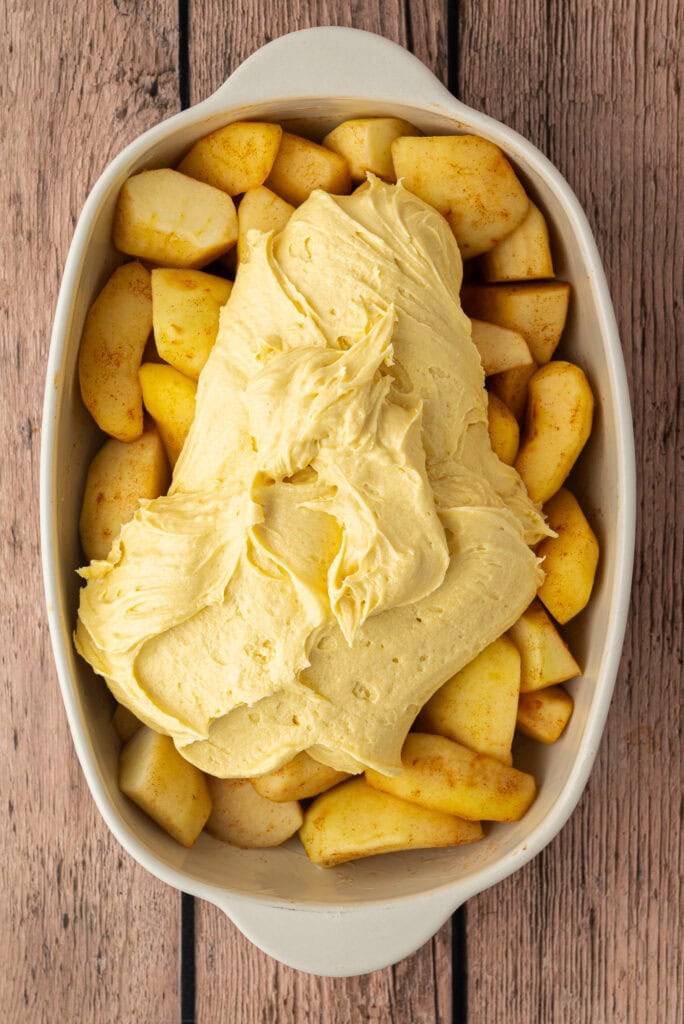
- Dollop the sponge over the apples. Spoon the sponge mixture in dollops over the apples.
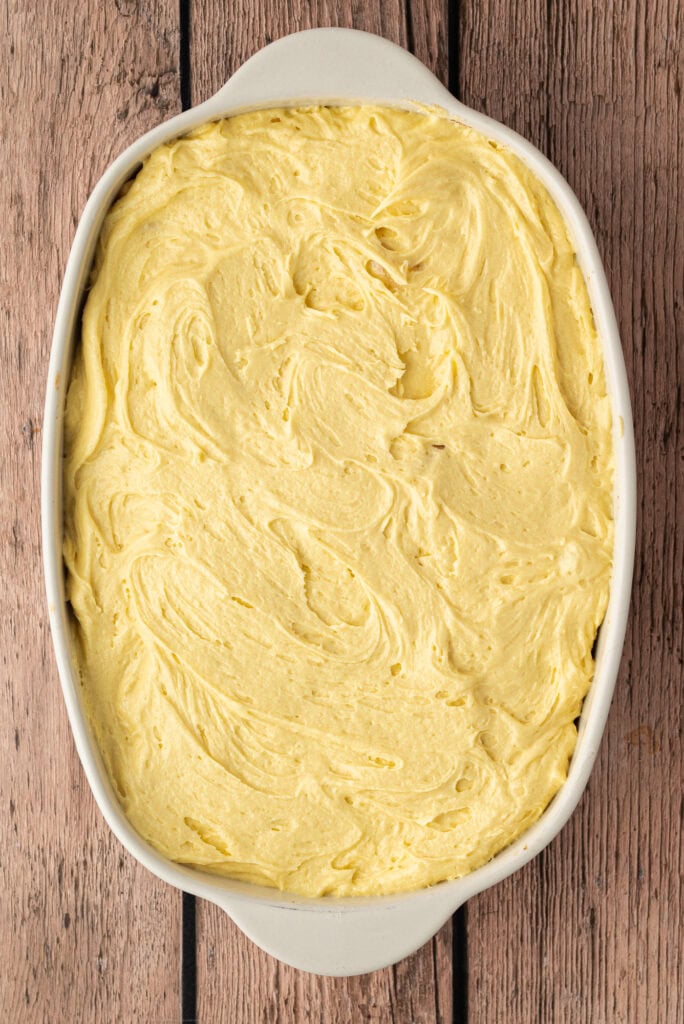
- Gently spread the sponge to the edges. Use the back of a spoon or a spatula to carefully join the dollops together, covering the apples completely and taking the batter right to the edges of the dish. It doesn’t need to be perfectly smooth.
- Bake. Bake for 30-35 minutes, until the sponge is well risen and golden and a skewer inserted into the sponge comes out clean.
- Rest before serving. Leave the Eve’s Pudding to stand for 10 minutes after removing it from the oven. This gives the apples a chance to cool from molten-hot while keeping the pudding lovely and warm for serving.
Top Tips for the Best Eve’s Pudding
- Don’t Overcook the Apples: The 4-5 minutes on the hob is only to get them started. They’ll continue cooking underneath the sponge, so you still want them to have a wee bit of texture when they go into the baking dish, so they aren’t just mush by the end.
- Don’t Worry About Perfect Apple Pieces: Large, bite-sized chunks are ideal, but they don’t need to be exactly the same size. Just avoid cutting them very small, where they can disappear into an apple sauce, or leave them so big that they struggle to soften.
- Use a Deep Baking Dish: A deeper 2 litre dish gives the apples and sponge plenty of room without risking the pudding bubbling over as it bakes. Ceramic, glass or even a suitable cake tin will all work.
- Dollop Before You Spread: Spoon the sponge mixture over the apples in several dollops before gently joining them together. It’s much easier than putting all the batter into one heap in the middle and then trying to spread it across softened fruit.
- Don’t Overmix the Sponge: Once the self-raising flour is added, fold only until everything is combined. Overworking the mixture can mean you end up with a heavier sponge rather than the light, fluffy topping you’re after.
- Give It a Few Minutes Before Serving: Leave the baked pudding for at least 10 minutes before digging in. The apples underneath will be extremely hot straight from the oven, and that short rest lets everything settle while the pudding stays lovely and warm.
Storage, Freezing & Reheating
- Storage: Once completely cool, cover the Eve’s Pudding well or transfer leftovers to an airtight container and keep in the fridge for up to 3 days. The sponge will become a little softer the longer it sits, as it continues to absorb some of the juices from the apples underneath. That’s completely normal – the texture changes a little, but the flavour is still delicious.
- Freezing: Eve’s Pudding freezes well once baked. Allow it to cool completely, then wrap the whole dish well or transfer individual portions to freezer-safe containers. Freeze for up to 3 months. Defrost overnight in the fridge before reheating.
- Reheating: For the best texture, reheat Eve’s Pudding in the oven at 180°C (160°C fan-assisted ovens, Gas Mark 4 or 350°F) until piping hot throughout. Cover loosely with foil if the sponge is already well browned..
Individual portions can also be reheated in the microwave in short bursts until hot. The sponge will be softer than when freshly baked, but it’s still very good – especially once there’s custard involved!
How to Serve Eve’s Pudding
Eve’s Pudding is best served warm, after giving it 10 minutes to rest once it comes out of the oven. This lets the apple layer cool slightly while keeping the sponge lovely and warm.
For a proper old-fashioned pudding vibe, serve it with plenty of warm custard. Pouring cream or a scoop of vanilla ice cream are also lovely, but custard would always be my first choice!
Spoon it straight from the baking dish, making sure each serving gets plenty of both the soft apple layer and the yummy sponge topping.

With thanks to Naomi Seiler for creating these photos.
Eve’s Pudding FAQs
Really, any variety of apple will work. Eating apples, cooking apples, or a mixture of both are all fine – they’ll simply give you slightly different flavours and textures. Cooking apples tend to soften more and can be sharper, while many eating apples retain a little more shape. If your apples are particularly tart, you can add a little extra sugar to the filling.
I recommend giving them the brief 4-5 minute stew used in this recipe. You’re not trying to cook them completely – just start the softening process before they go underneath the sponge. They’ll continue cooking in the oven, leaving you with soft apples that still have a little texture rather than them being an apple sauce at the bottom.
Yes. The capacity is more important than the exact shape or material, so use a deep dish of around 2 litres. Ceramic, glass or even a suitable cake tin can work. Avoid anything too shallow, as you need enough room for the apple layer and for the sponge to rise as it bakes.
The sponge should be well risen and golden on top. Insert a skewer into the sponge layer – avoid pushing it right down into the wet apples underneath – and it should come out clean or with just a few dry crumbs. If the top is browning before the sponge is fully baked, loosely cover it with tin foil and continue baking.
Yes. You can prepare the apple layer a few hours ahead, transfer it to your baking dish and set it aside until you’re ready to finish the pudding. But only make the sponge mixture when you are ready to bake, rather than leaving the assembled unbaked pudding sitting for a long time – the sponge needs to go in the oven as soon as it is made.
More Classic British Dessert
If you loved this Eve’s Pudding, here are some more of my favourite British dessert recipes for you to try next:
Save this recipe!
Want to save this recipe for later? Pop your email below and come back to it when you’re ready to bake.
Eve’s Pudding
INGREDIENTS
For the Filling:
- 1 kg Apples (approx. 8 medium apples; peeled and cored)
- 2 tbsp Lemon Juice
- 2 tbsp Water
- 3 tbsp Caster Sugar
- 1 tsp Ground Cinnamon
For the Sponge Topping:
- 170 g Soft Margarine (or Butter) (at room temperature; plus extra for greasing)
- 170 g Caster Sugar
- 3 Free-range Eggs (at room temperature; see Egg Size note below)
- 170 g Self-raising Flour (see Self-raising Flour note below)
EQUIPMENT
- Baking Dish (approx. 2-litre capacity, high-sided)
INSTRUCTIONS
- Preheat your oven to 180°C (160°C for fan-assisted ovens, Gas Mark 4 or 350°F). Grease a baking dish with some extra margarine/butter and set aside.
For the Filling
- In a large saucepan, add the apples, lemon juice and water, and warm over a medium-high heat for 4-5 minutes, until the apples begin to soften a little. Remove from the heat, then stir in the sugar and cinnamon. Transfer to the pre-greased baking dish and set aside while you prepare the sponge topping.1 kg Apples; 2 tbsp Lemon Juice; 2 tbsp Water; 1 tsp Ground Cinnamon; 3 tbsp Caster Sugar
For the Sponge Topping:
- In a large bowl, cream together the margarine and sugar until light and fluffy in both colour and texture. Add the eggs one at a time, making sure each is mixed through before adding the next. Sift in the flour and gently fold to create a batter.170 g Soft Margarine (or Butter); 170 g Caster Sugar; 3 Free-range Eggs; 170 g Self-raising Flour
- Spoon the sponge batter on top of the apple mixture and spread it into the corners and sides, ensuring all of the apple mixture is covered.
- Bake in your preheated oven for 30-35 minutes, until risen, golden, and a skewer inserted comes out clean.
- Leave to rest for 10 minutes before serving, to allow the apples to cool a little, then serve with custard, cream or ice cream.
IMPORTANT NOTE:
All my recipes are developed using a digital scale and the metric system (grams and millilitres). Cup measurements are available as a conversion, but these, unfortunately, won’t always be as accurate. For best results, I always recommend baking with a digital scale.









ABOUT THE AUTHOR
Amy Beth Reid
Amy Beth Reid is an award-winning food blogger, mother, wife and cookbook author. Inspired by her childhood in the kitchen with her Mum – a professional baker and her children’s Granny – Amy now shares her tried-and-tested traditional home baking recipes with bakers of all abilities around the world. She lives in Scotland with her husband, two sons and her small pack of Siberian huskies.