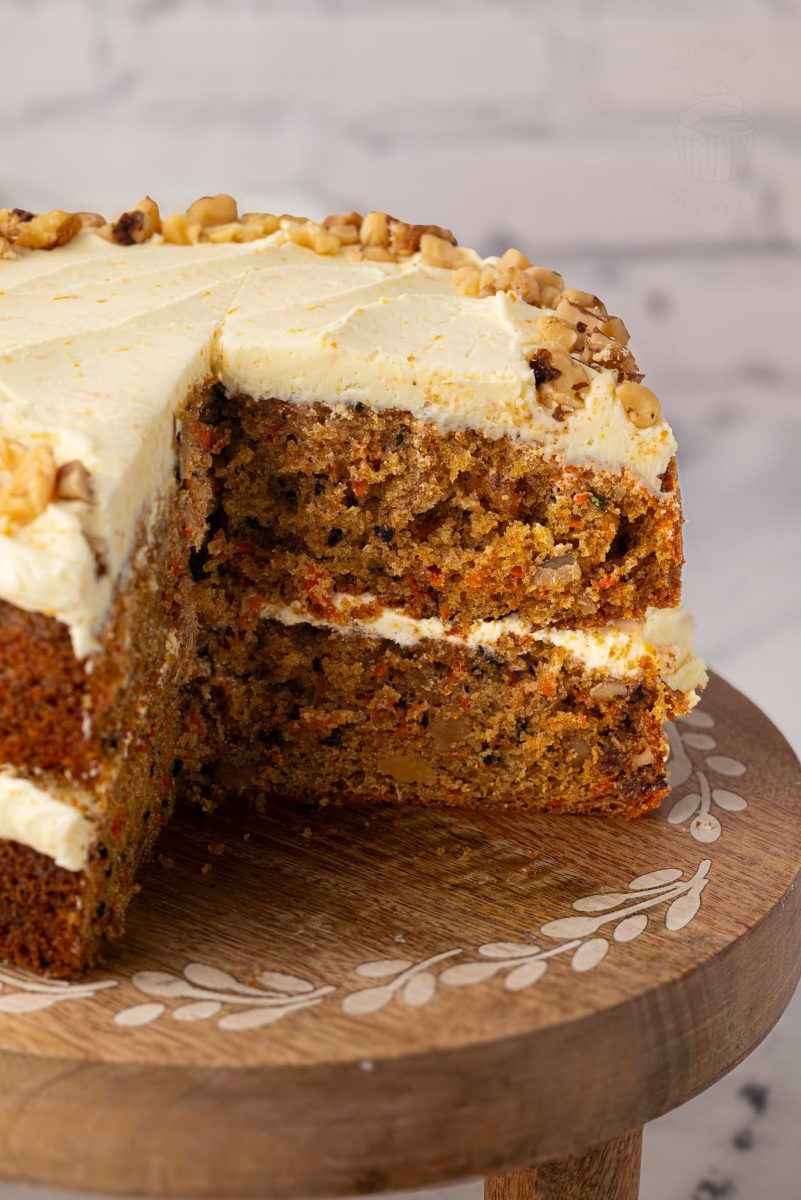
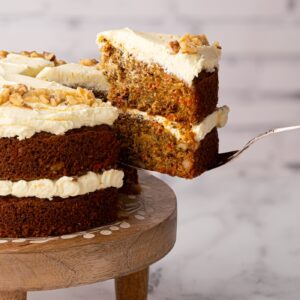
This easy Carrot Cake recipe makes two soft, moist layers flavoured with cinnamon, nutmeg, orange zest, sultanas and walnuts. The simple, one-bowl batter is mixed by hand before the cakes are baked, sandwiched together and topped with buttercream icing, rather than cream cheese frosting. This delicious cake was a favourite of mine long before I first shared it here in 2020, and remains a firm favourite today.
Carrot Cake Recipe Snapshot
- Recipe: Easy Carrot Cake.
- Texture: Soft, moist and slightly crumbly, with grated carrot, sultanas and walnuts throughout.
- Flavour: Sweet and gently spiced, with cinnamon, nutmeg and orange zest.
- Difficulty: Easy, great for beginners.
- Method: One-bowl cake batter, mixed by hand.
- Prep Time: 25 minutes.
- Bake Time: 30-35 minutes.
- Tins: Two 18cm (7-inch) sandwich tins.
- Layers: Two cakes, sandwiched together with buttercream icing.
- Topping and Filling: Simple buttercream rather than cream cheese frosting.
- Makes: 10 slices.
Summarise & Save this Recipe on:
What is Carrot Cake?
Carrot Cake is a soft, moist cake made with grated carrot, sugar, eggs, flour and oil, usually flavoured with warming spices. Nuts and dried fruit are also common additions, adding texture and a little bit of chewiness.
Carrot Cake became especially popular in the UK during the Second World War, when rationing and food shortages encouraged home bakers to make more use of carrots in sweet recipes. It has remained a firm teatime favourite ever since, alongside classic British bakes such as Victoria Sponge and Madeira Cake.
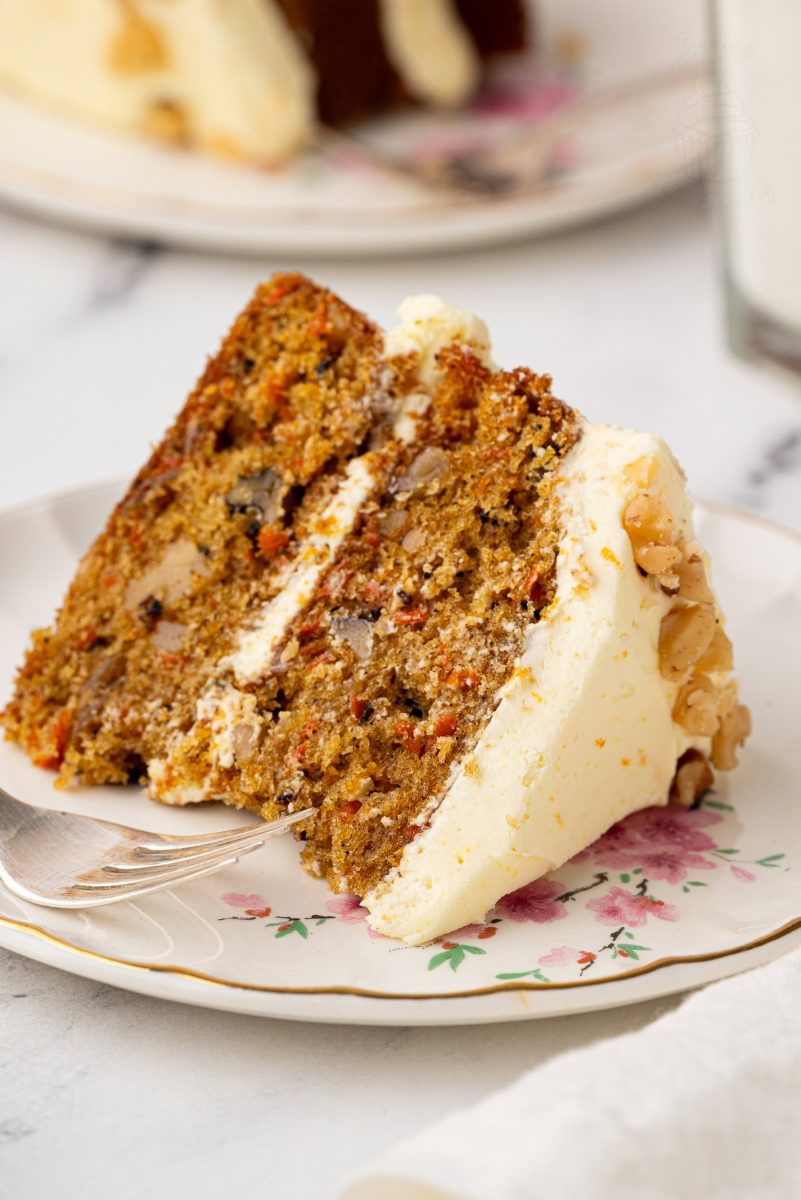
My version is a simple two-layer Carrot Cake, made with a mixture of caster sugar and light brown sugar. I like the balance this gives between sweetness and the deeper flavour of brown sugar, while sunflower oil helps to keep the cake light and moist without adding an overwhelming flavour. Grated carrot, sultanas, walnuts, orange zest, cinnamon and nutmeg then bring plenty of texture and flavour to the finished cake.
The batter itself is mixed by hand in one bowl, making this a super-simple bake and a good Carrot Cake recipe for beginners, or anyone who doesn’t like having too much washing up! It is then divided between two 18cm sandwich tins, so you get two lovely layers ready to fill and top without having to faff about cutting one big, moist, slightly crumbly cake in half.
While cream cheese frosting is perhaps the most popular topping for Carrot Cake, I prefer to use simple buttercream icing. It’s made with everyday ingredients that you probably already have, without needing a mad dash to the supermarket for a pack of cream cheese. And because it doesn’t need to be kept in the fridge, the finished cake is a little more convenient to store and serve.
And if you enjoy soft, old-fashioned cakes with warming spices and plenty of flavour, you might also like my Golden Syrup Cake, Honey Nut Cake and Gingerbread Loaf.
“Does Carrot Cake Have Carrots in it?”
Whenever someone mentions Carrot Cake, I’m taken straight back to my final years at high school. Business Management was one of my favourite subjects – so much so that I actually mentioned my teacher in the acknowledgements of my debut cookbook, Scottish Bakes. And because our Friday morning Business Management lesson fell at the end of a half-day of school, our class somehow got into the habit of bringing in cake to share. Each week, on what became known as Cake Day, someone would bring a bake to enjoy while we learned about Marketing and Operations.
One week, Carrot Cake was on the menu. When my friend asked, completely seriously, “Why is it called Carrot Cake? Does it have carrots in it?”, the whole class burst out laughing 🤣
That wee comment has stuck with me ever since, and it’s still the first thing I think of whenever I see Carrot Cake on a menu or start making this recipe. Of course, this cake does have carrots in it – along with plenty of other delicious additions – and it has been a favourite cake of mine since the Business Management Cake Days.
Key Ingredients
There are quite a few ingredients in this Carrot Cake, but they are all pretty recognisable and things you probably already have at home.
See the recipe card for a full ingredients list, required quantities and cup conversions.
Substitutions & Additions
Sugars: The recipe uses equal amounts of caster sugar (superfine sugar) and soft light brown sugar. You can use all caster sugar for a sweeter cake, or all light brown sugar for a less sweet-tasting cake with a deeper flavour. Golden caster sugar in place of the regular caster sugar is a good middle ground if you want to retain the sweetness but have a slightly more caramel flavour.
Oil: Sunflower oil is my preference because it has a neutral flavour, but vegetable or rapeseed oil work well too. Coconut oil can also be used, giving a subtle coconut flavour, but you will need to warm it up to its liquid form before adding it to the batter. Olive oil works if you prefer not to use sunflower oil, although it can give the cake a noticeable olive oil flavour.
Dried Fruit: I like using sultanas (golden raisins) or raisins, but you could use whatever dried fruit you have or prefer, even opting for a mixture.
Nuts: I like using walnuts because they are my favourite, but you can use whatever nuts you like best. Pecans, almonds and cashews all work great, and you could even use a combination of them all, like I do on my Honey Nut Cake.
Spices: I like the balance of cinnamon and nutmeg used here, but you can increase the quantities of both or either if you prefer a stronger spiced flavour.
Orange Zest: Orange zest isn’t necessarily essential – you can leave it out completely, but I highly recommend it as the fresh citrus flavour works great alongside the carrot and spices. If you don’t like orange, you can use lemon zest instead, or even add a little vanilla extract.
Looking for dairy-free, gluten-free or vegan adaptations? See the Free-from & Vegan section below.
Why I Use Buttercream
There are plenty of Carrot Cake recipes topped with cream cheese frosting, but I much prefer to use a simple buttercream icing on mine. The cake is already soft, moist and full of flavour, so the sweetness and creaminess of the buttercream make a lovely finish without overpowering the carrot, spices, fruit or walnuts.
To tie the flavours together even more, I also recommend adding a little extra orange zest or a small amount of cinnamon to the buttercream. Both work well with the flavours in the cake – you can choose whichever you prefer.
Buttercream is also made with ingredients you’re more likely to already have at home, meaning there’s no need for a mad dash to the supermarket for a pack of cream cheese, and because it doesn’t need to be kept in the fridge, the finished cake is easier to store as well – which are the same reasons I don’t use a cream cheese frosting on my Cinnamon Buns recipe.
Free-from & Vegan
Amy recommends: If you regularly need to adapt baking recipes for gluten-free, dairy-free, egg-free or vegan diets, I highly recommend The Elements of Baking by Katarina Cermelj, creator of The Loopy Whisk. It’s a brilliant resource for understanding how substitutions work, rather than simply swapping ingredients and hoping for the best.
Gluten-free Options:
Swap the self-raising flour for a gluten-free self-raising flour on a like-for-like basis. This should work especially well for Carrot Cake, particularly as this is a very moist, slightly dense cake rather than a super light sponge.
Nut-free Adjustments:
To make this a nut-free Carrot Cake, simply leave out the walnuts. If you’d still like a little added texture, pumpkin seeds or sunflower seeds work particularly well instead.
Dairy-free Swaps:
There is no dairy in the cake itself, but to make the buttercream dairy-free, simply use a plant-based block margarine in place of the butter.
Egg-Free Adaptations:
I wouldn’t recommend using an egg replacer in this recipe, as it uses three eggs and the result could be unpredictable. For an egg-free Carrot Cake, I’d recommend using a recipe developed specifically for that purpose, such as Jane’s Patisserie’s Vegan Carrot Cake.
Vegan Substitutions:
While adapting the buttercream to make it dairy-free is straightforward, replacing the three eggs in the cake is trickier. Instead of trying to adapt this particular recipe, I’d recommend using an intentionally vegan Carrot Cake recipe such as Jane’s Patisserie’s Vegan Carrot Cake.
Allergy Disclaimer & Resources:
Any advice or suggestions to make recipes “free-from” or vegan are purely suggestions. Please double-check all packaged ingredients individually, taking extra caution when baking for those with allergies or intolerances.
For official guidance on food allergies, please see Food Standards Agency (food.gov.uk) | For more info on coeliac disease, please see Coeliac UK (coeliac.org.uk) | For more info on a vegan diet, please see The Vegan Society (vegansociety.com)
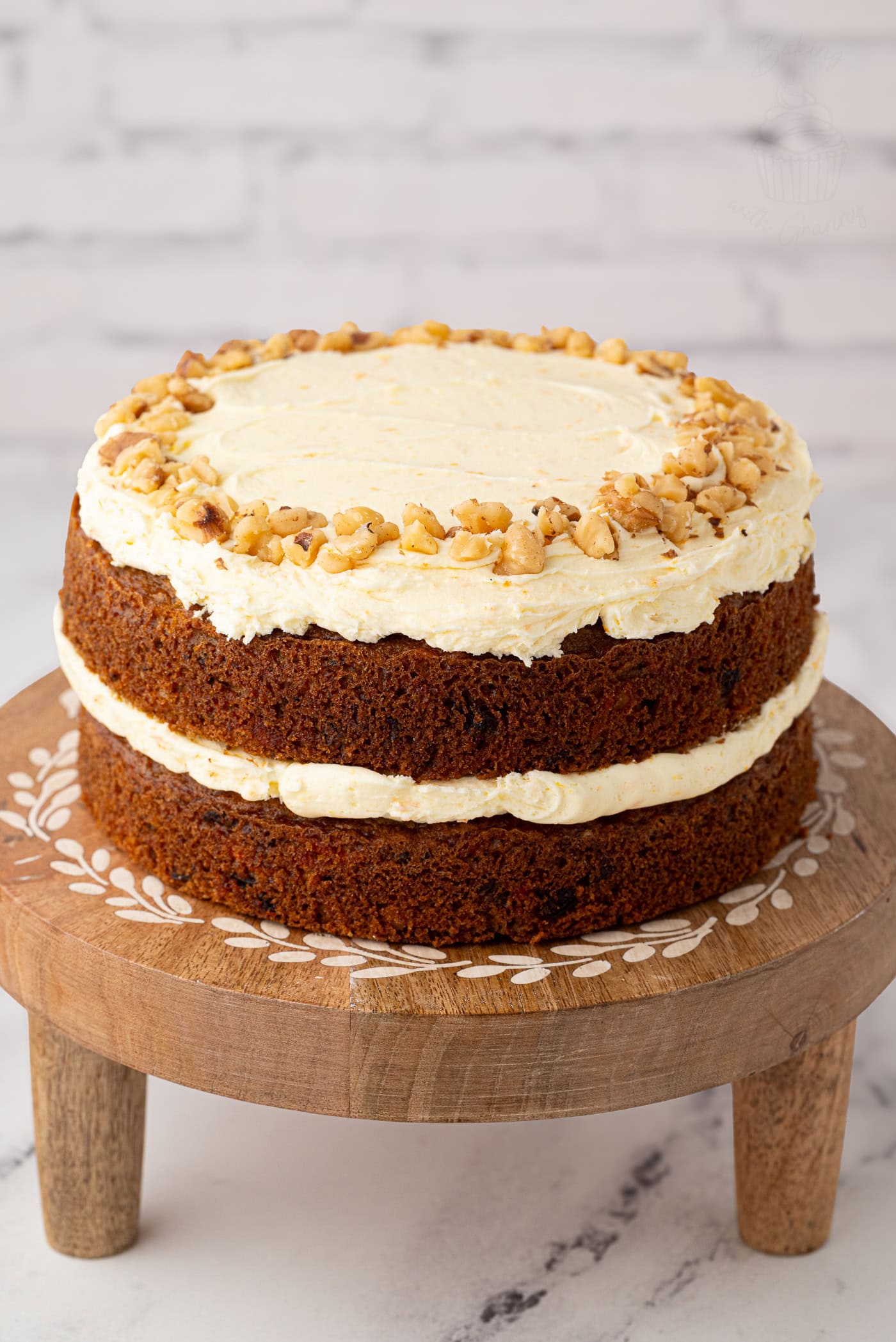
How to Make Carrot Cake
The cake batter for this Carrot Cake is mixed by hand in one bowl, so there’s no need for an electric mixer and very little washing up. Follow the step-by-step below, or head to the recipe card at the bottom for the full printable recipe.
- Prepare the oven and tins. Preheat your oven to 180°C (160°C fan, Gas Mark 4 or 350°F). Grease and line two 18cm (7 inch) sandwich cake tins.
- Mix the wet ingredients. In a large bowl, mix together the sunflower oil, caster sugar (superfine sugar) and light brown sugar. Add the eggs one at a time, mixing well after each addition, then stir through the grated carrot, sultanas or raisins, chopped walnuts and orange zest.
- Add the dry ingredients. Sift in the self-raising flour and bicarbonate of soda, then add the cinnamon and nutmeg. Fold everything together to make a batter.
- Bake. Divide the batter evenly between the prepared tins and bake for 30-35 minutes, until risen, the tops look dry, and a skewer inserted into the centre comes out clean.
- Cool the cakes. Leave the cakes in their tins to cool a little before transferring them to a wire cooling rack to cool completely.
- Make the buttercream. Cream together the margarine/butter and icing sugar (powdered sugar) until smooth. Add extra orange zest or cinnamon, if using.
- Fill and decorate. Once completely cool, spread half the buttercream over one cake. Place the second cake on top, then spread the remaining buttercream over the top. Finish with extra chopped walnuts, if you like.
Top Tips for Carrot Cake
- Grate, Don’t Squeeze: Grate the carrots before adding them to the batter, but don’t squeeze out any of their moisture. That moisture adds to the cake, helping to give it the soft, moist texture you want from Carrot Cake.
- Don’t Overmix the Batter: Once you’ve added the flour, bicarbonate of soda and spices, fold everything together until just combined. There’s no need to keep mixing once there are no obvious pockets of flour – otherwise, you may end up with an overly dense cake.
- Keep an Eye on the Baking Time: Begin checking the cakes at around 30 minutes. They should look dry on top, and a skewer inserted into the centre should come out clean. If ready, remove from the oven; if not, give them a little longer while checking regularly.
- Cool Completely Before Adding Buttercream: Make sure the cakes are completely cool before filling and decorating. If they are still warm, the buttercream can soften and slide.
- Use Two Tins: Because this is a moist, dense cake with carrot, dried fruit and nuts running through it, it’s much easier to bake it as two layers than try to cut one deep cake in half. The texture makes it much more difficult to get a neat middle cut than you would with a simple sponge cake, so using two tins is the best approach.
Making Ahead, Storage & Freezing
- Making Ahead: The cake layers can be baked ahead of time and kept well wrapped at room temperature until you’re ready to fill and decorate. Just make sure they are completely cool before wrapping.
- Storage: Once filled and topped with buttercream, store the Carrot Cake in an airtight container at room temperature. It will keep for around 1 week – there’s no need to refrigerate it unless you add a cream cheese frosting instead.
- Freezing: For the best results, freeze the cake layers before adding the buttercream. Wrap each cooled cake tightly in cling film, then again in tin foil, and freeze for up to 3 months. To defrost, remove the cakes from the freezer and allow them to come back to room temperature before filling and decorating.
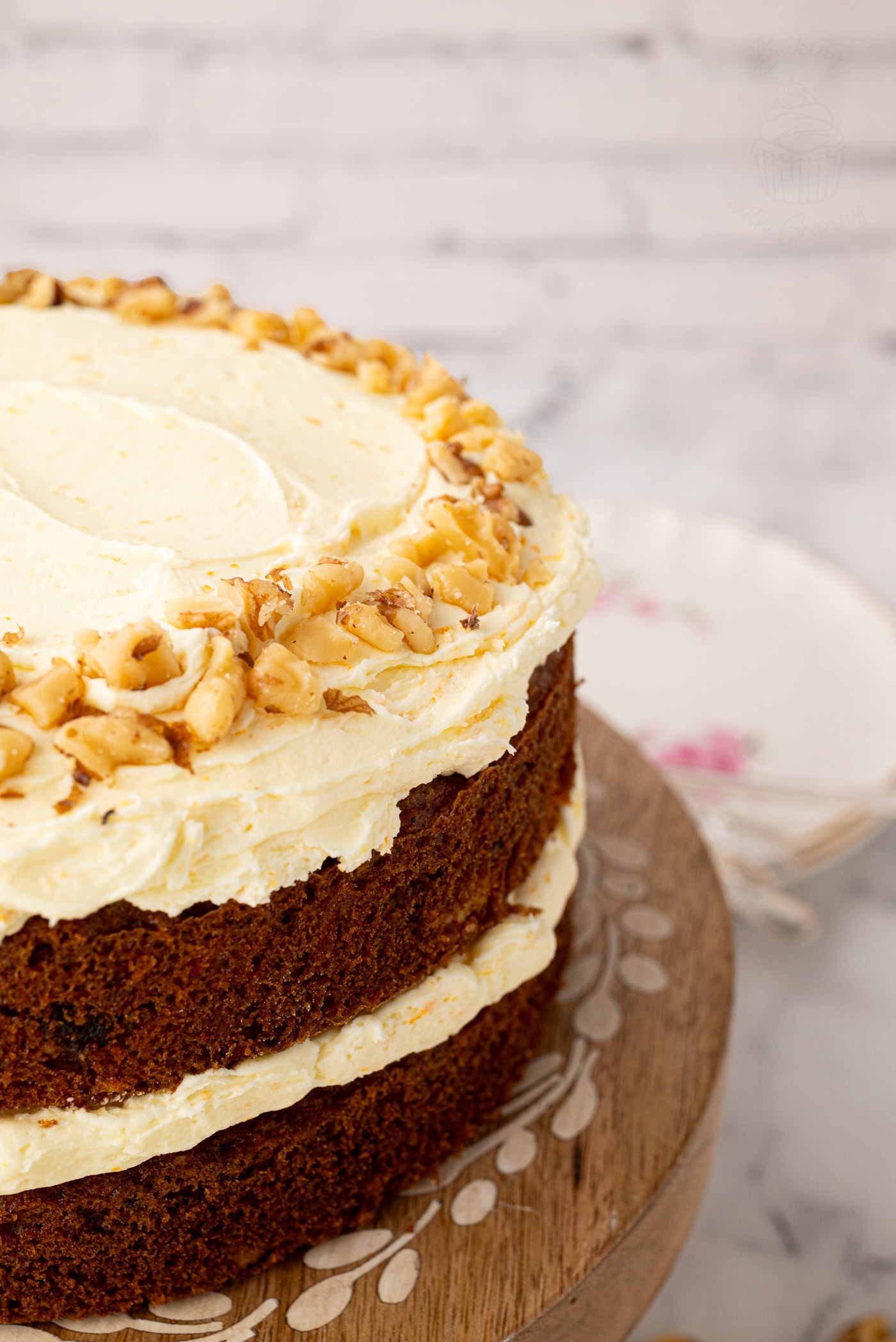
Thank you to Naomi Seiler for creating these photos.
Carrot Cake FAQs
Technically, yes, but I recommend using two 18cm (7 inch) sandwich tins as per the recipe. This is a moist, dense cake with carrot, dried fruit and nuts throughout it, so cutting one deep cake neatly in half is a bit more difficult than it would be with a simple sponge cake. You may also need to adjust the baking time if using a different-sized tin.
This Carrot Cake is naturally a little bit crumbly because of the grated carrot, dried fruit and walnuts running through it. But it should still hold together well once completely cool. If it is falling apart excessively, make sure it has been baked through (and not overbaked) and cooled completely before turning it out and assembling the layers.
A sunken middle is usually caused by the cake not being fully baked, opening the oven door too early, or the balance in the raising agents being off. Make sure your oven is fully preheated, measure the flour and bicarbonate of soda (baking soda) carefully, also ensuring neither has expired, and avoid opening the oven until the cakes are close to being ready.
Yes, you can use cream cheese frosting if that’s what you prefer. I use buttercream because it is made with ingredients I’m more likely to have at home and also means the finished cake doesn’t have to be kept in the fridge.
More Classic Cakes
If you loved this easy Carrot Cake, here are some more of my favourite cake recipes for you to try next:

Save this recipe!
Want to save this recipe for later? Pop your email below and come back to it when you’re ready to bake.
Easy Carrot Cake
INGREDIENTS
- 75 g Caster Sugar
- 75 g Soft Light Brown Sugar
- 150 ml Sunflower Oil
- 3 Free-range Eggs (beaten; at room temperature; see Egg Size note below)
- 140 g Grated Carrot (approx. one medium-large carrot)
- Zest of 1 Orange (optional but recommended)
- 75 g Sultanas or Raisins
- 50 g Walnuts (roughly chopped)
- 175 g Self-raising Flour (see Self-raising Flour note below)
- 1 tsp Bicarbonate of Soda
- 1 tsp Ground Cinnamon
- ½ tsp Ground Nutmeg
For the Buttercream
- 150 g Block Margarine or Butter (at room temperature; plus extra for greasing)
- 300 g Icing Sugar
- Zest of an Orange or ½ tsp Cinnamon (optional)
- 1 handful Walnuts (roughly chopped; optional)
EQUIPMENT
INSTRUCTIONS
- Preheat your oven to 180°C (160°C for fan-assisted ovens, Gas Mark 4 or 350°F). Grease and line two 18cm (7 inch) sandwich cake tins with
greaseproof paper . Set aside. - In a large bowl, mix the oil,
caster sugar and brown sugar before adding the eggs one at a time, ensuring they are mixed through. Add the carrot, raisins/sultanas, walnuts and orange zest, and mix to combine.75 g Caster Sugar; 75 g Soft Light Brown Sugar; 150 ml Sunflower Oil; 3 Free-range Eggs; 140 g Grated Carrot; Zest of 1 Orange; 75 g Sultanas or Raisins; 50 g Walnuts - Sift in the flour and
bicarbonate of soda , add the cinnamon and nutmeg before folding the mixture together to create a batter.175 g Self-raising Flour; 1 tsp Bicarbonate of Soda; 1 tsp Ground Cinnamon; ½ tsp Ground Nutmeg - Spoon the batter evenly into your prepared tins and bake in your preheated oven for 30-35 minutes.
- Remove from the oven and let the cakes cool in the tins a little before transferring to a wire cooling rack to cool completely.
For the Buttercream:
- In a large bowl, cream together the butter/margarine with the
icing sugar (and orange zest/cinnamon, if using) until you have a smooth buttercream.150 g Block Margarine or Butter; 300 g Icing Sugar; Zest of an Orange or ½ tsp Cinnamon - Once completely cool, spread half the buttercream on the top of one of your Carrot Cake layers, sandwich the other on top and spread the remaining buttercream on top. Finish with chopped walnuts to finish, if desired.1 handful Walnuts
IMPORTANT NOTE:
All my recipes are developed using a digital scale and the metric system (grams and millilitres). Cup measurements are available as a conversion, but these, unfortunately, won’t always be as accurate. For best results, I always recommend baking with a digital scale.
RECIPE NOTES:
LIKE THIS RECIPE?
Leave a comment and rating below!Originally published in May 2020.