
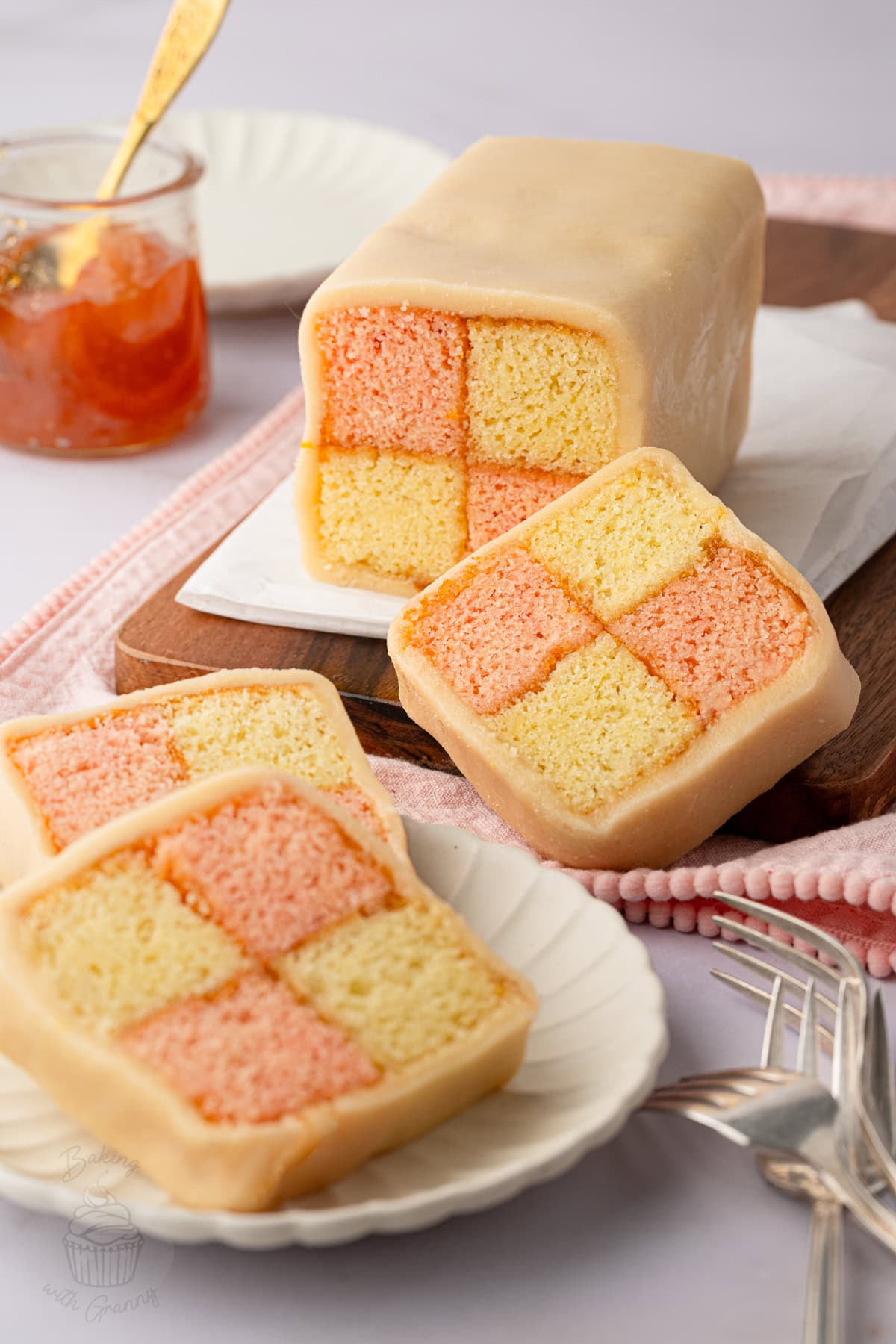
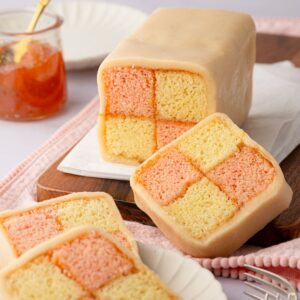
Battenberg Cake might look a little fancy, but you don’t need a special tin to make one at home. With soft almond sponge in the classic pink-and-plain checkerboard pattern, apricot jam and a layer of marzipan, this classic British bake is much easier to make than it looks.
Battenberg Cake Recipe Snapshot
- Recipe Type: Classic British Battenberg Cake.
- Texture: Soft, moist almond sponge wrapped in marzipan.
- Flavour: Sweet with a lovely, but not overpowering, almond flavour.
- Difficulty: Easy, with a little extra time needed for assembling.
- Bake Time: 30-35 minutes.
- Tin: 20×20cm (8×8 inch) square cake tin – no special Battenberg tin needed.
- Key Ingredients: Ground almonds, pink food colouring, apricot jam & marzipan.
- The Fiddly Bit: Trimming four even sponge strips for the checkerboard pattern.
- Make Ahead: The sponges can be baked a day ahead and wrapped until needed.
- Storage: Keep at room temperature – do not refrigerate, as the marzipan will sweat and become sticky
Summarise & Save this Recipe on:
What is Battenberg Cake?
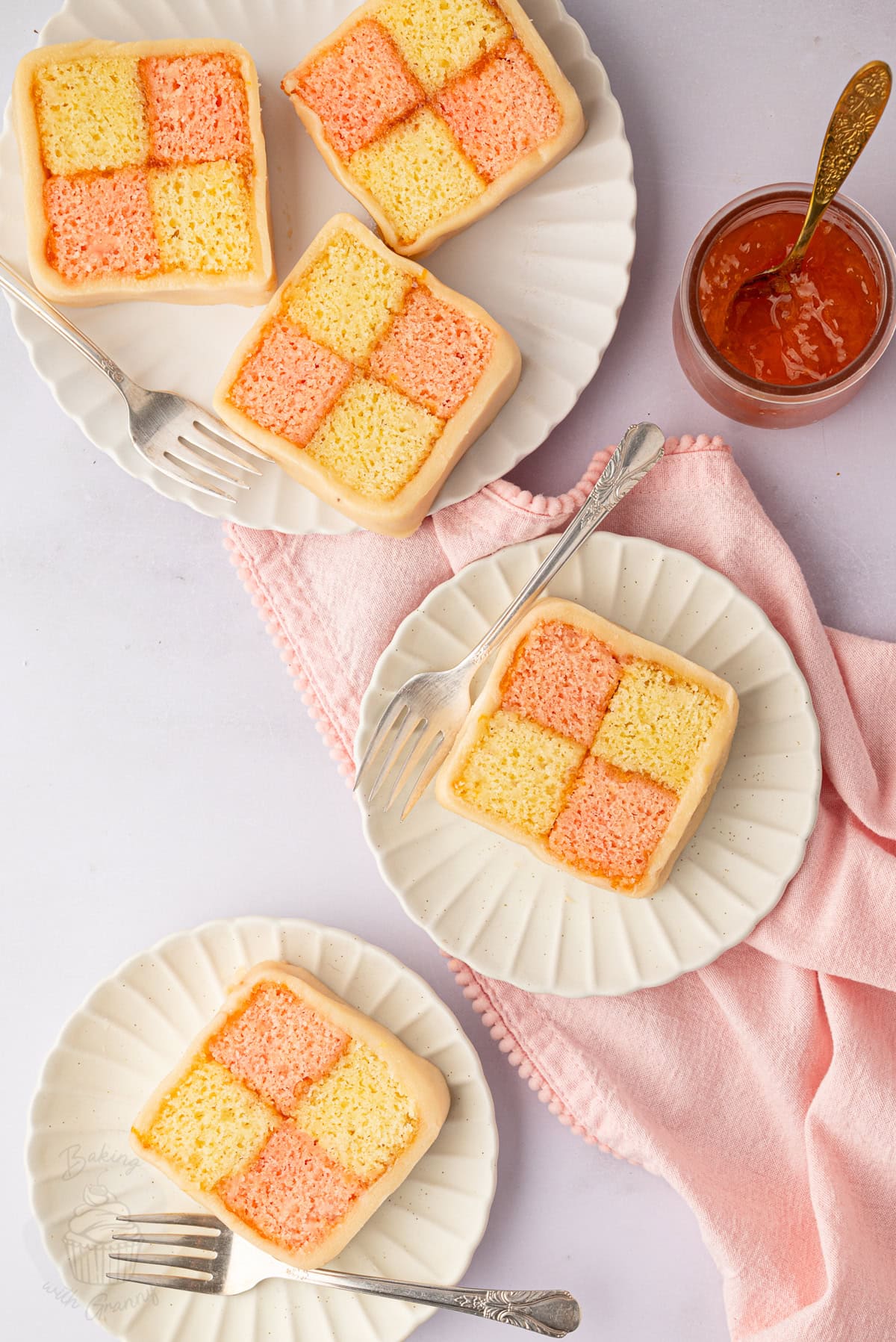
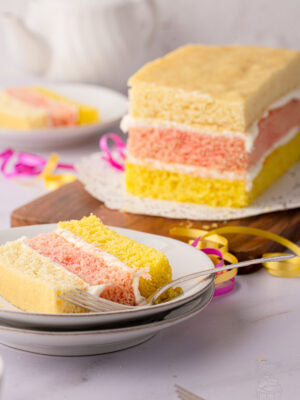
Battenberg Cake is a classic British bake made from four strips of almond sponge, arranged in an alternating pink-and-plain checkerboard pattern. The sponge is held together with apricot jam, before the whole cake is wrapped in a layer of marzipan and sliced to reveal those unmistakable little squares.
The exact origins of Battenberg Cake are a little unclear. It’s generally thought to get its name from the Battenberg family, with the best-known story being that the cake was created to celebrate the 1884 marriage of Queen Victoria’s granddaughter, Princess Victoria, to Prince Louis of Battenberg. However, there’s no concrete evidence that this is actually how the cake came about.
But it is one of those cakes that looks far more complicated than it actually is. The sponge itself is nice and straightforward – it’s getting those four even squares and wrapping everything neatly in marzipan that makes a Battenberg look impressive. Thankfully, neither part requires any special equipment.
And if you love traditional British cakes, you’ll also want to see my Madeira Cake recipe, Lemon Drizzle loaf and Victoria Sponge sandwich cake.
Developing My Battenberg Cake Recipe
Battenberg Cake is one of the classic British bakes that I’ve been asked to add to Baking with Granny many times over the years. Yet, it somehow kept getting pushed down the list – mostly because, given the choice, I’d personally go for an Angel Cake every time! Because I’m not actually the world’s biggest marzipan fan (sorry, marzipan lovers!). Thankfully, I have plenty of friends who are, and they were more than happy to help with the taste testing.
In fact, my Angel Cake recipe was where I started when developing this Battenberg. The two cakes have that same pink-and-plain sponge idea, but a Battenberg needs a slightly different balance. There’s no milk in this sponge, and the addition of ground almonds adds both flavour and a little extra weight, so the quantities needed adjusting to give a sponge that’s still soft and moist, but sturdy enough to trim and assemble.
I don’t add almond extract to my Battenberg. Between the ground almonds in the sponge and the marzipan on the outside, there’s already plenty of lovely almond flavour – and I definitely believe there can be too much of a good thing!
You Don’t Need a Battenberg Cake Tin
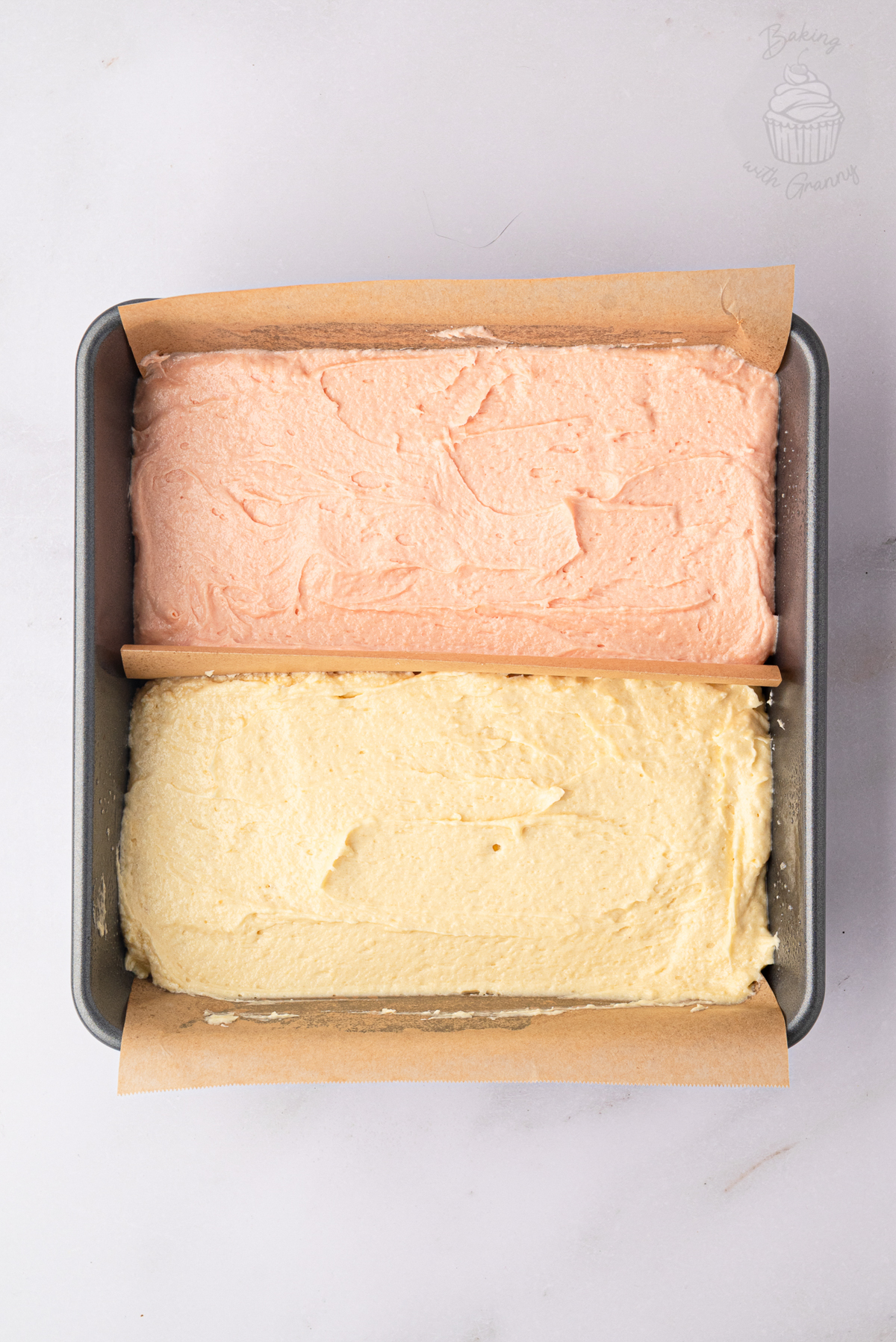
You can buy special Battenberg tins with dividers built into them, but you absolutely do not need one for this recipe. I use one ordinary 20×20cm (8×8 inch) square cake tin and make a divider with the greaseproof paper used to line it, in a similar way to how I create the tin dividers in my Angel Cake recipe.
Take a piece of greaseproof paper roughly 20×40cm, fold it in half, then fold it back on itself by around 5cm to create a pleat through the middle. When you place it inside the tin, that pleat forms a little wall between the two halves, keeping the pink and plain cake batter separate while they bake.
However, don’t get too hung up on making the divider absolutely perfect. It only needs to keep the majority of the two batters apart. The sponges are levelled and trimmed once baked anyway, so a slightly wonky edge or a divider that moves a little isn’t going to ruin your Battenberg.
Key Ingredients

See the recipe card for a full ingredients list, required quantities and cup conversions.
Substitutions
Sugar: Caster sugar (superfine sugar in the US) is what I use in most sponge cake recipes. Regular granulated sugar is also fine if that’s all you have, although because the crystals are larger, you may need to take a little extra time when creaming it with the margarine/butter.
Jam: Apricot is the classic choice and the one I’d always use in a Battenberg, but there’s no reason you couldn’t use another smooth, seedless jam if you prefer. Raspberry or strawberry would both work well with the almond sponge and marzipan, although bear in mind these will change the flavour slightly too.
Looking for dairy-free, gluten-free or vegan adaptations? See the Free-from & Vegan section below.
Free-from & Vegan
Amy recommends: If you regularly need to adapt baking recipes for gluten-free, dairy-free, egg-free or vegan diets, I highly recommend The Elements of Baking by Katarina Cermelj, creator of The Loopy Whisk. It’s a brilliant resource for understanding how substitutions work, rather than simply swapping ingredients and hoping for the best.
Gluten-free Options:
You can use gluten-free self-raising flour as a straight swap for the self-raising flour in this recipe. As always, check the labels on your other ingredients too, particularly the marzipan.
Nut-free Adjustments:
This can be a little trickier, as both the ground almonds in the sponge and the marzipan are central to a traditional Battenberg. Instead, I’d recommend using my Angel Cake recipe as the base, following the Battenberg tin-divider and assembly instructions here to create the four-square checkerboard, then covering the finished cake with fondant icing instead of marzipan. If you still want that classic almond flavour, you could also add a nut-free almond flavouring. Foodie Flavours or Badia make Almond Natural Flavouring, which is specifically labelled as nut-free. It won’t technically be a Battenberg cake, but it will be a close nut-free option.
Dairy-free Swaps:
Use a dairy-free baking margarine in place of the margarine/butter. The rest of the main cake ingredients are naturally dairy-free, but do check the labels on your marzipan and other packaged ingredients.
Egg-Free Adaptations:
Rather than trying to replace the three eggs in this particular sponge, I’d recommend using a Battenberg recipe that has been developed and tested specifically egg-free, like The Little Blog of Vegan’s Vegan Battenberg Cake.
Vegan Substitutions:
As above, rather than trying to replace the three eggs in this particular sponge, I would recommend using a Battenberg recipe that has been developed and tested specifically to be vegan. Again, The Little Blog of Vegan’s Vegan Battenberg Cake uses dairy-free butter and milk in an egg-free sponge, while keeping the classic almond, jam and marzipan finish.
Allergy Disclaimer & Resources:
Any advice or suggestions to make recipes “free-from” or vegan are purely suggestions. Please double-check all packaged ingredients individually, taking extra caution when baking for those with allergies or intolerances.
For official guidance on food allergies, please see Food Standards Agency (food.gov.uk) | For more info on coeliac disease, please see Coeliac UK (coeliac.org.uk) | For more info on a vegan diet, please see The Vegan Society (vegansociety.com)
How to Make Battenberg Cake
This Battenberg Cake is made with soft almond sponge, apricot jam and marzipan, with the classic pink-and-plain checkerboard centre. Follow the step-by-step photos below, or head to the recipe card at the bottom for the full printable recipe.
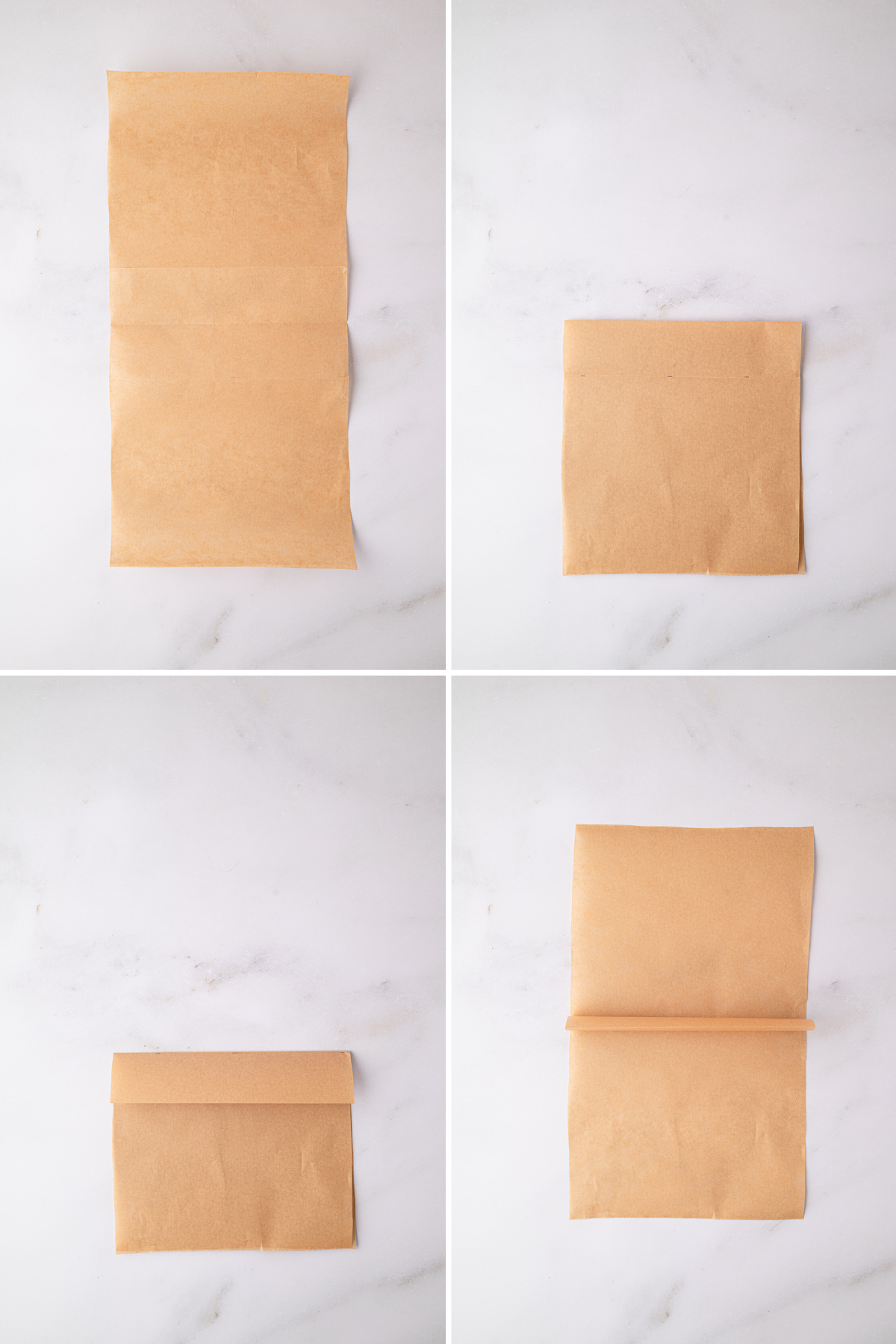
- Prepare your cake tin. Take a piece of greaseproof paper around 20×40cm (8×16 inches), fold it in half, then fold it back on itself by around 5cm (2 inches) to create a pleat through the middle. Place in the greased tin, with the pleat standing upright to divide the tin into two sections, and fold the excess paper up over the sides.
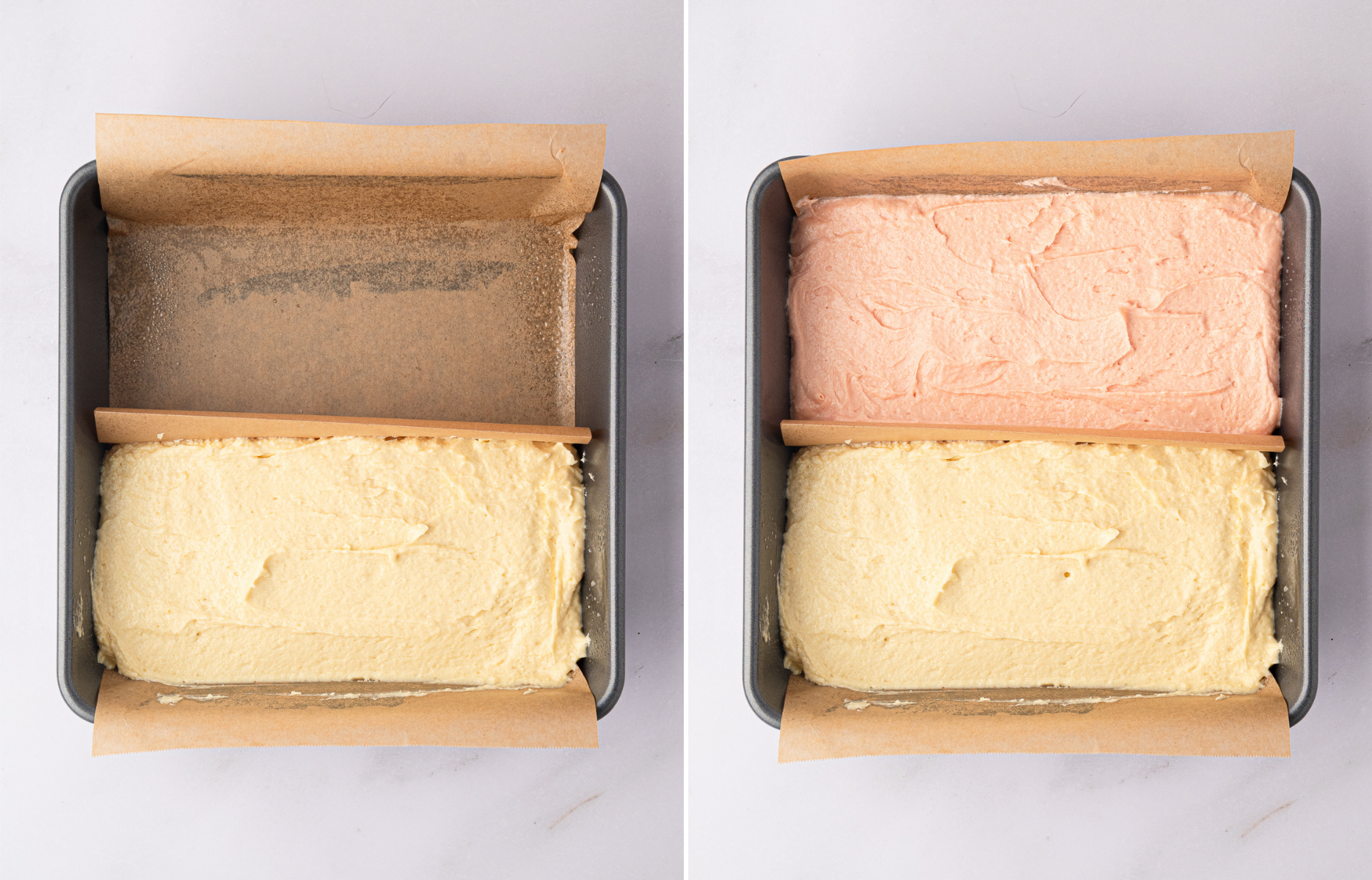
- Make the cake batter. Cream the margarine/butter and sugar, add the eggs and ground almonds, then fold through the flour and baking powder. Divide the mixture equally, colour one half pink, then spread each into one side of your prepared tin.
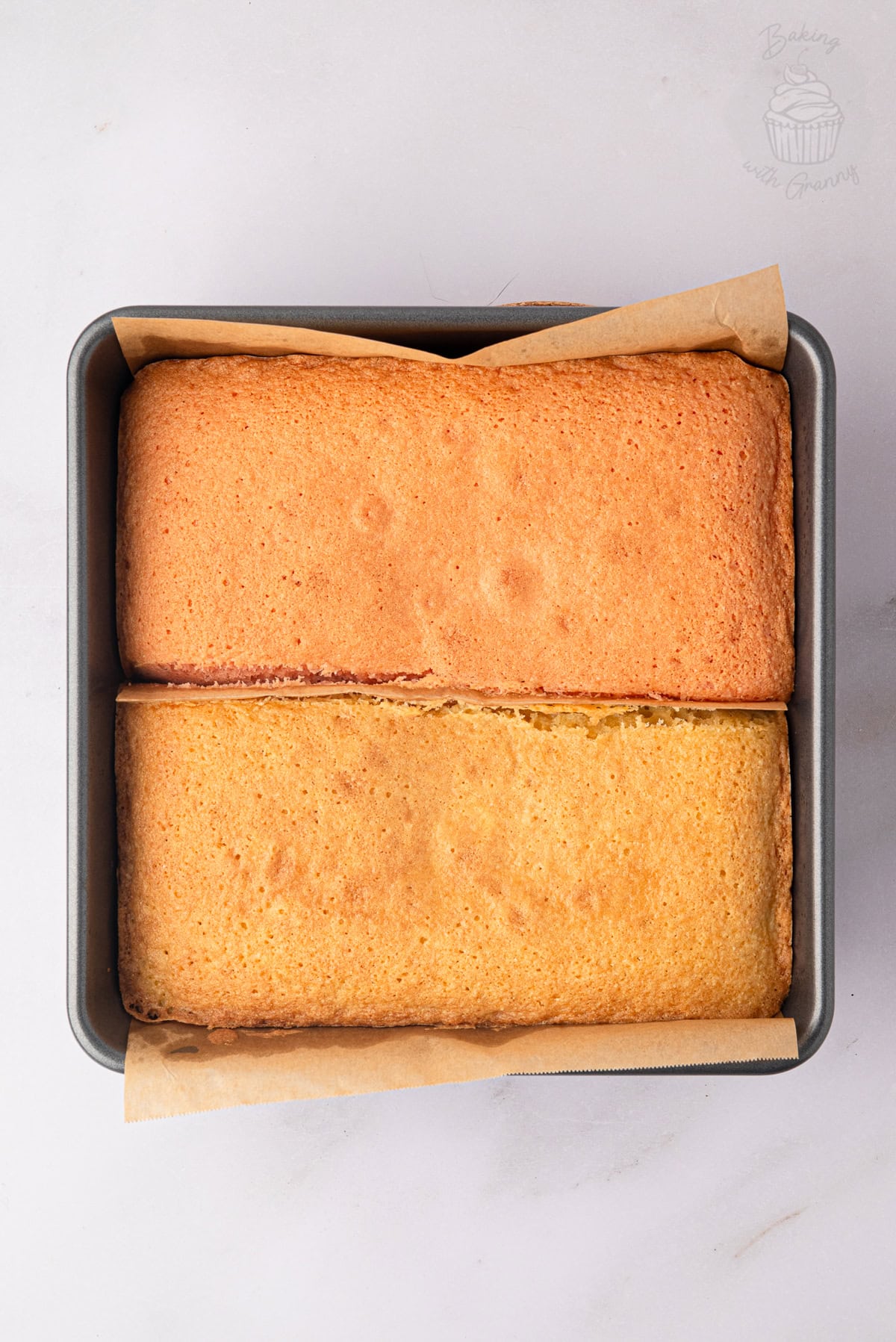
- Bake. Bake for 30-35 minutes, until risen, golden and a skewer comes out clean. Leave until cool enough to touch before transferring the sponges to a wire cooling rack to cool completely.
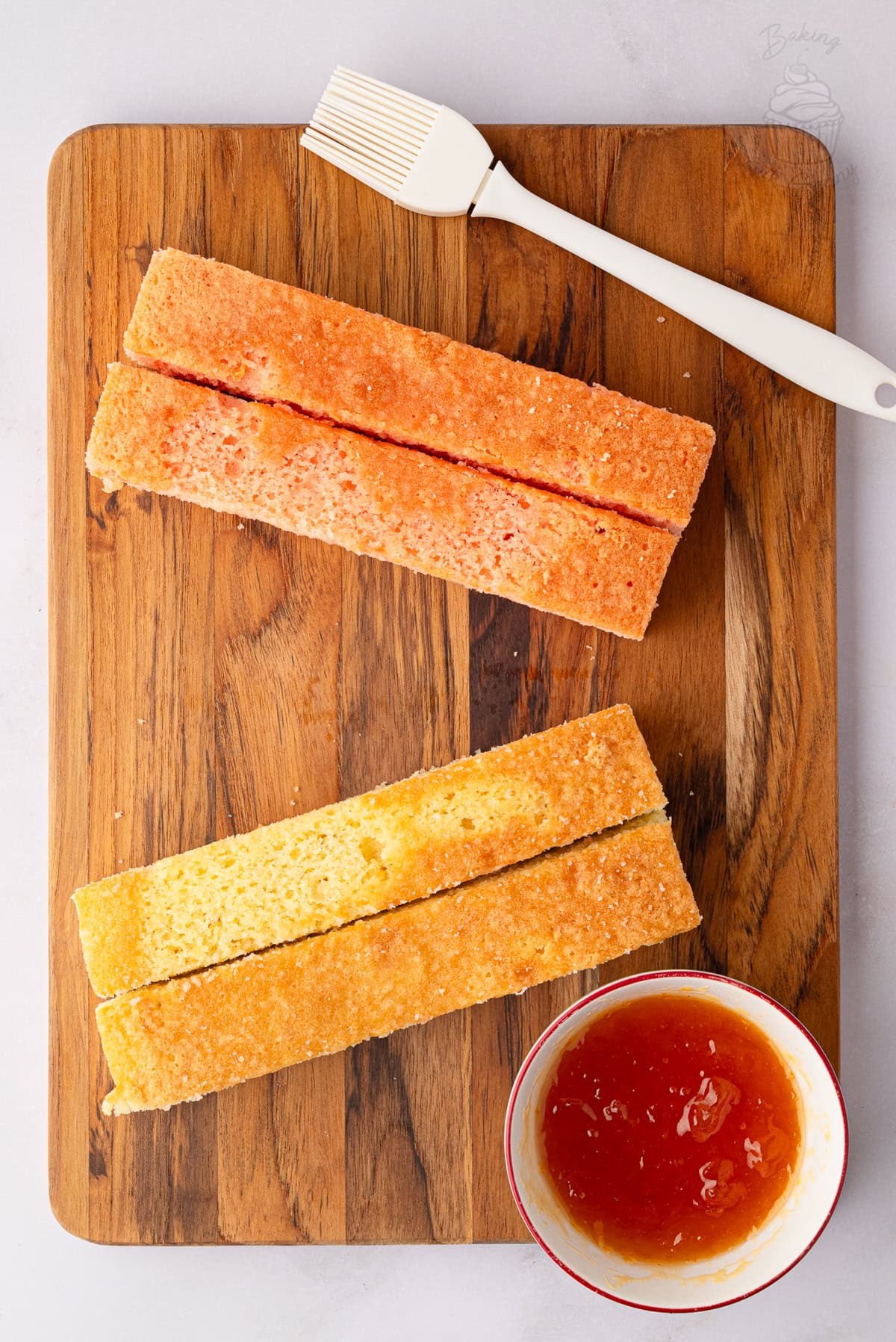
- Trim the sponges. Level the tops, then stack the two sponges and trim the edges so they’re the same size. Cut both lengthways to give you four even strips.
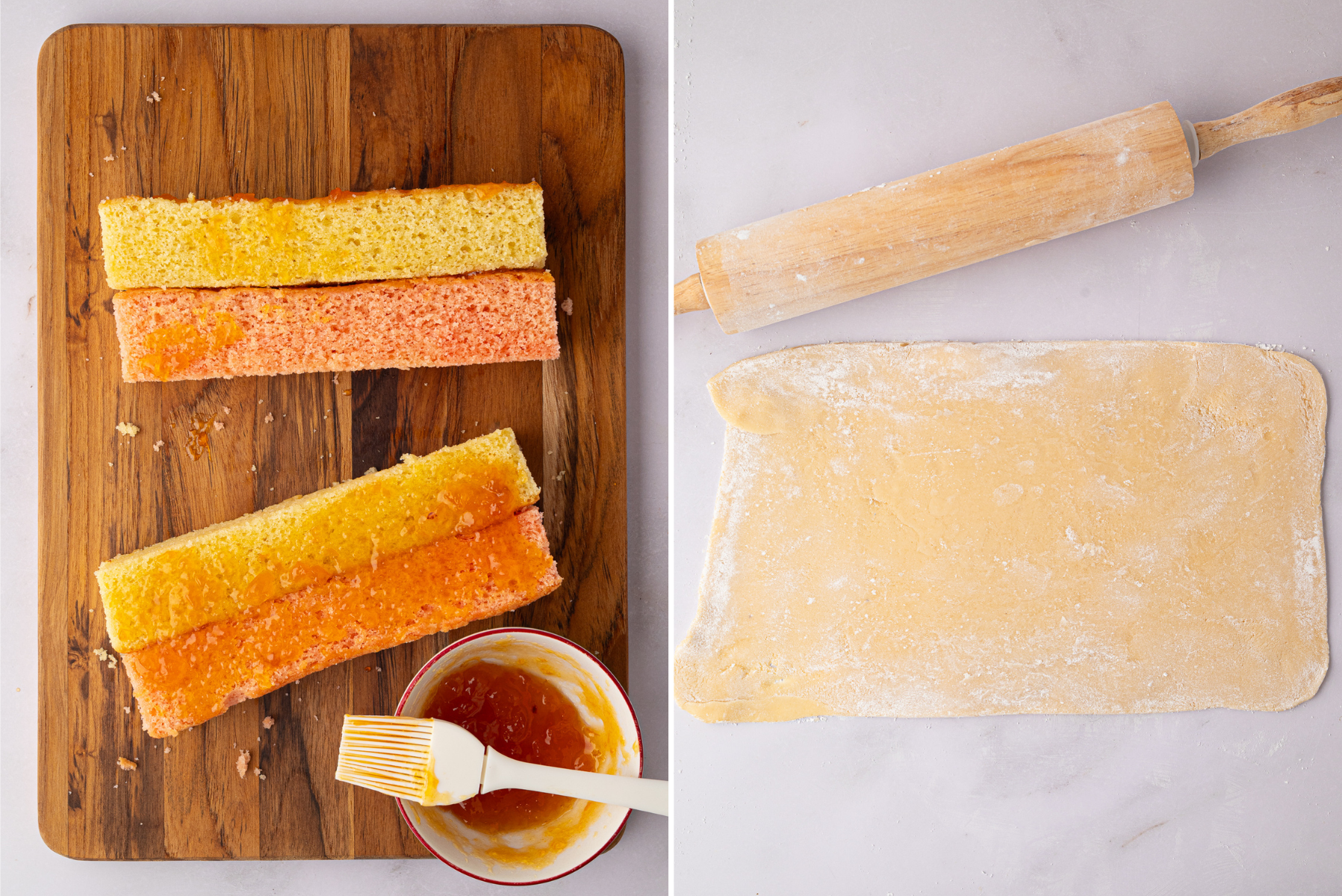
- Make the checkerboard. Warm the apricot jam and brush a little onto the inside edges of the sponge strips. Sandwich them together, alternating the pink and plain sponge to create the four-square Battenberg pattern. Roll the marzipan into a rectangle around 40×20cm (16×8 inches).
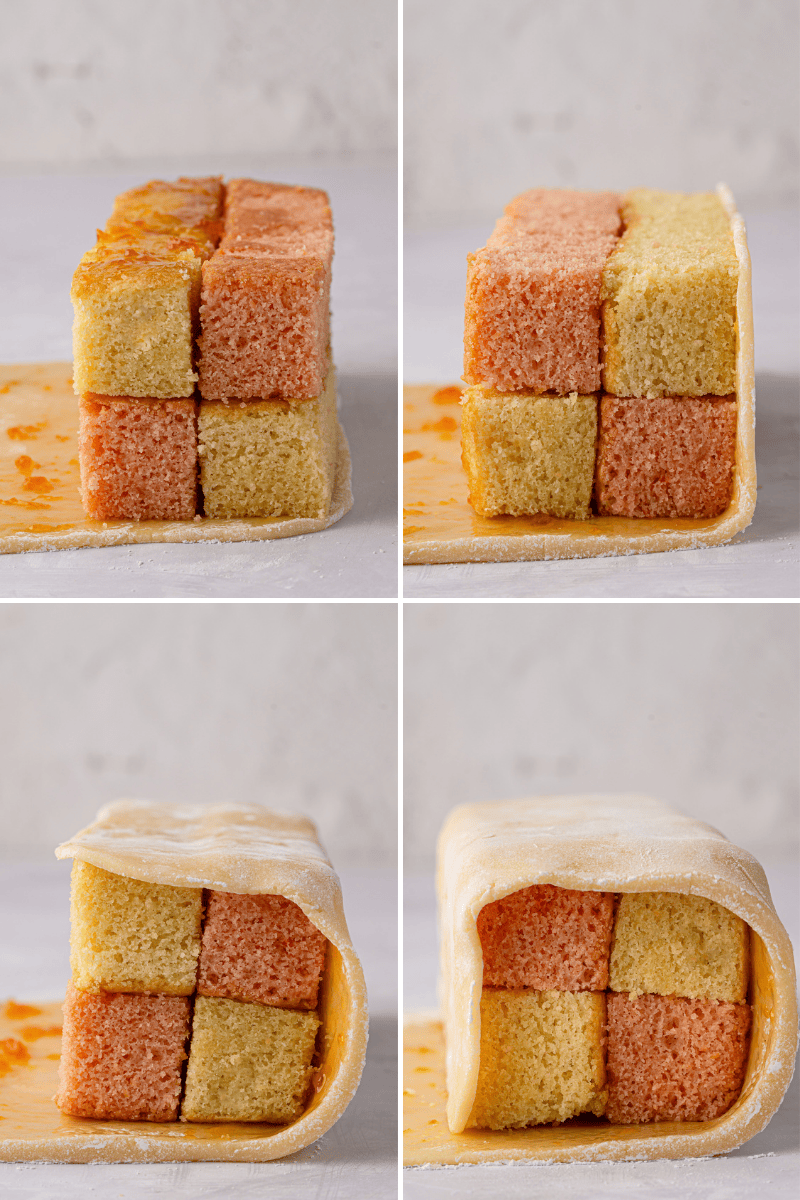
- Wrap in marzipan. Brush the remaining apricot jam over the marzipan. Place the cake at one edge and roll it across the marzipan to wrap, before neatening the join and trimming the ends.
Top Tips for Perfect Battenberg Cake
- Weigh the Batter: For the most even pink and plain sponges, weigh your finished cake batter before dividing it between two bowls. The exact weight can vary slightly from batch to batch, so divide your own mixture equally rather than relying on a fixed amount.
- Don’t Worry About a Perfect Divider: Your greaseproof-paper divider doesn’t need to be absolutely perfect, and it’s not the end of the world if it shifts slightly during baking. The sponges are trimmed once cool anyway, so any slightly uneven edges can easily be neatened up then.
- Stack the Sponges Before Trimming: Once completely cooled, place the pink and plain sponges on top of each other before trimming. This makes it much easier to square them up and get four evenly-sized sponge strips.
- Don’t Overdo the Jam: You only need a thin layer of apricot jam to sandwich the sponge strips together and help the marzipan stick. Too much will just make things unnecessarily messy.
- Brush the Jam Onto the Marzipan: For wrapping the outside of the cake, it’s much easier to brush the jam onto the rolled marzipan rather than trying to handle and rotate a potentially fragile, jam-covered cake.
Storage, Freezing & Make Ahead
- Storage: Once finished, wrap your Battenberg Cake in cling film (plastic wrap) and keep at room temperature for 3-5 days. Avoid storing it in the fridge or in an airtight container, as the marzipan can sweat and become very sticky. Keep the cut ends covered where possible – if they do dry out a little, simply trim off a thin slice before serving.
- Freezing: The unassembled Battenberg sponges freeze well. Once completely cool, wrap them well and freeze for up to 3 months. Defrost at room temperature, still wrapped, before trimming and assembling. I don’t recommend freezing the finished Battenberg, as the marzipan can sweat as it defrosts and become sticky.
- Make Ahead: You can bake the pink and plain sponges a day ahead. Once completely cool, wrap them well in cling film (plastic wrap) or place them in a food-safe plastic bag, then keep at room temperature until you’re ready to trim, sandwich together with jam and cover with marzipan.
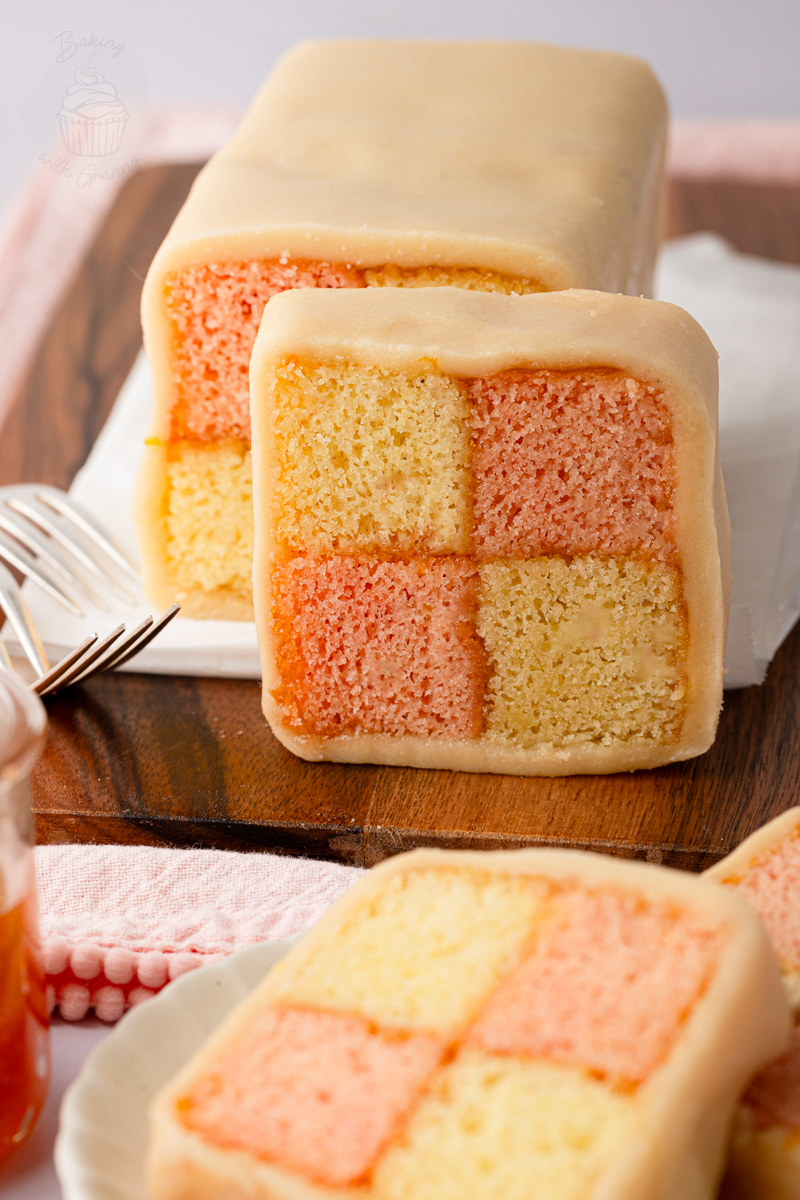
With thanks to Naomi Seiler for creating these photos.
Battenberg Cake FAQs
No. A 20×20cm (8×8 inch) square cake tin works perfectly well. A folded piece of greaseproof paper creates a divider through the centre of the tin, keeping the pink and plain batters separate while they bake. See my How to Make Battenberg Cake Step-by-step above for a visual guide to folding the divider for your tin.
No – I don’t use almond extract in this recipe because the ground almonds in the sponge and the marzipan already give plenty of almond flavour. I find adding extract as well can make the almond taste a bit too much for me, but you can, of course, add some almond extract if you like a more pronounced almond flavour.
Weigh the finished batter before dividing it, so the pink and plain sponges are as even as possible. Once baked and completely cool, stack the two sponges on top of each other before trimming, so you can use one as a guide for the other. Don’t worry if the baked edges aren’t perfectly straight – they’re all trimmed to match before assembling.
Marzipan can sweat when it’s stored somewhere cold or airtight, which makes the surface sticky. Keep your finished Battenberg wrapped at room temperature and avoid storing it in the fridge or an airtight container.
More Classic British Bakes
If you loved this homemade Battenberg Cake, here are some more of my favourite British baking recipes for you to try next:
Save this recipe!
Want to save this recipe for later? Pop your email below and come back to it when you’re ready to bake.
Battenberg Cake
INGREDIENTS
For the Cake
- 175 g Soft Margarine (or Butter) (at room temperature; plus extra for greasing)
- 175 g Caster Sugar
- 3 Free-range Eggs (at room temperature)
- 50 g Ground Almonds
- 140 g Self-raising Flour (see Self-raising Flour note below)
- 1 tsp Baking Powder
- Pink Food Colouring (gel food colouring preferable)
For Decorating
- 100 g Apricot Jam
- 400 g Marzipan
- Icing Sugar (for dusting)
EQUIPMENT
- Sharp Knife
INSTRUCTIONS
For the Cake
- Preheat your oven to 180°C (160°C for fan-assisted ovens, Gas Mark 4 and 350°F). Grease a square 20×20cm (8×8 inch) tin with some extra margarine/butter. Set aside while you prepare the
greaseproof paper divider. - Take a piece of
greaseproof paper around 20×40cm (8×16 inches), fold it in half, then fold it back on itself to about 5cm (2 inches) to create a pleat in the middle -this will act as a centre divider in your tin. Place thegreaseproof paper in your tin and fold the excess up the sides. Set aside. - In a large bowl, cream together the margarine/butter and sugar until light and fluffy in both colour and texture.175 g Soft Margarine (or Butter); 175 g Caster Sugar
- Add the eggs one at a time, ensuring each is mixed through before adding the next. Don't worry if the mixture appears to curdle – this will remedy itself once the
ground almonds and flour are added.3 Free-range Eggs - Add the
ground almonds and mix through. Sift in the flour and baking powder, and gently fold to create a thick batter.140 g Self-raising Flour; 1 tsp Baking Powder; 50 g Ground Almonds - Spoon half the mixture into a separate bowl and add a few drops of pink food colouring. Mix until well combined – don't go too dark with food colouring, as the colour will intensify as it bakes.Pink Food Colouring
- Spoon and spread the uncoloured batter into one side of your prepared tin and the pink batter into the other.
- Bake for 30-35 minutes in your preheated oven, until risen, golden in colour, and a skewer inserted comes out clean. Remove from the oven and leave in the tin until cool enough to touch, then remove the cakes from the tin (using the
greaseproof paper liner to help) and place on a wire cooling rack to cool completely.
To Construct & Decorate
- Start by levelling the tops of each sponge with a bread knife. Next, stack the sponges on top of each other and trim the edges until they are square and even. Finally, cut through both sponges lengthways to get 4 square and evenly-sized strips of sponge cake.
- Warm the apricot jam before brushing the inside edges of the sponge strips, then sandwich the contrasting colours together to create the checkered square look of a Battenberg. Set aside on a chopping board while you prepare the marzipan.100 g Apricot Jam
- On a clean, crumb-free surface, lightly dust some excess icing sugar before rolling out the marzipan into a rectangular shape around 40×20cm (16×8 inches) – it should be large enough to wrap around your cake lengthways, with the checkerboard pattern at each end exposed.400 g Marzipan; Icing Sugar
- Brush the remaining apricot jam over the marzipan before placing your cake on top, next to the edge of the marzipan. Wrap the marzipan around the cake by rolling the cake across the marzipan and pinching the marzipan ends together once they meet. If you have a large amount of overlap where the marzipan meets, you can trim it with a sharp knife, keeping the join tight and neat.
- Gently smooth the marzipan with your hands to neaten it up, before trimming the ends to expose the checkered pattern. Serve in slices.
IMPORTANT NOTE:
All my recipes are developed using a digital scale and the metric system (grams and millilitres). Cup measurements are available as a conversion, but these, unfortunately, won’t always be as accurate. For best results, I always recommend baking with a digital scale.







ABOUT THE AUTHOR
Amy Beth Reid
Amy Beth Reid is an award-winning food blogger, mother, wife and cookbook author. Inspired by her childhood in the kitchen with her Mum – a professional baker and her children’s Granny – Amy now shares her tried-and-tested traditional home baking recipes with bakers of all abilities around the world. She lives in Scotland with her husband, two sons and her small pack of Siberian huskies.