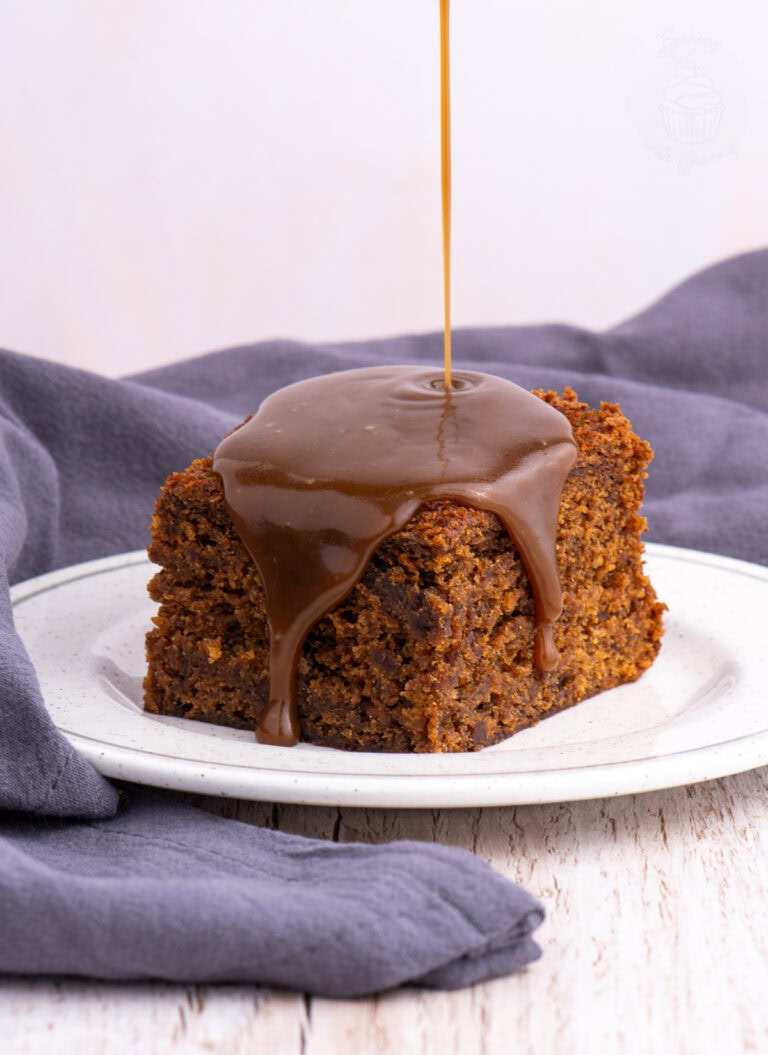
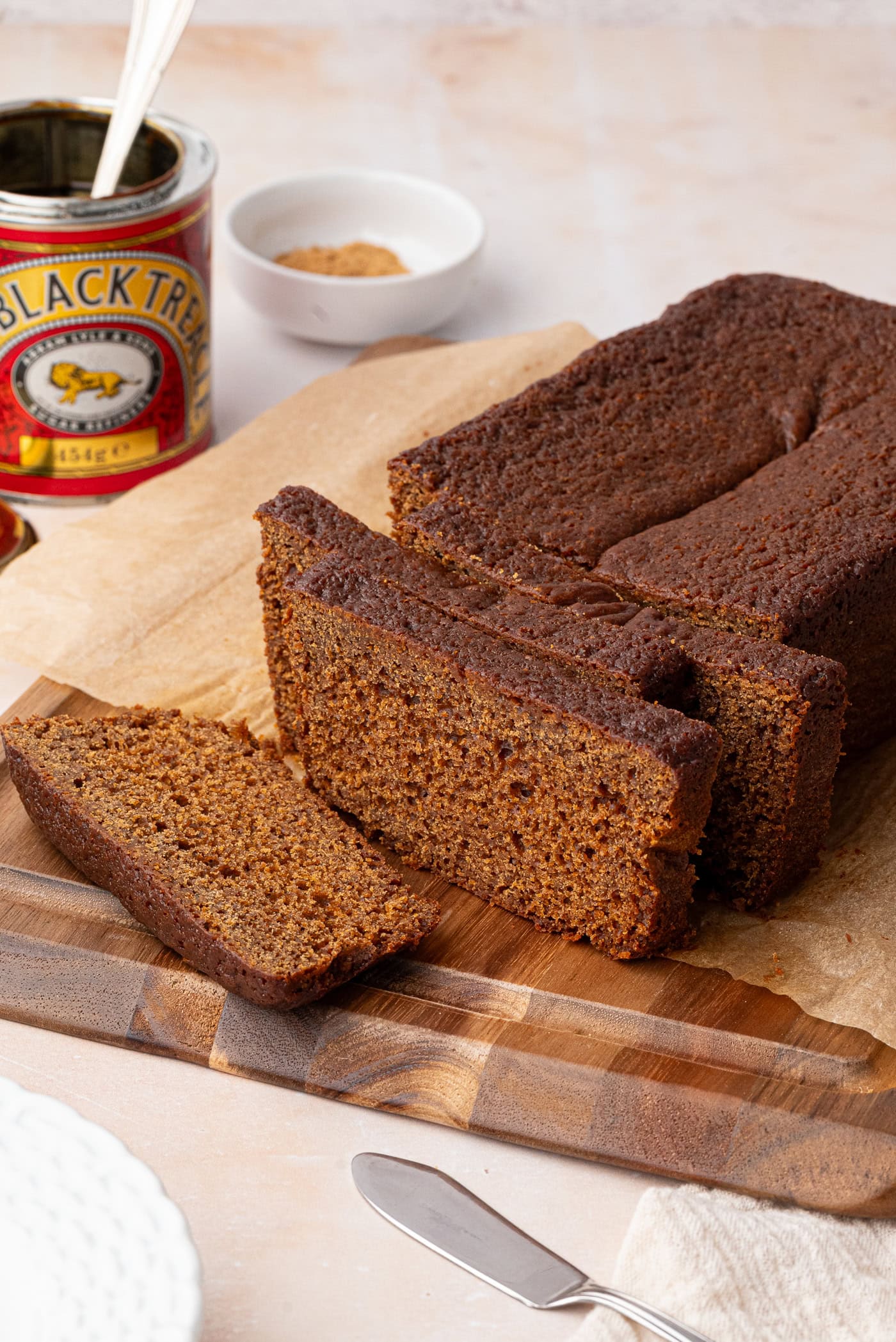
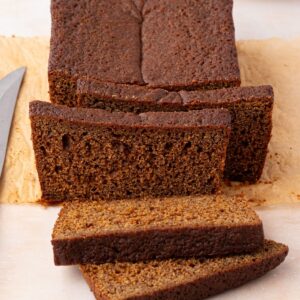
This sticky Gingerbread Loaf is rich, warmly spiced and wonderfully moist, with plenty of ground ginger, treacle and golden syrup. It tastes beautiful when freshly baked, but even better after a day or two, when the flavours deepen and the top becomes deliciously sticky – no icing or buttercream required.
Gingerbread Recipe Snapshot
- Recipe: Sticky British Gingerbread Loaf.
- Texture: Moist, dense and slightly sticky, with a soft top.
- Flavour: Sweet, rich and warmly spiced with plenty of ginger.
- Difficulty: Easy.
- Method: Melting method.
- Prep Time: 15 minutes.
- Bake Time: Approx. 1 hour to 1 hour 15 minutes.
- Tin: 900g/2lb loaf tin.
- Best Eaten: After at least 24 hours, but ideally 2-3 days.
- Keeps For: Around 1 week when stored airtight.
- Best Served: As it is, or with a good slather of butter, and a cup of tea.
Summarise & Save this Recipe on:
What Is Gingerbread Loaf?
Gingerbread Loaf is a soft, richly spiced cake made with ginger and dark syrup, baked in a loaf tin until risen and amazingly moist. You will sometimes see it called Gingerbread Cake, Gingerbread Loaf Cake or Sticky Gingerbread – all names for this softer, cake-style version of gingerbread rather than the crisp gingerbread biscuit used for Gingerbread Men Biscuits and my homemade Gingerbread House recipe.
My version is a proper old-fashioned British-style Gingerbread Loaf, made with both treacle and golden syrup. When paired together, they give the cake its deep colour, rich sweetness, and the lovely sticky texture that makes a good gingerbread feel so much more, well, moreish.
It’s also made using the melting method of cake baking, where the margarine/butter, sugar, treacle and golden syrup are gently melted together before the remaining dry ingredients and eggs are added. This does mean the batter is quite a bit runnier than a traditional creamed cake mixture, like what is used in my Best Victoria Sponge Cake, Madeira Cake recipe and Marmalade Cake – completely normal for this kind of gingerbread, and what I also use in other melting method recipes like my Golden Syrup Cake and Honey Nut Cake.
And unlike many loaf cakes, this one actually gets better with time – much like Welsh Bara Brith and Black Bun – if you can resist eating it straight away! After a day or two, the sponge softens a little further, the spices deepen, and the top develops even more of that lovely sticky finish which, for me anyway, is exactly how Gingerbread Loaf should be 😋
How I Developed This Sticky Gingerbread Loaf
I first developed this Gingerbread recipe almost nine years ago, so I’d be lying if I said I could remember every single iteration I tested along the way, before landing on this final version!
At the time, I was baking my way through all sorts of old recipes from Granny’s collection – think traditional baking books, Be-Ro books, Women’s Rural recipe books, church pamphlets, magazine cuttings and all sorts of handwritten bits and pieces. I would usually end up taking the parts I liked from one recipe and combining them with another, test them together and keep on tweaking ingredients and methods until I landed on one version I wanted to make again and again.
For this Gingerbread Loaf, that meant finding the right balance between treacle and golden syrup. Too much of either could pull the flavour in the wrong direction, but 100g of each gave me exactly what I wanted from gingerbread – deep flavour from the treacle, sweetness from the golden syrup, and a moist, perfectly sticky loaf with enough richness to stand up to all that ginger and spice.
That same balance of ingredients has remained the same ever since. Nearly a decade later, this is still the version I make – and judging by the feedback from home bakers who too have baked it over the years, I’m not the only one who thinks it works!
Key Ingredients
See the recipe card for a full ingredients list, required quantities and cup conversions.
Substitutions & Additions
Treacle: If you can’t get treacle, molasses is the closest alternative. I haven’t tested every brand of molasses in this recipe, and they can vary quite a lot in terms of flavour – some are more bitter or savoury than others – so you may notice a slight difference in the finished Gingerbread Loaf and want to experiment with which one works best for you.
Milk: You can use whichever milk you normally have at home, including non-dairy milk alternatives like soya and oat. Whole milk will give a slightly richer result, but with all those other flavours going on, the difference in the finished Gingerbread Loaf will be pretty subtle.
Mixed Spice: If you’re baking outside the UK and can’t easily find mixed spice, pumpkin pie spice is a good, close alternative.
Additions: If you really love ginger, try adding some finely chopped stem ginger or crystallised ginger to the batter for an extra hit of flavour. I’ve also topped this Gingerbread Loaf with a simple water icing before, which works particularly well if you want something a little sweeter – although I usually prefer it just as it is, especially once the top has become lovely and sticky.
Looking for dairy-free, gluten-free or vegan adaptations? See the Free-from & Vegan section below.
Free-from & Vegan
Gluten-free Options:
Swap the self-raising flour for a gluten-free self-raising flour on a like-for-like basis. This should work especially well for Gingerbread Loaf, particularly as this is naturally a moist, slightly dense cake rather than a light sponge.
Nut-free Adjustments:
This recipe contains no nuts, but as always, be sure to double-check the allergen lists for your individual ingredients.
Dairy-free Swaps:
To make this a dairy-free recipe, simply use a dairy-free block margarine in place of the butter/margarine and your favourite non-dairy milk alternative. I’ve made this with soya milk successfully, but other plant-based milks should work too.
Egg-Free Adaptations:
I haven’t yet tested this recipe egg-free, but like with many cake recipes, it should work just fine with a vegan egg replacer, such as Oggs or Bob’s Red Mill Egg Replacer.
Vegan Substitutions:
Combine the dairy-free and egg-free suggestions above, using dairy-free block margarine, non-dairy milk and a suitable vegan egg replacer. I haven’t tested a completely vegan version myself, but I’d love to hear how you get on if you give it a try!
Allergy Disclaimer & Resources:
Any advice or suggestions to make recipes “free-from” or vegan are purely suggestions. Please double-check all packaged ingredients individually, taking extra caution when baking for those with allergies or intolerances.
For official guidance on food allergies, please see Food Standards Agency (food.gov.uk) | For more info on coeliac disease, please see Coeliac UK (coeliac.org.uk) | For more info on a vegan diet, please see The Vegan Society (vegansociety.com)
How to Make Gingerbread Loaf
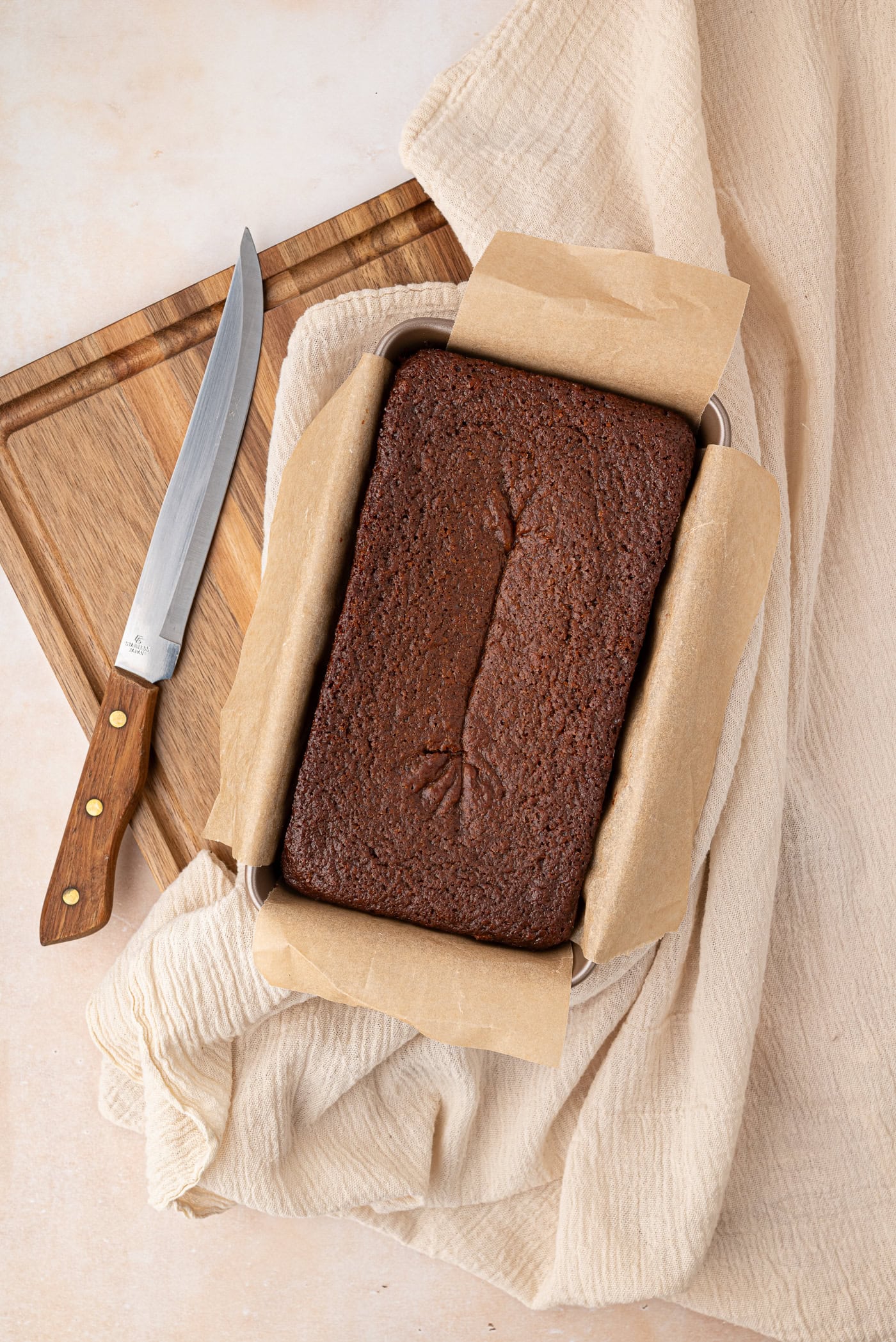
This Gingerbread Loaf uses the melting method, so there’s no creaming butter and sugar together. The finished batter is also runnier than a traditional sponge cake mixture – don’t worry, that’s exactly how it should look.
- Prepare your tin and oven. Preheat your oven to 160°C (140°C fan-assisted ovens, Gas Mark 2 or 325°F). Line a 900g (2lb) loaf tin with greaseproof paper and set aside.
- Melt the margarine/butter and syrups. Add the margarine/butter, golden syrup and treacle to a small saucepan. Warm gently over a low heat until everything has melted and combined. Don’t let the mixture boil!
- Add the milk. Remove the pan from the heat and stir in the milk. Set aside for a few minutes while you prepare the dry ingredients.
- Combine the dry ingredients. In a large bowl, sift together the self-raising flour, baking powder, soft brown sugar, ground ginger, mixed spice, cinnamon and nutmeg.
- Add the melted mixture. Pour the warm syrup mixture into the dry ingredients and mix until everything is combined. The batter will be quite runny compared with a traditional cake batter – this is completely normal.
- Add the eggs. Add the eggs and mix until you have a smooth, evenly combined batter.
- Fill the loaf tin. Pour the batter into your prepared loaf tin and gently level the top if needed.
- Bake low and slow. Bake for around 1 hour to 1 hour 15 minutes. Oven temperatures can vary, so use the time as a guide rather than relying on it alone. Your Gingerbread Loaf is ready when it has risen, and a skewer inserted into the centre comes out clean.
- Switch off the oven and cover the loaf. Once baked, switch the oven off but leave the Gingerbread Loaf inside. Loosely cover the top of the tin with foil and allow it to cool in the switched-off oven – ideally until completely cool, although a couple of hours is still worthwhile if you need your oven back!
- Leave it to mature – if you can resist! Once completely cool, keep the Gingerbread Loaf in an airtight container, or leave it in the tin and wrap well with cling film and foil. It’s good after 24 hours, but 2-3 days is even better, when the flavours have deepened, and the loaf has become softer and stickier.
Top Tips for the Best Gingerbread Loaf
- Keep the Heat Low When Melting: Gently melt the margarine/butter, treacle and golden syrup together over a low heat. You only want everything melted and combined – do not let it boil!
- Don’t Worry About the Runny Batter: Because Gingerbread Loaf uses the melting method, the batter is noticeably wetter than a traditional creamed cake mixture. If it looks somewhat runny when you pour it into the tin, don’t worry – that’s completely normal.
- Use the Baking Time as a Guide: Ovens vary, so don’t rely on the clock alone. Start checking your Gingerbread Loaf at around the 1-hour mark. It should be well risen, and a skewer inserted into the centre should come out clean.
- Don’t Overbake It: A dry Gingerbread Loaf loses one of the things that makes it so good – the moist, slightly dense and sticky texture. Once it’s risen and the skewer comes out clean, it’s done.
- Let It Cool Slowly: Once baked, switch the oven off, loosely cover the loaf with foil and leave it inside as it cools. This helps trap some steam around the top of the cake, softening the freshly baked crust and helping to create that lovely sticky finish.
- Give It Time to Mature: Gingerbread is one of those great cakes that actually gets better if you leave it for a while after baking. Even 24 hours makes a difference, but 2-3 days is ideal. The spice flavour will deepen, the whole loaf will soften slightly, and the top will become deliciously sticky.
Making Ahead, Storage & Freezing
- Making Ahead: Gingerbread Loaf is a brilliant cake to make ahead of time because it actually gets better with time. You can eat it once it has completely cooled, but I recommend letting it mature for at least 24 hours (or ideally 2-3 days if you can resist!). As it sits, the ginger and spices deepen in flavour, the whole loaf softens slightly, and any crispness from the oven disappears. The top also becomes lovely and sticky, which is exactly the texture I want from a proper Gingerbread Loaf. Once completely cool, place the loaf in an airtight container, or leave it in the loaf tin and wrap it well with cling film and tin foil while it matures.
- Storage: Keep your Gingerbread Loaf well wrapped or in an airtight container, and it will keep for around 1 week. Only slice what you need each time, then cover it again to help keep the remaining loaf soft and moist.
- Freezing: Gingerbread Loaf freezes well, either as a whole loaf or in individual slices. Once completely cool, wrap it tightly in cling film and then again in tin foil before freezing for up to 3 months. To defrost, remove the gingerbread from the freezer and leave it to come back to room temperature before serving.
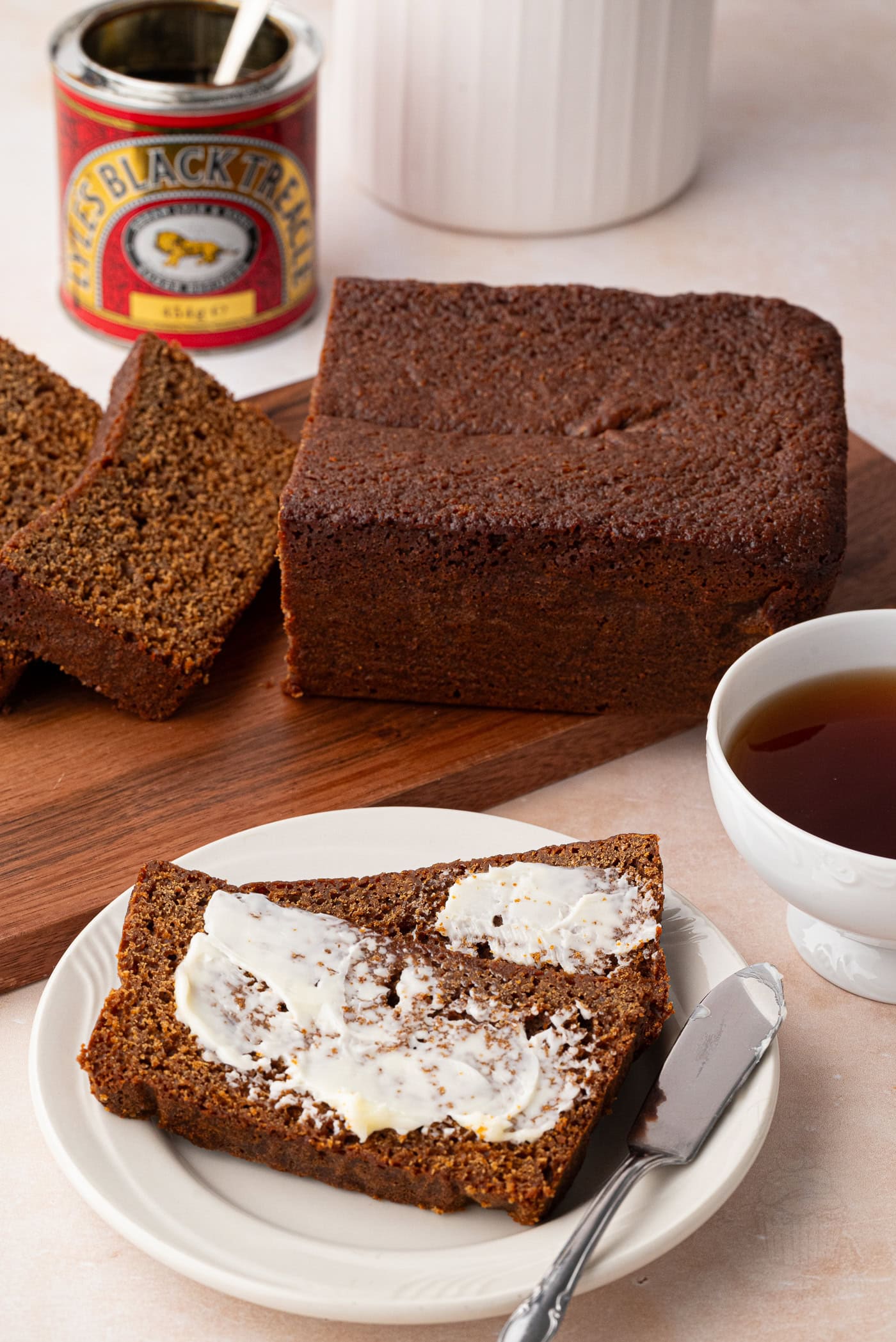
Thank you to Naomi Seiler for creating these photos.
Gingerbread Loaf FAQs
Yes, molasses is the closest alternative if you can’t get treacle. However, different brands of molasses can vary considerably in flavour, with some tasting more bitter or savoury than others, so the finished Gingerbread Loaf may taste slightly different from one made with treacle.
Absolutely! I use 4 teaspoons of ground ginger because I like a definite ginger flavour, but you can add more if you prefer something stronger, or reduce it a little for a gentler flavour. For an extra hit of ginger, you can also add finely chopped stem ginger or crystallised ginger to the batter.
That’s completely normal. This Gingerbread Loaf is made using the melting method, rather than creaming margarine/butter and sugar together, so the batter is much looser than a traditional sponge cake mixture. As long as you’ve followed the ingredient quantities, a fairly runny batter is exactly what you’re looking for.
Use the baking time as a guide rather than relying on it alone, as ovens can vary massively. The loaf should be well risen and a skewer inserted into the centre should come out clean. Start checking it at around the 1-hour mark and avoid leaving it in longer than necessary, as overbaking can make your gingerbread dry.
Yes – a good Gingerbread Loaf should be moist, slightly dense and develop a lovely sticky top. Don’t worry if it isn’t especially sticky as soon as it comes out of the oven. Once cooled, wrapped and left for at least 24 hours, the loaf will soften and become even stickier. I find it’s at its best after around 2-3 days (if you can wait that long!).
More British Loaf Cakes
If you loved this Gingerbread Loaf Cake, here are some more of my favourite loaf cake recipes for you to try next:
Save this recipe!
Want to save this recipe for later? Pop your email below and come back to it when you’re ready to bake.
Sticky Gingerbread Loaf
INGREDIENTS
- 110 g Block Margarine or Butter
- 100 g Golden Syrup (see Golden Syrup note below)
- 100 g Treacle
- 150 ml Milk
- 225 g Self-raising Flour (see Self-raising Flour note below)
- ½ tsp Baking Powder
- 55 g Soft Light Brown Sugar
- 4 tsp Ground Ginger
- 1 tsp Mixed Spice
- 2 Free-range Eggs (at room temperature; see Egg Size note below)
- ½ tsp Ground Cinnamon
- ½ tsp Ground Nutmeg
EQUIPMENT
INSTRUCTIONS
- Preheat your oven to 160°C (140°C for fan-assisted ovens, Gas Mark 2 or 325°F) and line a 2lb loaf tin with
greaseproof paper . Set aside. - In a saucepan, warm the butter/margarine, golden syrup and treacle over a low heat until melted and just combined. Remove from the heat and stir in the milk. Set aside to cool slightly.
- In a large bowl, sift in the flour, baking powder, sugar, ginger and spices. Pour the melted mixture into the dry ingredients and mix until combined.
- Add the eggs to the batter and mix until combined. The batter will be quite thin in comparison to some other cake batters – this is normal.
- Transfer the batter to your pre-lined loaf tin and bake in your preheated oven for 1 hour to 1 hour 30 mins. Use the time as a guide, as ovens can vary. The Gingerbread Loaf is ready when it is well risen, and a skewer inserted into the centre comes out clean.
- Switch the oven off and loosely cover the top of the loaf with a sheet of
tin foil and allow it to cool in the switched-off oven – ideally until completely cool, but a couple of hours is still worthwhile if you need your oven back sooner - Once completely cool, store the gingerbread loaf in an airtight container, or leave it in the tin and wrap well. It can be eaten straight away, but it is even better after at least 24 hours (or ideally 2–3 days), when it will become softer and stickier.
IMPORTANT NOTE:
All my recipes are developed using a digital scale and the metric system (grams and millilitres). Cup measurements are available as a conversion, but these, unfortunately, won’t always be as accurate. For best results, I always recommend baking with a digital scale.
RECIPE NOTES:
LIKE THIS RECIPE?
Leave a comment and rating below!Originally published in September 2017.