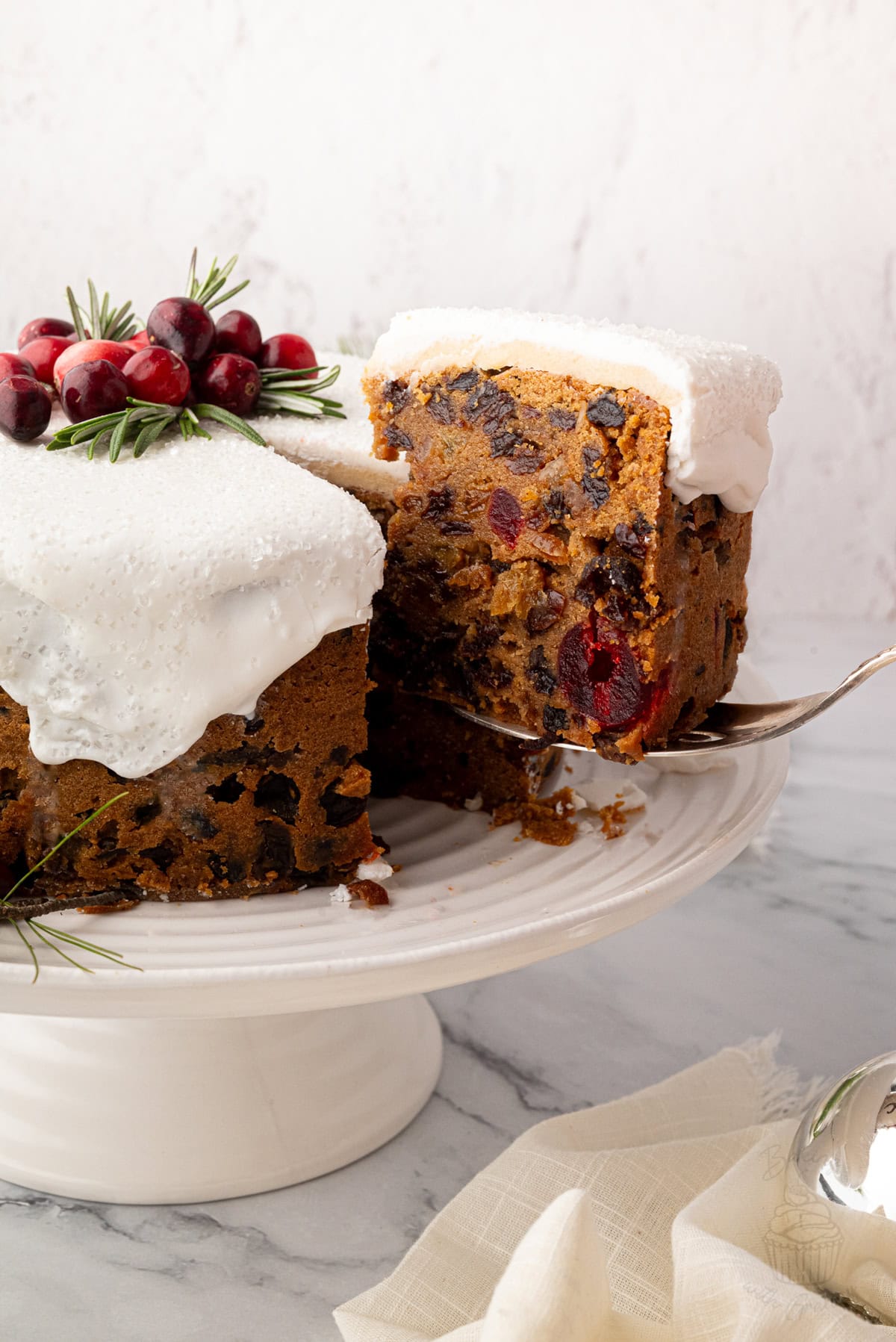
My Mum’s traditional Christmas Cake! Packed with dried fruit, warm spices and orange zest. It’s the same rich fruit cake recipe she used for decades, both in bakeries and at home. Made with brandy or orange juice, it’s ideal for baking ahead – but you can still make it a week or so before Christmas if you’re not that organised 😅
You will find advice here on everything from soaking the fruit to feeding and decorating your Christmas Cake. And you can simply use the contents menu below to jump straight to the bits you need!
Christmas Cake Recipe Snapshot
- Recipe: Traditional British rich fruit cake.
- Makes: Around 16 large slices.
- Tin: Deep 20cm (8 inch) round cake tin.
- Prep Time: Around 30–40 minutes, including preparing the tin.
- Fruit Soaking: Overnight, before making the cake.
- Baking Time: Approximately 3½-4 hours, followed by cooling completely in the tin.
- With or Without Alcohol: Soak the fruit in brandy – or orange juice for an alcohol-free Christmas Cake.
- Make Ahead: Up to 12 weeks before Christmas, stored well-wrapped, somewhere cool and dark – or make it a week or so before.
- Decoration: Marzipan and fondant, or royal icing – finished however you fancy!
Summarise & Save this Recipe on:
What is Christmas Cake?
A familiar part of Christmas celebrations across the UK, Christmas Cake is a rich, dense fruit cake made with dried fruit, brown sugar and warm spices. The fruit is soaked in brandy or orange juice before being mixed into the cake batter and baked slowly. It’s often covered with marzipan and finished with fondant or royal icing, although you can leave it plain if you prefer.
Its history is linked to the older tradition of Twelfth Night cake – a spiced fruit cake served at the celebrations marking the end of the twelve days of Christmas. By the late Victorian time, Christmas cakes were becoming much more fashionable, while the older Twelfth Night cake parties were becoming less common.
Despite sharing some familiar festive ingredients, Christmas Cake is different from Christmas Pudding or Clootie Dumpling, which are both made with suet and steamed or boiled, rather than baked. It’s also a close relative of Scottish Black Bun, which is another rich fruit cake, but that is enclosed in pastry and traditionally enjoyed at Hogmanay.
My Mum’s Christmas Cake Recipe
The smell of a rich fruit cake baking takes me straight back to my childhood – but not to December, funnily enough! For me, it’s early summertime, when Mum would be baking for the wedding season, and the whole house would fill with that unmistakable warm, spiced scent.
My Mum became well known locally for her Christmas cakes, making dozens of them each year – some to sell and plenty to give away as homemade gifts. And the recipe wasn’t reserved for Christmas either. It’s the same one she used for traditional wedding and christening cakes, both during her years working in professional bakeries and later baking from home.
Making tiered wedding cakes meant she needed the recipe to work for cakes big and small, in both round and square tins. That flexibility is just as handy when you’re making a Christmas Cake – whether you want a smaller cake for your household, a bigger one for a family gathering, or several to give as gifts. My FREE Christmas Cake Size Guide gives you the ingredient quantities and baking times for different tin sizes and shapes, so you can scale the recipe up or down to suit.
Key Ingredients
See the recipe card for a full ingredients list, required quantities and cup conversions.
Substitutions & Additions
Different Dried Fruits: Dried cranberries, chopped dried apricots and chopped dates all work well here. Swap them for some of the raisins or sultanas, keeping the overall weight of dried fruit the same rather than adding extra fruit to the mixture.
Sugar: You can swap the dark brown sugar for a light brown sugar, although your cake will be lighter in colour and have a milder flavour. Dark muscovado is my Mum’s favourite for a darker cake with a richer flavour, and it always feels a little more indulgent, too!
Citrus Zest: Orange is my favourite and always feels quite festive. But lemon zest works well too, and it’s actually what Mum would use in her celebration fruit cakes for weddings and christenings.
Other Alcohols: Brandy isn’t your only option. Whisky, rum, sherry, port or Grand Marnier can also be used for soaking the fruit and feeding the cake. Choose according to the flavour you enjoy the most, or whatever you have that needs to be used up!
Flaked Almonds: You can use flaked almonds instead of ground almonds, but they won’t help the cake retain moisture in quite the same way. If you do make this swap, be sure to soak your dried fruit as instructed and feed the cake before decorating or serving – follow the separate alcohol or orange juice feeding guidance below, depending on which version you’re making.
Spices: You can use more or less mixed spice or cinnamon depending on your personal taste. Nutmeg, ground cloves, allspice, ginger and cardamom are all great options too – choose your favourites and have a little fun experimenting! Start with a small amount of any extra spices, just so they don’t overpower the fruit.
Looking for dairy-free, gluten-free or vegan adaptations? See the Free-from & Vegan section below.
Christmas Cake With or Without Alcohol
Despite the common misconception, alcohol isn’t essential for a traditional Christmas Cake. You can use orange juice instead of brandy to soak the dried fruit, then follow the same mixing and baking instructions. The choice comes down to whether you enjoy that boozy flavour or you prefer your cake without it.
I find it helps to think of the soaking and the feeding as two separate things. Soaking the fruit happens before baking, giving it time to absorb some moisture and flavour. Feeding means adding more liquid to the baked cake as it matures, again for even more additional moisture and flavour.
When you have the ground almonds included, feeding is entirely optional – even when you’ve made the cake with alcohol. The flavours will still mature while the cake is stored, so don’t worry if you forget a feed it or simply prefer to leave it alone.
If you do want to feed your cake, alcohol and orange juice need different approaches. Orange-juice feeds should be limited and kept until nearer decorating or serving, rather than following the regular alcohol-feeding schedule. You’ll find both methods in How to Feed Your Christmas Cake below.
Free-from & Vegan
Amy recommends: If you regularly need to adapt baking recipes for gluten-free, dairy-free, egg-free or vegan diets, I highly recommend The Elements of Baking by Katarina Cermelj, creator of The Loopy Whisk. It’s a brilliant resource for understanding how substitutions work, rather than simply swapping ingredients and hoping for the best.
Gluten-free Options:
Swap the plain flour for a gluten-free plain flour, using the same weight. If you’re baking for someone with coeliac disease, check all the other ingredients too, including anything used for decorating, and take care to avoid cross-contamination during the preparation, baking, decorating and storing.
Nut-free Adjustments:
Leave out the ground almonds, but do not replace them with extra flour – that will make the cake dry. Soak your dried fruit as instructed, and feed the cake to help make up for the moisture the almonds would otherwise give, following the alcohol or orange-juice instructions in How to Feed Your Christmas Cake below.
You’ll also need to leave off any marzipan and check your icing, decorations and other ingredients are suitable for whoever you’re baking for.
Dairy-free Swaps:
Simply use a dairy-free margarine – check the label, as not all margarines are dairy-free, and remember to check any icing and decorations too.
Egg-Free Adaptations:
The five eggs play an important part in binding this fruit-heavy mixture, so I wouldn’t recommend simply swapping them for an egg replacer. Instead, I would recommend using an intentionally egg-free Christmas Cake, like the Vegan Christmas Cake from Domestic Gothess.
Vegan Substitutions:
The dairy-free swap is straightforward, but replacing the eggs needs a different approach, so I would recommend using an intentionally vegan Christmas Cake like the Vegan Christmas Cake from Domestic Gothess.
Allergy Disclaimer & Resources:
Any advice or suggestions to make recipes “free-from” or vegan are purely suggestions. Please double-check all packaged ingredients individually, taking extra caution when baking for those with allergies or intolerances.
For official guidance on food allergies, please see Food Standards Agency (food.gov.uk) | For more info on coeliac disease, please see Coeliac UK (coeliac.org.uk) | For more info on a vegan diet, please see The Vegan Society (vegansociety.com)
Christmas Cake Tin Sizes & Quantities
The quantities in the recipe card make one deep 20cm (8-inch) round Christmas Cake. I use a tin that’s around 9.5cm deep, so do check the depth as well as the diameter before you begin – the last thing you want is to find out your tin is too shallow right as you add the batter to it!
If you’re using a different tin, my FREE Christmas Cake Size Guide gives you the ingredient quantities (in grams and cups) and baking times for both smaller and larger cakes, and square tins. You can print it out and keep it beside you while you bake.
Sign up below to receive your FREE guide, along with recipes and seasonal emails from Baking with Granny.
FREE Christmas Cake Size Guide

Wanting to bake a smaller or bigger Christmas Cake?
Grab a copy of my FREE Christmas Cake Size Guide!
You’ll find the ingredient amounts for 6, 7, 8 and 9 inch Christmas Cakes (in both grams and cups), how to alter the recipe for square tins, and the adjusted baking times.
How to Make Christmas Cake
Making Christmas Cake starts the day before, with an overnight soak for the fruit. After that, the mixing is straightforward – it’s preparing the tin and allowing enough time for the long, slow bake that needs a little extra attention and planning ahead for.
Soaking the Dried Fruit

- Soak the fruit. Put the dried fruit, cherries, mixed peel and zest into a large bowl. Add the brandy or orange juice, stir well and cover. Leave to soak overnight.
Preparing Your Christmas Cake Tin
- Prepare the oven and tin. Preheat your oven to 150°C (130°C fan, Gas Mark 2 or 300°F). Grease and double-line a deep 20cm (8-inch) round cake tin with greaseproof paper.
- Prepare the wrapping. Cut brown paper to wrap around the tin and stand above the rim. Have a length of cotton string or twine, and a separate piece of dampened greaseproof paper ready for covering the cake.
Mixing and Baking the Cake
- Cream the margarine/butter and sugar. Beat together in a large bowl.
- Add the eggs and almonds. Mix in the eggs one at a time, followed by the ground almonds.
- Add the dry ingredients. Sift in the flour, mixed spice and cinnamon, then mix into a thick batter.
- Add the soaked fruit. Mix in the fruit and any remaining soaking liquid until evenly combined.
- Fill the tin. Spoon in the mixture and smooth the surface, making a slight dip in the centre.
- Wrap and cover. Secure the brown paper around the tin with cotton string. Cover the cake with dampened greaseproof paper and place the tin on a baking tray.
- Bake. Bake for approximately 3½-4 hours, checking after 3 hours. A skewer inserted into the centre should come out clean.
- Cool. Leave to cool completely in the tin before removing, keeping the greaseproof lining on the cake for storing.
How to Feed Your Christmas Cake
Feeding is actually optional for this Christmas Cake, but I do recommend it if you’ve left out the ground almonds or replaced them with flaked almonds, to help make up for the reduced moisture.
Feeding with Alcohol
Once the cake is completely cool, poke a few holes in the top with a skewer and brush over 1-2 tablespoons of brandy (or your alcohol of choice) for a 20cm (8-inch) cake. You can give it this first feed once it’s cool, before wrapping and storing it.
Repeat this process roughly every 7-14 days, wrapping the cake well again afterwards. You don’t need to be exact – forgetting a feed now and then is absolutely fine! Feeding gradually adds to that boozy flavour, but the cake’s flavours will also mature without it.
Stop feeding about a week before decorating, so the top of the cake has time to dry before you add the marzipan or icing.
Feeding with Orange Juice
Orange juice needs a slightly more cautious approach, as repeatedly adding juice may encourage the cake to spoil – so don’t follow the same feeding schedule as you would for when using alcohol.
I use freshly squeezed orange juice and recommend just one or two small feeds within the 7-10 days before decorating. Poke a few holes in the cake and brush the juice over, then wrap it again. Skip feeding on the final few days before you plan on decorating so the top of the cake can dry.
With orange juice, you are adding a little moisture here, rather than gradually building up a boozy flavour, so as frequent feeding isn’t necessary.
Feeding a Christmas Cake You Baked Close to Christmas
If you’re making a cake around a week before Christmas, you can give it a feed as soon as it comes out of the oven. This applies whether you’re using alcohol or orange juice, including cakes made without ground almonds. As long as you have soaked the fruit before baking, this will be sufficient so that you don’t end up with a dry cake.
Then leave the cake to cool completely in its tin before wrapping and storing it. And allow the top of the cake to dry for a day or two before adding marzipan or icing.
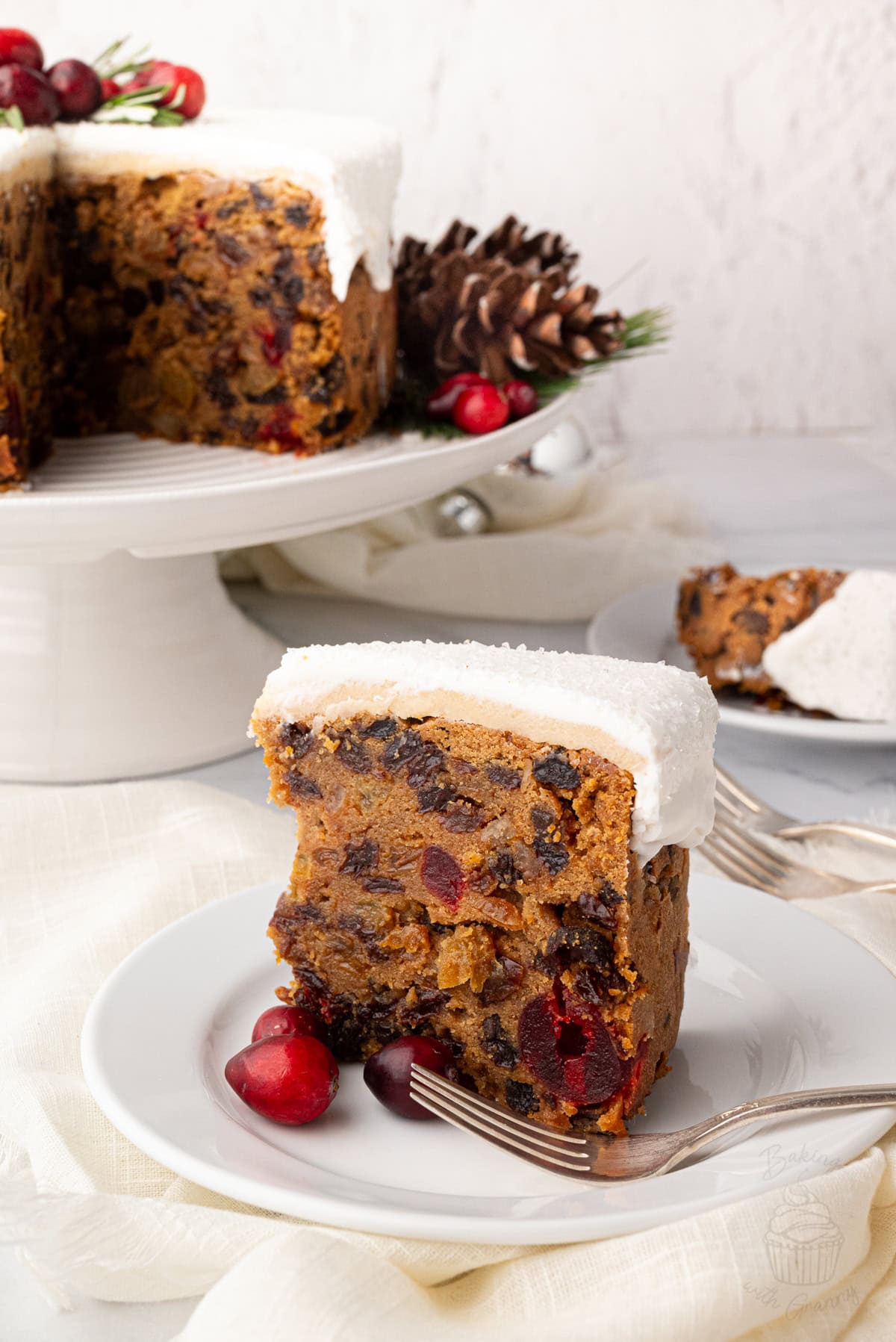
Thank you to Naomi Seiler for creating the updated photos.
Make Ahead, Storage & Freezing
- Make Ahead: You can make this Christmas Cake up to 12 weeks before Christmas, whether you’re using brandy or orange juice. Keep it well wrapped somewhere cool and dark, following the storage instructions below. If you choose to feed it, follow How to Feed Your Christmas Cake instructions above.
- Storage: Allow the cake to cool completely before wrapping, keeping its greaseproof lining in place and covering any exposed cake with more greaseproof paper. Then either:
• Wrap in foil, followed by cling film.
• Wrap in cling film and place inside a cake storage tin.
Keep at room temperature, preferably somewhere cool and dark. And rewrap carefully whenever you unwrap it for feeding. - Freezing: Christmas Cake can be frozen, although it isn’t always necessary when you’re making it within the recommended make-ahead period. But if you want/need to freeze your Christmas Cake, simply wrap the undecorated cake as described above, then place it in the freezer. Allow it to thaw completely at room temperature before adding marzipan, icing or other decorations.
Top Tips for Christmas Cake
- Different Tin Sizes and Shapes: This recipe is for a 20cm (8 inch) round cake which requires a deep cake tin. I use a Masterclass 20cm/8-inch Deep Cake Tin, and I absolutely love it. However, if you want a smaller cake, a larger cake, or even a square cake, you can download my FREE Christmas Cake Size Guide, which gives you the ingredient quantities (in grams and cups) and altered baking times for different sized and shaped cakes
- Don’t Skip the Overnight Soak: The soaking gives the dried fruit time to absorb moisture before its long bake. It’s especially important if you’re using dried fruits you’ve had sitting around for a while (no judgement here), or you are leaving out the ground almonds, or using flaked almonds instead.
- Protect the Sides, Top and Base: The brown paper around the tin, dampened greaseproof paper on top and a baking tray underneath all help protect the outside of the cake while the centre cooks through. The tray also makes it a little easier to get the heavy cake in and out of the oven.
- Choose the Right String: Use cotton string to secure or twine to secure the brown paper around your tin. And avoid nylon string, which can melt in the oven!
- Slow and Steady Bake: Christmas Cake really does need to be baked low and slow. Increasing the temperature to hurry things along risks overbaking the outside before the middle is ready. Allow plenty of time, and use the baking time as a guide, checking the centre with a skewer towards the end.
- Cool Completely in the Tin: A cake packed with this much fruit needs plenty of time to settle and firm up before you move it. Let it cool completely in the tin, ideally overnight if possible. And leave the greaseproof lining on when you remove it, ready for wrapping and storing.
- Keep it Well Wrapped: Whether you feed your cake or leave it to mature on its own, keep it well wrapped somewhere cool and dark. Rewrap carefully after each feed.
- Leave Time After the Final Feed: Stop alcohol feeds about a week before decorating, or orange-juice feeds a few days before, so the surface can dry before adding marzipan or icing. See the How to Feed Your Christmas Cake section above for more detail.
How to Decorate Your Christmas Cake
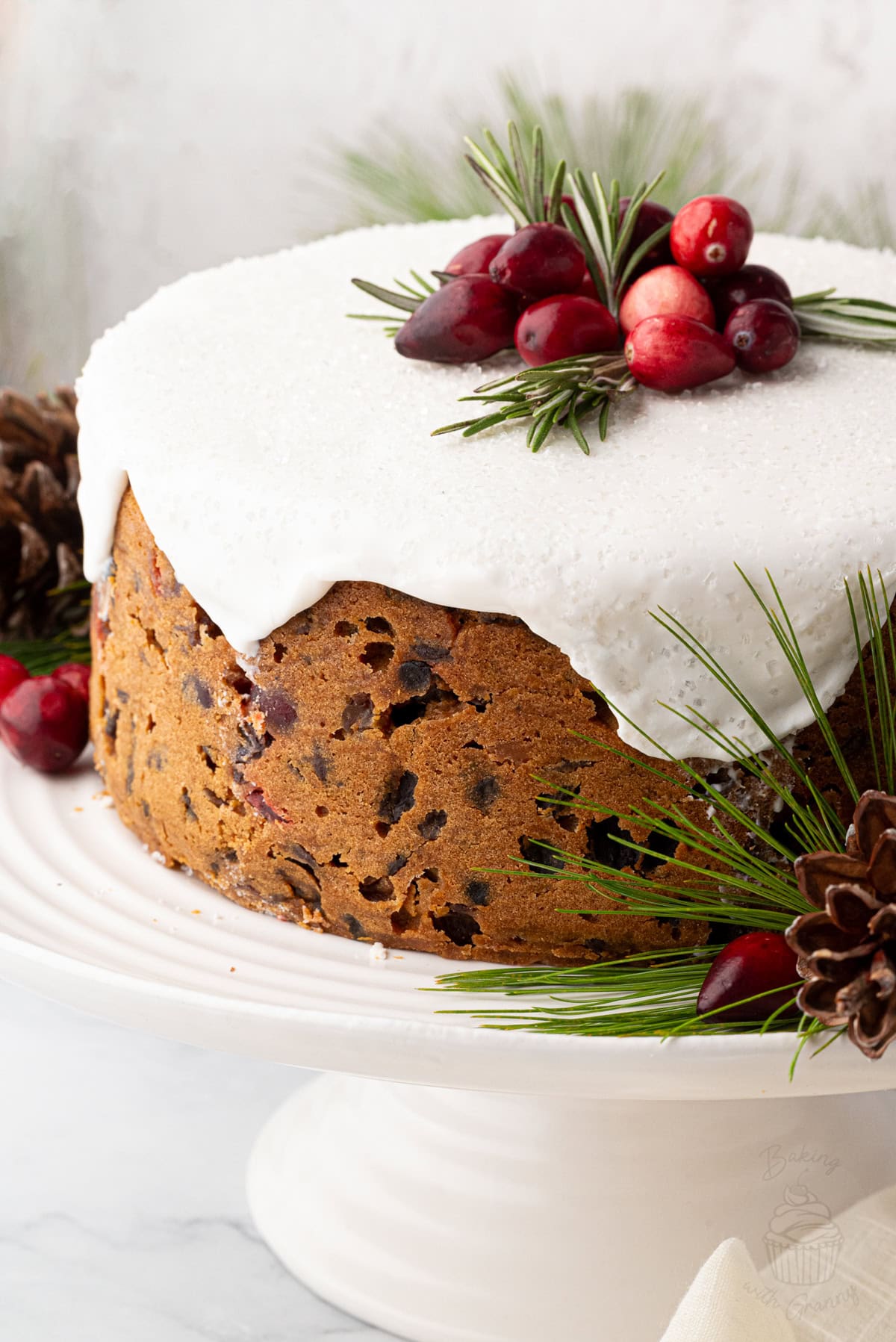
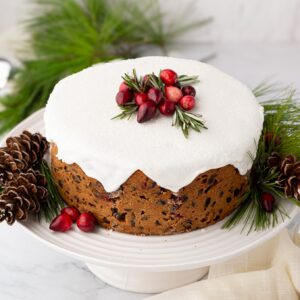
Marzipan topped with white icing is a traditional finish, but decorating your Christmas Cake can be as simple or elaborate as you fancy. Before you begin, make sure the cake is completely cool, and the surface has had time to dry after its final feed.
Marzipan
A layer of marzipan adds that familiar sweet almond flavour and gives the icing a smoother base to sit on. You can use ready-made marzipan, rolled out to cover the cake. If you’re making a nut-free version, remember to leave this layer off.
Fondant or Royal Icing
Fondant icing, also called ready-to-roll icing, is a convenient choice for a smooth finish. It’s also handy for cutting out shapes or making little decorations with.
Royal icing gives a more old-school finish. You can spread it into snowy peaks and swirls, so there’s no need to aim for a perfectly smooth surface.
Christmas Cake Decorating Ideas
A few decorations can turn a plain white cake into something festive:
- Fondant holly leaves and berries for a classic Christmas finish.
- Little fondant snowmen for a snowy scene.
- Sugared berries for a frosty effect.
- Chocolate pine cones for a woodland-inspired cake.
You can also use food-safe Christmas cake ornaments – just remove any non-edible decorations before slicing.
How to Serve Christmas Cake
Christmas Cake is rich and packed with fruit, so a small slice is usually plenty. Serve it at room temperature, plain or with its marzipan and icing, alongside a cup of tea or coffee – or something a little bit special; it is Christmas after all!
For something a little different, why not try a slice of cheese with your cake? Christmas Cake with Wensleydale is an established Yorkshire tradition, with the cheese served alongside or perched on top. Its creamy, crumbly texture and savoury flavour can make a lovely contrast to the sweet fruit cake.
Christmas Cake FAQs
Not in this recipe! My Mum’s version uses dark brown sugar, dried fruit and spices for its rich colour and flavour. Some Christmas Cake recipes include treacle, but you don’t need to add it to this one.
I recommend sticking with plain flour (all-purpose flour). This recipe is made without baking powder or other raising agents, giving you the dense, rich fruit cake intended. Self-raising flour contains raising agents, so it isn’t a direct substitute here.
Overbaking, insufficiently soaked fruit or adding too much flour can leave the cake dry. Soak the fruit overnight, measure your ingredients carefully (I always recommend weighing over using cups), and check the cake during baking rather than relying entirely on the clock. If you’ve omitted the ground almonds or used flaked almonds instead, follow the feeding guidance to help make up for the reduced moisture.
Yes! Although Christmas Cake is ideal for making ahead, you can still make this recipe a week or so before Christmas. Allow time for the overnight fruit soak, baking and cooling before decorating. See How to Feed Your Christmas Cake section above for advice on feeding a cake made nearer Christmas.
Yes! The recipe can be scaled for different round and square tins. The ingredient quantities in the recipe card are for a deep 20cm (8 inch) round tin, but you can use my FREE Christmas Cake Size Guide for the ingredient quantities and baking times to suit your chosen tin.
More Classic Christmas Bakes
If you loved this traditional Christmas Cake, here are some more of my favourite Christmas baking recipes for you to try next:
Save this recipe!
Want to save this recipe for later? Pop your email below and come back to it when you’re ready to bake.
Traditional Christmas Cake
INGREDIENTS
- 450 g Currants
- 200 g Sultanas
- 200 g Raisins
- 150 g Glacé Cherries (halved)
- 75 g Dried Mixed Peel
- Zest of 1 Orange
- 100-200 ml Orange Juice or Brandy (plus extra for feeding)
- 275 g Soft Margarine (or Butter) (at room temperature)
- 275 g Soft Dark Brown Sugar
- 5 Free-range Eggs (beaten; at room temperature; see Egg Size note below)
- 75 g Ground Almonds
- 350 g Plain Flour
- 1 tsp Mixed Spice
- 1 tsp Ground Cinnamon
To Decorate (Optional):
- Marzipan
- Fondant Icing or Royal Icing
- Christmas Cake Decorations
EQUIPMENT
- 20cm (8 inch) Round Cake Tin (or your chosen size)
INSTRUCTIONS
Soak the Fruit:
- Put the currants, sultanas, raisins, cherries, mixed peel and orange zest into a large bowl. Add the brandy or orange juice and stir thoroughly. Cover and leave to soak overnight. Start with around 100ml for recently bought fruit, using up to 200ml for older, drier fruit. You can add a little more if the liquid is fully absorbed.450 g Currants; 200 g Sultanas; 200 g Raisins; 150 g Glacé Cherries; 75 g Dried Mixed Peel; Zest of 1 Orange; 100-200 ml Orange Juice or Brandy
The Next Day:
- Preheat your oven to 150°C (130°C for fan-assisted ovens, Gas Mark 2 or 300°F). Grease and double-line a
20cm (8 inch ) round cake tin withgreaseproof paper . Set aside. - Prepare a length of brown paper long enough to wrap around the outside of the tin, folded over to provide an extra layer. It should stand a couple of inches above the rim. Have cotton string ready to secure it, and a separate piece of
greaseproof paper large enough to cover the cake. Set aside. - In a large bowl (separate from the one you have your fruit soaking in), cream together your butter/margarine and sugar. Add the eggs one at a time, ensuring each is mixed through before adding the next. Mix in the ground almonds.275 g Soft Margarine (or Butter); 275 g Soft Dark Brown Sugar; 5 Free-range Eggs; 75 g Ground Almonds
- Sift in your flour, mixed spice and cinnamon before mixing together to create a somewhat thick batter.350 g Plain Flour; 1 tsp Ground Cinnamon; 1 tsp Mixed Spice
- Combine the cake batter with the soaked dried fruit, mixing until all the fruit is well-coated. Transfer the mixture to your pre-lined cake tin and spread it to the edges. Using a spoon, create a slight dip in the centre of the cake (this helps prevent it from doming on top).
- Wrap the brown paper around the outside of the tin and secure with string. Dampen the separate piece of
, gently squeeze out excess water and drape it over the cake. Place the tin on a flat baking tray. - Bake for 3½-4 hours. Check your cake after 3 hours. If the cake appears to be baking too quickly, reduce the oven temperature a little. A skewer inserted into the centre should come out clean when the cake is baked through.
- Remove your cake from the oven and allow it to cool completely in the tin. Once completely cool, remove the cake from the tin but keep the
greaseproof paper lining on the cake. Cover the top of the cake with extraand wrap well in cling film andtin foil. Keep the cake somewhere safe to mature before decorating for Christmas.
Feeding the Cake (Optional):
- With alcohol: Poke a few holes in the top with a skewer and brush over 1-2 tablespoons of brandy. Repeat approximately every 7-14 days, wrapping carefully after each feed. Stop feeding about a week before decorating.With orange juice: Use freshly squeezed orange juice sparingly, giving just one or two small feeds within the 7-10 days before decorating. Leave the final few days free from feeding so the surface can dry. Do not follow the regular alcohol-feeding schedule, as repeated juice feeds could cause the cake to spoil.
Decorating:
- Once the cake is completely cool and the top has dried after feeding, cover with marzipan followed by fondant or royal icing, before adding some festive decorations to finish.Marzipan; Fondant Icing or Royal Icing; Christmas Cake Decorations
IMPORTANT NOTE:
All my recipes are developed using a digital scale and the metric system (grams and millilitres). Cup measurements are available as a conversion, but these, unfortunately, won’t always be as accurate. For best results, I always recommend baking with a digital scale.
RECIPE NOTES:
LIKE THIS RECIPE?
Leave a comment and rating below!FREE Christmas Cake Size Guide
Wanting a smaller or bigger Christmas Cake?
Grab a copy of my FREE Christmas Cake Size Guide!
You’ll find the ingredient amounts for 6, 7, 8 and 9 inch Christmas Cakes (in both grams and cups), how to alter the recipe for square tins, and the adjusted baking times.
Originally published in November 2022.