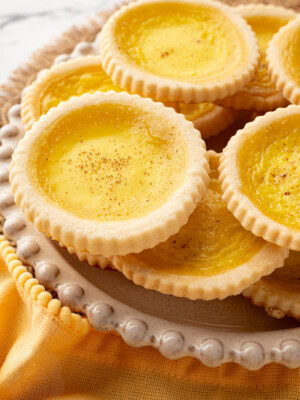
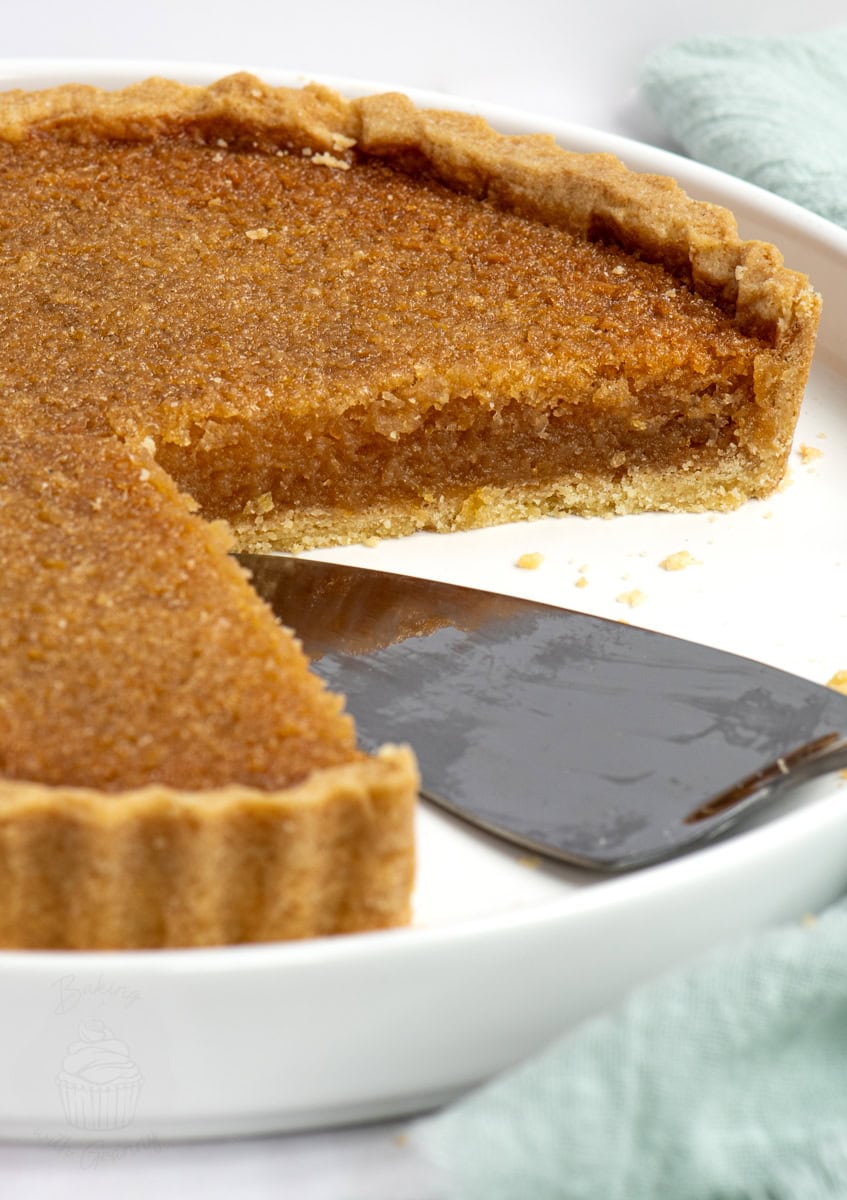
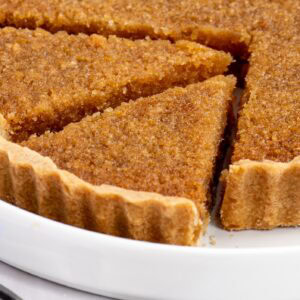
Treacle Tart is a proper school-dinner favourite, with sweet shortcrust pastry and a soft, sticky golden syrup filling. Made with my favourite homemade pastry, it’s a lovely old-fashioned pudding to serve warm with a generous helping of custard.
Treacle Tart Recipe Snapshot
- Makes: 8 slices.
- Tin: 20cm (8-inch) loose-bottom tart tin.
- Pastry: Homemade sweet shortcrust.
- Filling: Golden syrup and fresh breadcrumbs, with lemon zest, double cream and egg.
- Chilling Time: 30 minutes for the pastry.
- Baking Time: 55-60 minutes altogether, including 20 minutes part-baking of the pastry.
- Cooling Time: 20 minutes before serving.
- Ready When: Golden on top with the filling beginning to set – a slight wobble is fine.
Summarise & Save this Recipe on:
What is Treacle Tart?
Treacle Tart is a traditional British pudding made with a shortcrust pastry case and a filling of golden syrup, breadcrumbs and lemon. The breadcrumbs give the filling its body, so it holds its shape when sliced while staying soft and sticky.
Despite the name, this Treacle Tart uses golden syrup rather than black treacle. The word “treacle” was once used more broadly for syrups, which helps explain the slightly misleading name. If you’re baking outside the UK, don’t mistake it for a tart made with dark molasses – that would be something entirely different 😅
An Old-school Pudding Favourite
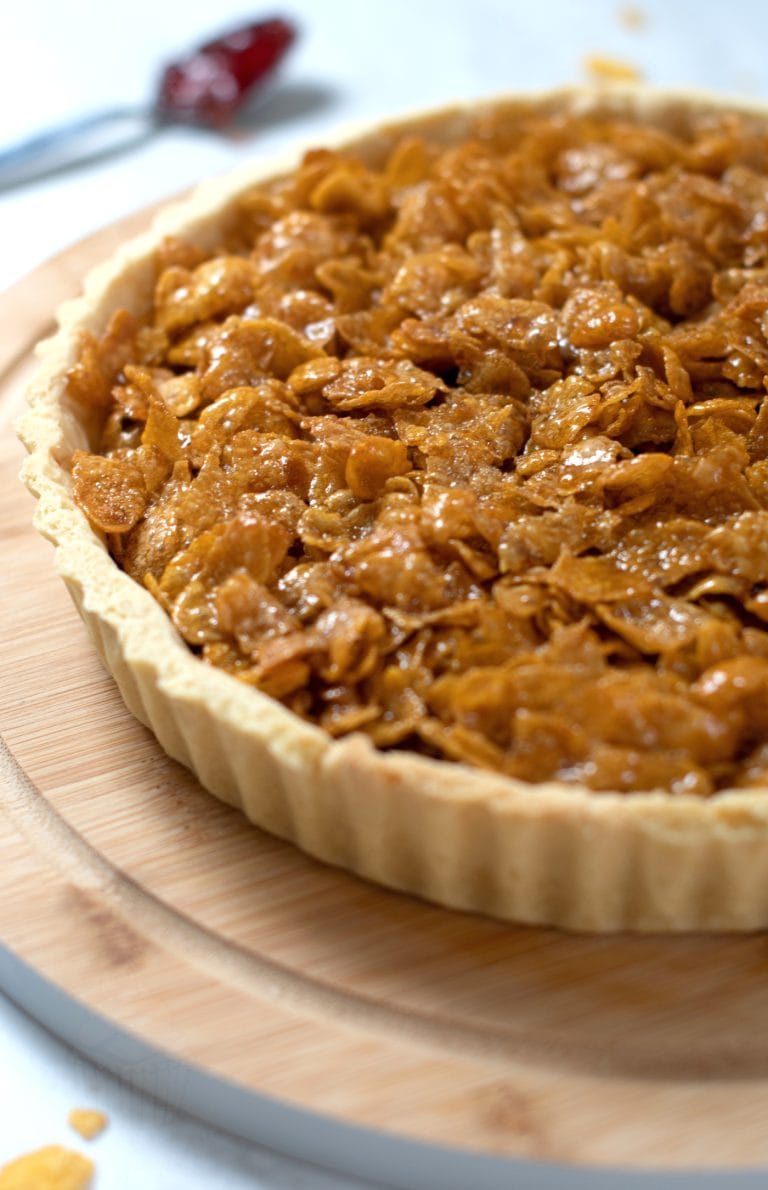
Alongside School Cake, Cornflake Tart and Spotted Dick, Treacle Tart is one of those puddings closely associated with British school dinners. And, as with so many school puddings, a generous ladle of custard was very much part of the experience! Although I’m not sure it would meet the healthy food standards that school dinners require these days.
For my Treacle Tart, I use the same favourite sweet shortcrust pastry that I use in most of my tart recipes. It’s made by creaming the butter/margarine and sugar together before adding the flour, rather than rubbing cold fat into flour. And I am often told it is the best shortcrust pastry recipe!
Treacle tart recipes often appeared in Victorian cookbooks, although early versions can be quite different from the golden syrup and breadcrumb filling we know and love today. And it has another famous connection: Harry Potter fans will know it as Harry’s favourite dessert, too!

Key Ingredients
See the recipe card for a full ingredients list, required quantities and cup conversions.
Need cups, a different batch size or an ingredient swap?
Head to the recipe card for US measurements and adjustable ingredient quantities. For advice on ingredients and suitable substitutions, check the key ingredients and substitutions sections.
Substitutions & Additions
Shop-bought Pastry: You can use shop-bought shortcrust pastry to save a little time, although I do recommend making the sweet shortcrust from scratch for the best-tasting results. You’ll still need to blind bake the pastry case before adding the filling, unless you are using a pre-baked tart pastry case.
Golden Syrup: I don’t recommend replacing the golden syrup with honey, maple syrup, corn syrup or black treacle. Golden syrup is very much central to the familiar flavour of this pudding, so it’s well worth sourcing some for this recipe.
Looking for dairy-free, gluten-free or vegan adaptations? See the Free-from & Vegan section below.
Free-from & Vegan
Amy recommends: If you regularly need to adapt baking recipes for gluten-free, dairy-free, egg-free or vegan diets, I highly recommend The Elements of Baking by Katarina Cermelj, creator of The Loopy Whisk. It’s a brilliant resource for understanding how substitutions work, rather than simply swapping ingredients and hoping for the best.
Gluten-free Options:
For the pastry, I recommend using ready-made gluten-free shortcrust pastry or a dedicated recipe, such as Becky Excell’s gluten-free shortcrust pastry, rather than simply swapping the flours – this is because gluten-free flours can sometimes be a little drier. Also use gluten-free bread to make the fresh breadcrumbs for the filling too.
Nut-free Adjustments:
This recipe contains no nuts, but as always, be sure to double-check the allergen lists for your individual ingredients.
Dairy-free Swaps:
To make this a dairy-free Treacle Tart, simply use a dairy-free block margarine in your pastry and a plant-based double cream in your filling (I like Elmlea Double Plant Cream).
Egg-Free Adaptations:
Simply replace the egg in the filling with an egg-replacer, such as Oggs or Bob’s Red Mill Egg Replacer.
Vegan Substitutions:
To make this a vegan Treacle Tart, use a plant-based block margarine for the pastry, a plant-based cream and an egg-replacer, such as Oggs or Bob’s Red Mill Egg Replacer in the filling.
Allergy Disclaimer & Resources:
Any advice or suggestions to make recipes “free-from” or vegan are purely suggestions. Please double-check all packaged ingredients individually, taking extra caution when baking for those with allergies or intolerances.
For official guidance on food allergies, please see Food Standards Agency (food.gov.uk) | For more info on coeliac disease, please see Coeliac UK (coeliac.org.uk) | For more info on a vegan diet, please see The Vegan Society (vegansociety.com)
How to Make Treacle Tart
Start with the sweet shortcrust pastry, then prepare the filling while the pastry case blind bakes. You’ll find the full ingredient quantities in the recipe card below.
- Make and chill the pastry. Cream the margarine/butter and sugar. Sift the flour and mix to a soft dough. Gently knead until combined, wrap and refrigerate for 30 mins.
- Prepare the tin and oven. Lightly grease a 20cm (8 inch) loose-bottom tart tin with margarine/butter and dust with flour. Preheat the oven to 180°C (160°C fan, Gas Mark 4 or 350°F).
- Line the tart tin. Roll the chilled pastry into a circle approximately 28cm (11-inches) and 5mm thick. Carefully transfer to the tin, gently press into the base and sides. Trim the edges and prick with a fork.
- Part bake the pastry. Line the pastry and fill with baking beans. Bake for 15 mins, then remove the paper and beans and bake for another 5 mins. Prepare the filling while it bakes.
- Make the filling. Warm the golden syrup over a low heat until thinner and easier to stir. Remove from the heat and mix in the fresh breadcrumbs, lemon zest, double cream and salt. Add the egg and mix until combined.
- Fill and bake. Pour the filling in the part-baked pastry case. Reduce the oven to 160°C (140°C fan, Gas Mark 3 or 325°F) and bake for 35-40 mins. The top should be golden and the filling beginning to set, with a slight wobble.
- Cool before serving. Allow the tart to cool for 20 mins before slicing and serving.
Top Tips for Treacle Tart
- Chill the Pastry: Chilling firms up this soft dough and makes it easier to roll. If it becomes too soft or sticky while you’re working with it, pop it back in the fridge to firm up again.
- Patch Any Cracks: If the pastry tears when you transfer it to the tin, use a little spare dough to patch the gap. Check the base and corners before blind baking so the filling has no gaps to escape through.
- Don’t Skip the Part-Bake: Giving the pastry a head start in the oven helps avoid the dreaded soggy bottom – even Mary Berry would approve! Just 15-20 minutes with baking beans or rice will do the trick.
- Warm the Syrup Gently: You only need to loosen the syrup enough to make mixing easier. Avoid boiling it, and take the pan off the heat before adding the other filling ingredients.
- Don’t Wait for a Firm Middle: The tart is ready when it’s golden on top, and the filling has begun to set. A slight wobble is fine, as it will continue to bake even once it’s out of the oven, and the filling should still be slightly soft and sticky when served.
- Wait to Slice: Allow 20 minutes of cooling before serving, rather than cutting straight from the oven. This helps the filling hold its shape when sliced.
Storage, Freezing & Make Ahead
- Storage: Once cooled, store your Treacle Tart in an airtight container at room temperature for up to 2 days, or in the fridge for up to 5 days. If you prefer it warm, gently reheat individual slices in the oven or microwave before serving.
- Freezing: Treacle Tart freezes well, either whole or in slices. Allow it to cool completely, then wrap tightly in cling film and tin foil and freeze for up to 3 months. Defrost overnight in the fridge, then gently warm through in the oven before serving if desired.
- Make Ahead: You can make the sweet shortcrust pastry 1-2 days ahead. Wrap it in cling film and keep it in the fridge until needed. If it’s too firm to roll straight from the fridge, let it soften a little before rolling.
How to Serve Treacle Tart
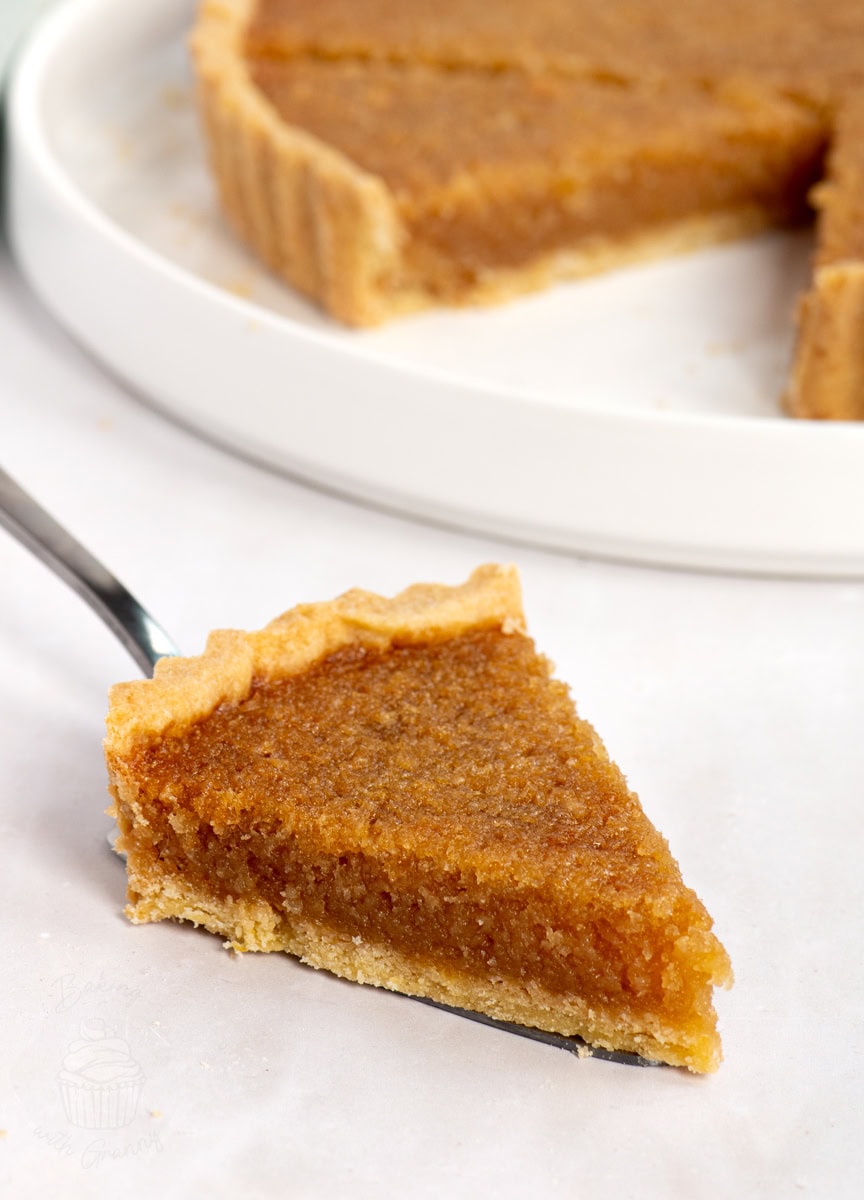
For a proper school-dinner-style pudding, serve your Treacle Tart warm with a generous helping of custard. A scoop of vanilla ice cream or a drizzle of double cream works beautifully too, if that’s more your thing.
Treacle Tart FAQs
Overbaking can make the filling too firm, so don’t wait until the centre looks completely solid before taking it out of the oven – it does continue to bake a little once you do take it out. Also check that you’re using fresh breadcrumbs rather than dried, and weigh them carefully – too much bread can make the filling dry and dense, too.
There’s a difference between a slight wobble and a liquid centre. The filling should have begun to set before the tart leaves the oven, then needs 20 minutes to cool before slicing. If it still runs out when cut after cooling, it may have needed longer in the oven. Check your breadcrumb quantity too, as these give the filling its body.
This recipe is written for a 20cm (8-inch) loose-bottom tart tin. Changing the width or depth affects the thickness of the filling and how quickly it bakes, so the same timings won’t necessarily apply. For the most predictable results, I do recommend using the stated tin size.
More Golden Syrup Recipes
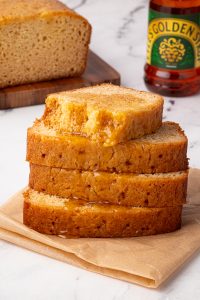
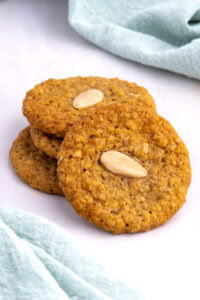
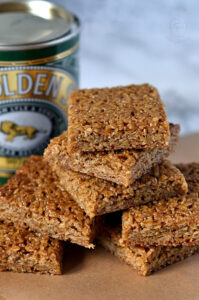
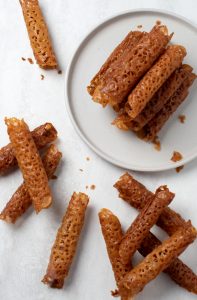
If you loved this traditional Treacle Tart, here are some more of my favourite golden syrup recipes for you to try next:
Save this recipe!
Want to save this recipe for later? Pop your email below and come back to it when you’re ready to bake.
Treacle Tart
INGREDIENTS
For the Pastry:
- 175 g Block Margarine or Butter (at room temperature; plus extra for greasing)
- 65 g Caster Sugar
- 250 g Plain Flour (plus extra for dusting)
For the Filling:
- 500 g Golden Syrup (see Golden Syrup note below)
- 125 g Fresh Breadcrumbs (fresh – not golden or panko)
- 1 Lemon (zested)
- 3 tbsp Double Cream
- small pinch Sea Salt
- 1 Free-range Egg (at room temperature; beaten; see Egg Size note below)
EQUIPMENT
INSTRUCTIONS
For the Pastry:
- In a large bowl, cream together the butter/margarine and sugar until light and fluffy. Sift in the flour and mix to create a soft dough, using your hands to bring it together when necessary. Gently knead the dough on a clean surface to ensure it is thoroughly combined, before wrapping the dough in cling film and placing it in the fridge for 30 minutes to firm up a little.175 g Block Margarine or Butter; 65 g Caster Sugar; 250 g Plain Flour
- Lightly grease a 20 cm (8-inch) loose-bottom fluted tart tin with a little excess butter/margarine before lightly dusting with flour. Set aside.
- Preheat your oven to 180°C (160°C for fan-assisted ovens, Gas Mark 4 or 350°F). Roll the chilled pastry on a lightly floured surface into a 28cm/11 inch circle (about 5mm/¼ inch thick). Transfer the pastry to the prepared tart tin, pressing into the edges and leaving a slight overhang at the top.
- Trim the edges neatly with a sharp knife. Prick the base with a fork before lining with greaseproof paper and filling with baking beans. Part-bake the pastry base in the preheated oven for 15 minutes. Remove the baking beans and continue to bake for a further 5 minutes. While the pastry base is baking, prepare the filling.
For the Filling:
- In a large pan, warm the golden syrup over a low heat until it is a little thinner in consistency and easier to stir. Remove from the heat and add the breadcrumbs, lemon zest, double cream and salt. Mix together before adding the egg, then mix thoroughly until combined.500 g Golden Syrup; 125 g Fresh Breadcrumbs; 1 Lemon; 3 tbsp Double Cream; small pinch Sea Salt; 1 Free-range Egg
- Pour the filling mixture into the part-baked pastry base. Reduce your oven temperature to 160°C (140°C for fan-assisted ovens, Gas Mark 3 or 325°F). Bake the tart for 35-40 minutes, until golden and the filling has begun to set but still has a slight wobble to it.
- Allow the tart to cool for at least 20 minutes before serving in slices.
IMPORTANT NOTE:
All my recipes are developed using a digital scale and the metric system (grams and millilitres). Cup measurements are available as a conversion, but these, unfortunately, won’t always be as accurate. For best results, I always recommend baking with a digital scale.
RECIPE NOTES:
LIKE THIS RECIPE?
Leave a comment and rating below!Originally published in July 2025.