
Summarise & Save this Recipe on:
Summarise & Save this Recipe on:
What is Manchester Tart?
As the name probably gives away, the origins of Manchester Tart lie in Manchester, England, and it is believed to date waaay back to the Victorian era. But it eventually became popular far beyond Manchester itself, particularly in British school dinner halls during the 1970s, 80s, and 90s. And honestly, I can understand why! It’s a simple, comforting dessert made from a handful of everyday ingredients – perfect for serving to masses of children in need of something sweet 😅
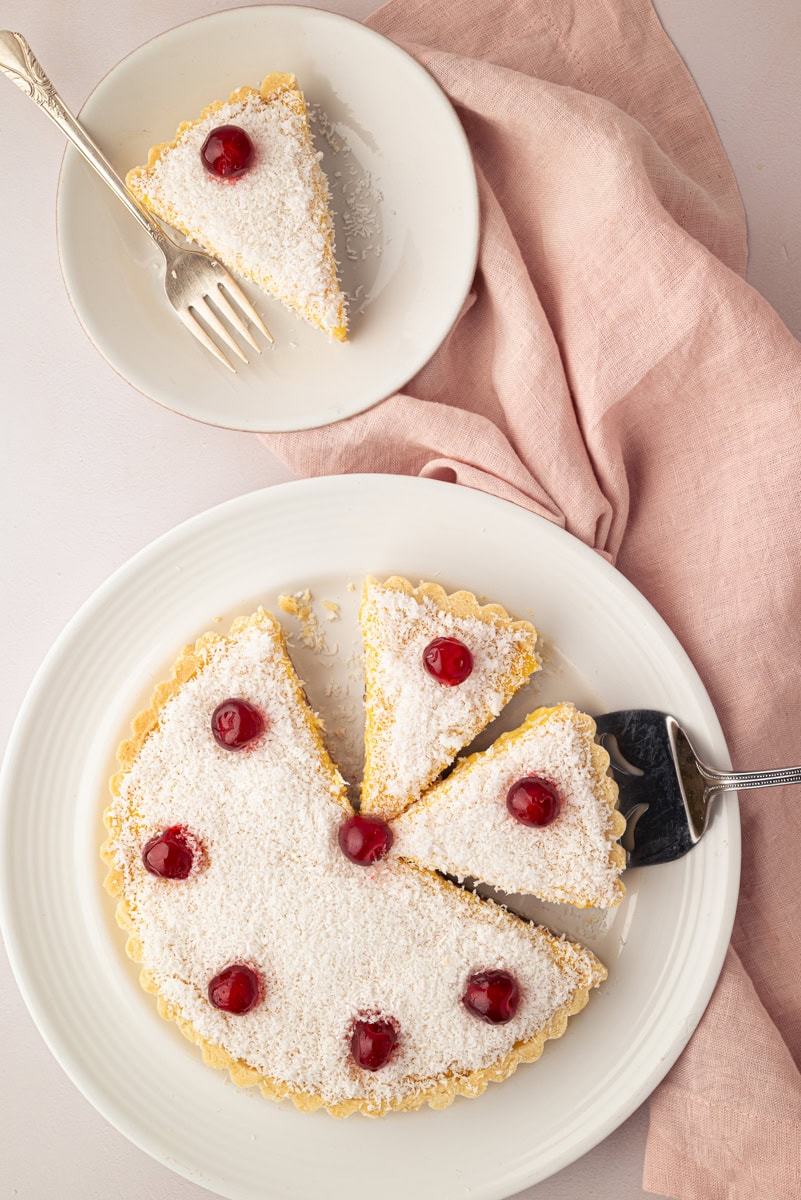
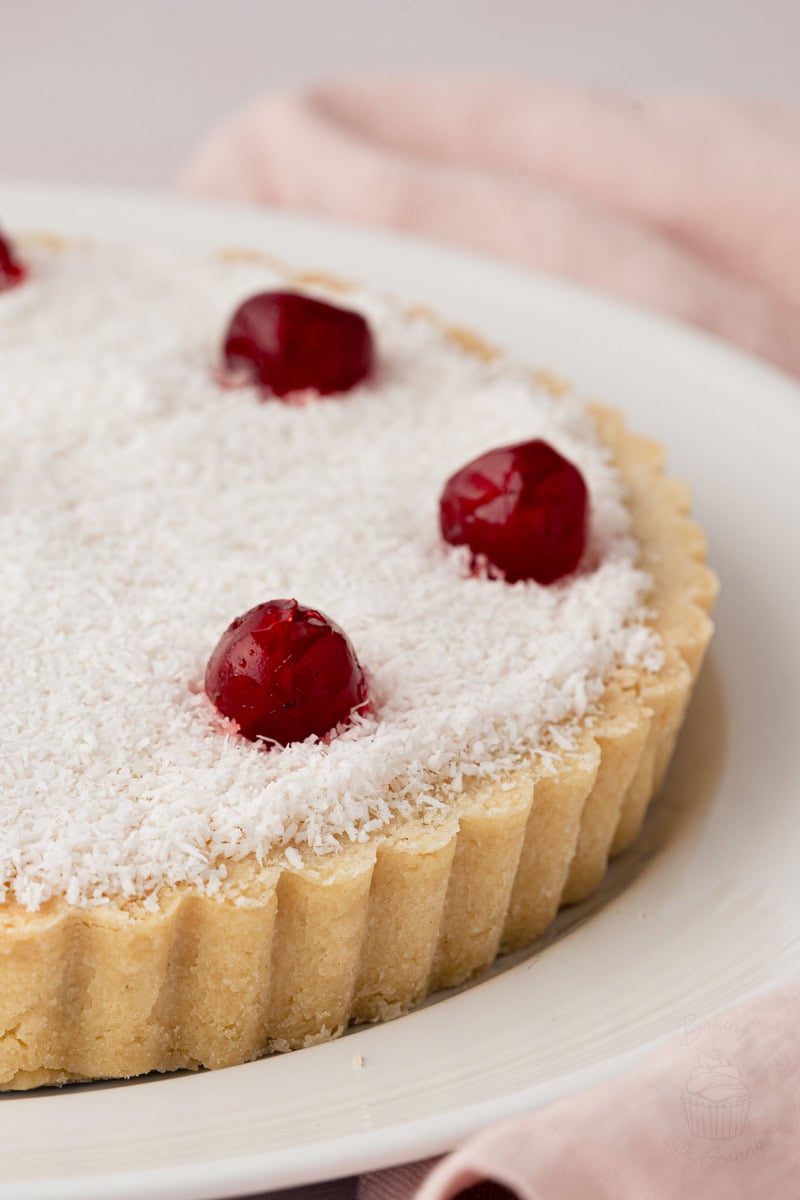
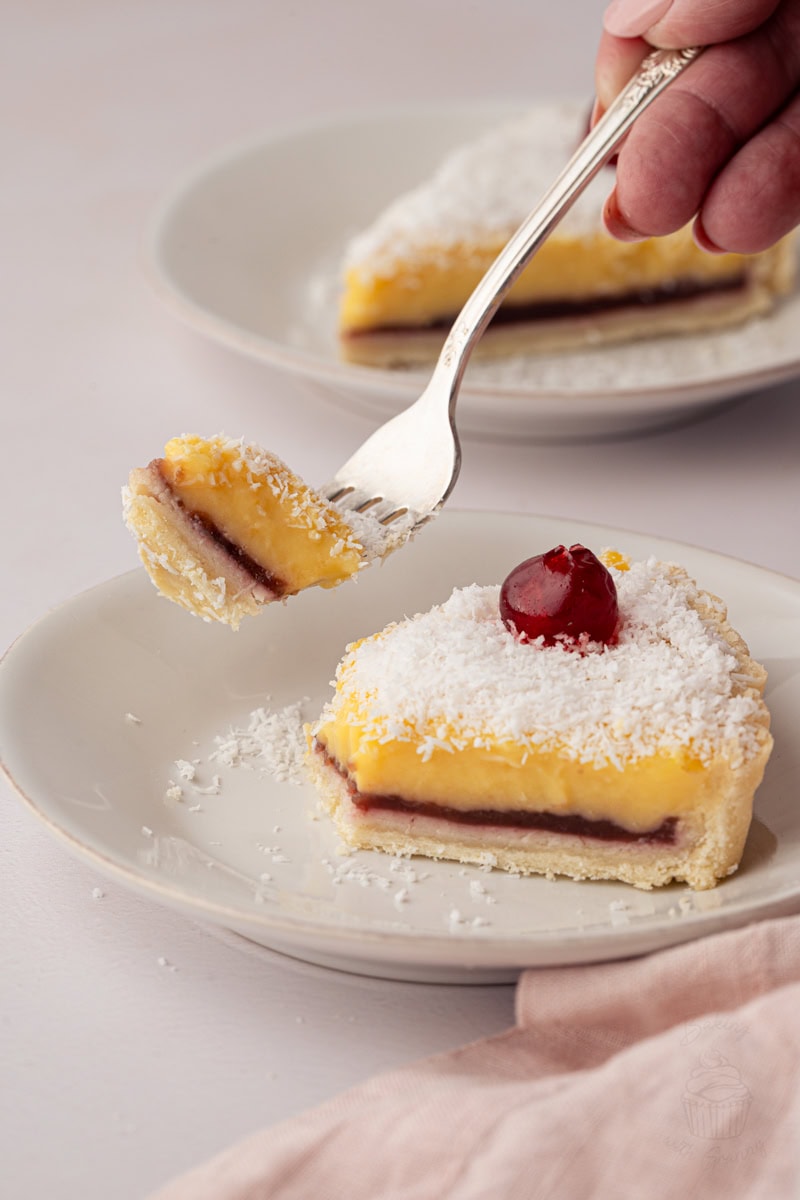
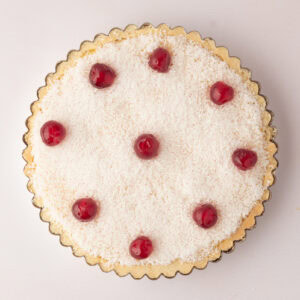
A sweet shortcrust pastry case, with a layer of raspberry jam, thick homemade custard, and a snowy topping of desiccated coconut – all finished with bright red glacé cherries. If you grew up in the UK, there’s a good chance you had it as part of your school dinners, alongside classics like School Cake and Cornflake Tart.
I believe my version stays true to what seems to be the traditional style. With a sweet shortcrust pastry base – homemade is best, and I use the same pastry recipe here as I do in favourites like my Fruit Tart and Bakewell Tart, but shop-bought does work well in a pinch. You want enough raspberry jam to bring a sweet, fruity contrast to the custard, but not so much that it seeps through and overwhelms everything else. The custard should also be thick enough to hold its shape once sliced, which is why I cook mine until it reaches a yoghurt-like consistency before spreading it into the tart case.
And then there’s the coconut. People either absolutely love it or spend years trying to pick it off the top in the school canteen! But it is such an important part of Manchester Tart, adding both some texture and that instantly recognisable snowy topping. The glacé cherries are equally important, too. Traditionally, you’d often see one cherry in the centre, but I prefer adding a ring of cherries around the tart to make sure everybody gets one in their slice.
It’s Easier Than You Think
Although Manchester Tart looks impressive once sliced, it’s actually a very straightforward bake to make at home, especially once you break it down into stages. Most of the time spent making Manchester Tart is actually waiting for it to chill and set properly in the fridge. In fact, I’d always recommend making it the day before you plan to serve it, as the flavour and texture will be even better once fully chilled overnight.
If you too love classic British baking, especially old-school desserts, Manchester Tart is definitely one worth trying – particularly if you’ve never tasted it before 😋
Should you add bananas to a Manchester Tart?
There are some recipes for Manchester Tart that call for sliced banana between the jam and custard. And that definitely seems to divide opinion! Many say Manchester Tart should never have bananas, while others distinctly remember their school’s version always having banana. I haven’t included it in my recipe, but if you are a banana-believer, go ahead and add it in (I can see the appeal, to be honest!).
Free-from & Vegan:
Gluten-free Options:
Rather than trying to adapt the homemade pastry in this recipe, I’d recommend using ready-rolled gluten-free shortcrust pastry or following an intentionally gluten-free shortcrust pastry recipe, like Becky Excell’s gluten-free shortcrust pastry recipe. And for the filling, custard powder is often gluten-free, but I would always recommend checking the individual brand you are using to be safe. Alternatively, you can use cornflour (corn starch) instead of custard powder.
Nut-free Adjustments:
This recipe is naturally nut-free, but always check the labels, particularly on your jam and coconut, to be safe when serving to those with nut allergies.
Dairy-free Swaps:
To make a dairy-free Manchester Tart, simply use a dairy-free block margarine in the pastry, and your favourite milk alternative in the custard filling – I have had success using soya milk, but most milk alternatives should work just fine.
Egg-Free Adaptations:
To make an egg-free Manchester Tart, you would need to use an alternative filling to the traditional egg custard. Addicted to Dates has a great-looking recipe for a Vegan Pastry Cream that, in theory, could work well in place of the egg custard filling. I haven’t tested this, but if you do, please share the results with me!
Vegan Substitutions:
To make a vegan Manchester Tart, you can follow the tips above: swap the butter for a dairy-free margarine in the pastry, and try an alternative filling to the egg custard, like Addicted to Dates Vegan Pastry Cream. Also, check your glacé cherries, as some brands aren’t always vegan-friendly.
Allergy Disclaimer & Resources:
Any advice or suggestions to make recipes “free-from” or vegan are purely suggestions. Please double-check all packaged ingredients individually, taking extra caution when baking for those with allergies or intolerances.
For official guidance on food allergies, please see Food Standards Agency (food.gov.uk) | For more info on coeliac disease, please see Coeliac UK (coeliac.org.uk) | For more info on a vegan diet, please see The Vegan Society (vegansociety.com)
Tips for Manchester Tart:
- Use a Loose-Bottom Tart Tin: A loose-bottom tart tin makes removing the tart much easier and helps keep the pastry edges neat when serving. Just be sure to also grease and lightly flour your tin before adding the pastry.
- Don’t Skip Blind Baking: Blind baking the pastry helps the tart case hold its shape and prevents the base from puffing up while baking. Once the baking beans are removed (careful, they will be hot!), you’ll continue baking until the pastry is fully cooked and a light golden colour.
- Spread the Jam While Warm: Spread the jam into the pastry case while the pastry is still slightly warm. This makes it much easier to spread evenly as it will melt a little bit, and it will then set in place as the pastry cools, making slicing easier too.
- Don’t Bin the Whites: The custard filling calls for egg yolks only, but instead of just binning the egg whites, keep them to make another recipe, like my Meringues and Scottish Japs.
- About the Custard Powder: I use custard powder in my filling, which is a popular ingredient in UK kitchens. It is essentially cornflour with added colouring and vanilla flavouring. It helps give the custard its traditional colour and flavour, but if you can’t get custard powder where you are, you can substitute it with cornflour (corn starch) instead. You may just want to add a little extra vanilla extract if you feel your custard needs a bit more flavour.
- Cook the Custard Properly: Your custard should be quite thick before adding it to the tart case. It should resemble a yoghurt-like consistency and hold its shape on a spoon. If the custard is too thin, your Manchester Tart won’t set properly once chilled, and it will be tricky to slice. Sometimes the custard can take a little time to thicken, but be patient and stick with it!
- Chill Overnight if Possible: Although Manchester Tart will set after a few hours in the fridge, the custard slices much more neatly once fully chilled overnight. So, if possible, make it ahead of time to give yourself plenty of chilling time.
- Banana is Optional: Thin slices of banana layered between the jam and custard are a popular variation in some school dinner versions of Manchester Tart. Totally optional, and not to everyone’s taste, but worth trying if you do enjoy banana.
- Clean Your Knife Between Slices: For the neatest slices, wipe your knife clean between cuts. The custard, jam and coconut can stick to the knife and can quickly build up, meaning less-than-perfect slices.
With thanks to Naomi Seiler for creating these photos.
Manchester Tart FAQs
Manchester Tart is a traditional British dessert made with a sweet shortcrust pastry case, filled with raspberry jam and thick custard, then topped with desiccated coconut and glacé cherries. It originated in Manchester, England, but became especially popular across the UK through school dinners during the 1970s, 80s, and 90s.
Manchester Tart is said to have originated in Manchester, England, where versions of the dessert have been enjoyed since at least the Victorian era. Although it began as a regional bake, it later became popular across Britain, especially in school canteens.
Manchester Tart is made by baking a rich shortcrust pastry case, spreading it with raspberry jam, then filling it with thick homemade custard. The tart is then topped with desiccated coconut and glacé cherries before being chilled until fully set.
This is probably the biggest Manchester Tart debate! There are a few recipes that include sliced banana between the jam and custard, while most others don’t include banana at all. It seems to be a matter of whether you remember the one at your school having banana in it or not! I haven’t included banana in my recipe, but you can absolutely add a layer if that’s what you like.
Manchester Tart is traditionally served chilled. This helps the custard fully set, making the tart much easier to slice neatly.
More Classic British Tarts
If you loved this traditional Manchester Tart, here are some more of my favourite British tart recipes for you to try next:

Save this recipe!
Want to save this recipe for later? Pop your email below and come back to it when you’re ready to bake.
Manchester Tart
INGREDIENTS
For the Pastry:
- 175 g Block Margarine or Butter (at room temperature)
- 65 g Caster Sugar
- 250 g Plain Flour
For the Filling:
- 100 g Raspberry Jam (or strawberry; seedless)
- 400 ml Milk
- 1 tsp Vanilla Extract
- 3 Free-range Egg Yolks (at room temperature; see Egg Size note below)
- 60 g Caster Sugar
- 2 tbsp Custard Powder or Cornflour (Cornstarch) (see Substitution notes below)
- 20-30 g Desiccated Coconut
- Glacé Cherries
EQUIPMENT
INSTRUCTIONS
For the Pastry:
- Preheat your oven to 180°C (160°C for fan-assisted ovens, Gas Mark 4 or 350°F). Lightly grease a 20cm (8 inch) loose-bottom tart tin and dust with flour. Set aside.
- In a large bowl, cream together the caster sugar and butter/margarine until light and fluffy. Add the flour and mix to create a dough – you may need to use your hands.
- Transfer the dough to a floured surface and gently knead until it is smooth. Wrap the pastry in clingfilm and pop it in the fridge to firm up for 30 minutes.
- On a lightly floured surface, roll your pastry dough into a large circle until it is a few centimetres larger than the diameter of your tart tin (around 26-28cm / 10-11 inches). Carefully transfer the pastry dough to your prepared tart tin, taking care not to trap too much air underneath, and gently press it into the sides. Leave a little overhang on the pastry, but trim off any large bits of excess overhang. Prick the bottom of your pastry with a fork, then line it with greaseproof paper and fill it with baking beans.
- Blind bake the pastry for 15 minutes before carefully removing the paper and baking beans (watch out, they will be hot!) and return the tart pastry to the oven to continue baking for a further 5-10 minutes, until it is a light golden colour. Remove from the oven and trim the remaining excess pastry overhang to leave a neat edge on your tart.
- Spread your jam within the pastry when it is still warm, then set aside while you prepare your custard.
For the Filling:
- Add the milk and vanilla to a large saucepan and bring to the boil over a medium heat.
- In a large bowl, beat the egg yolks, caster sugar and custard powder together until well combined.
- Slowly pour the hot milk over the egg mixture, whisking continuously until everything is smooth and combined. Pour the custard mixture back into the saucepan over medium heat, stirring continuously until very thick (think yoghurt in texture) – this may take up to 10 minutes. Remove from the heat and leave to cool slightly.
- Pour the custard over the jam in the pastry, and smooth it into the edges. Sprinkle the top of the custard with coconut and top with glacé cherries – one in the middle is traditional, but I prefer a ring around the edge, so everyone gets a cherry in their slice.
- Leave to set in the fridge for at least 6 hours, or ideally overnight. Remove from the tin before serving, cut into slices.
IMPORTANT NOTE:
All my recipes are developed using a digital scale and the metric system (grams and millilitres). Cup measurements are available as a conversion, but these, unfortunately, won’t always be as accurate. For best results, I always recommend baking with a digital scale.









ABOUT THE AUTHOR
Amy Beth Reid
Amy Beth Reid is an award-winning food blogger, mother, wife and cookbook author. Inspired by her childhood in the kitchen with her Mum – a professional baker and her children’s Granny – Amy now shares her tried-and-tested traditional home baking recipes with bakers of all abilities around the world. She lives in Scotland with her husband, two sons and her small pack of Siberian huskies.