
School Dinner Jam and Coconut Cake
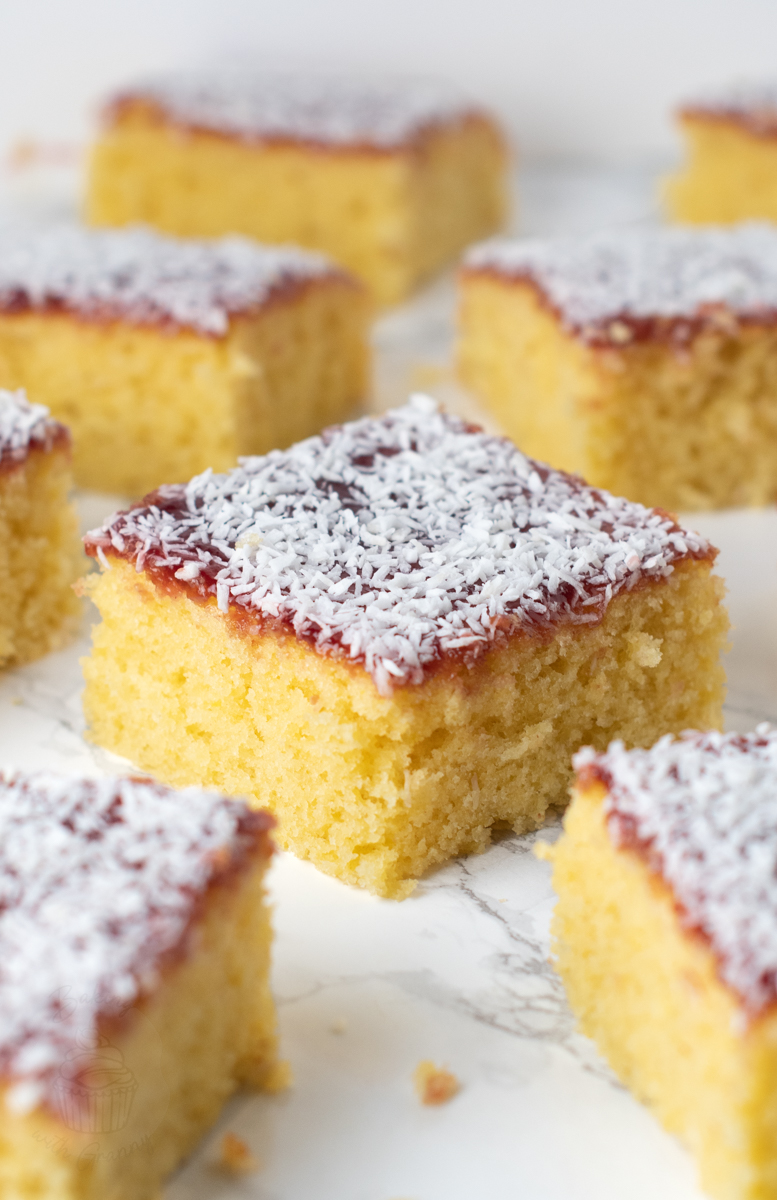
Bring back the magic of school dinner puddings with this traditional Jam and Coconut School Cake. A simple, massive sponge topped with sweet jam and desiccated coconut, this nostalgic recipe is quick to make and even better when served with a generous amount of warm (pink!) custard.
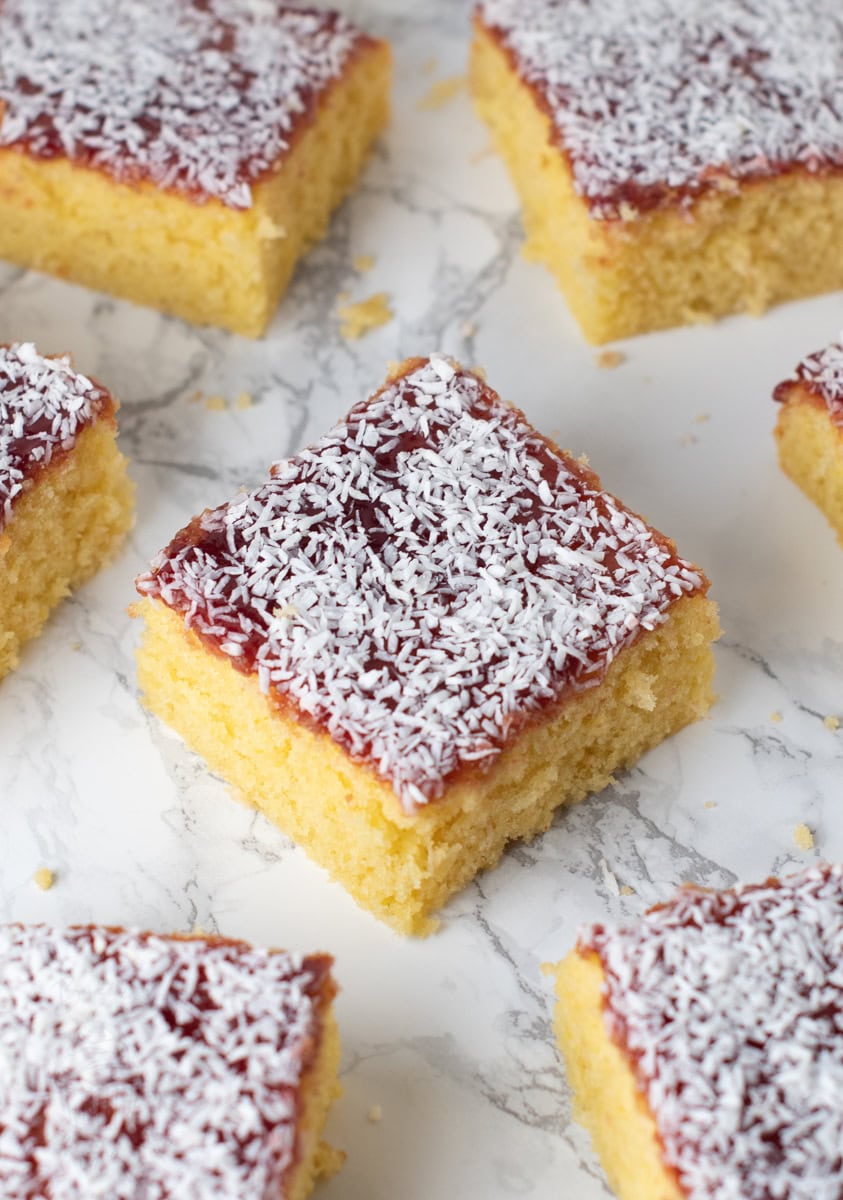
Let’s flash back to summer 2020. Baking with Granny had skyrocketed as everyone stuck at home turned to comforting, nostalgic bakes. While looking for a new recipe to share, I kept thinking back to the one treat I absolutely loved as a child: classic school dinner cake.
Growing up with my Mum baking all day, every day, I wasn’t actually a big fan of home baking. (Too much of a good thing, you could say!)
But the one bake I always looked forward to was the plain sponge topped with white icing and sprinkles, “lovingly” prepared by our school dinner ladies. It’s no wonder that my original School Cake recipe became the all-time favourite here on the blog.
The Nostalgic Jam and Coconut School Cake
I could never have predicted how crazy people would go for that sprinkle cake! But one recurring question I always get is: “Can you do a recipe for the jam and coconut version?” People-pleasing is in my nature—so your wish is my command.
This Jam and Coconut School Cake recipe uses the exact same formula for success as our famous sprinkle version. You get a simple, light, and incredibly fluffy sponge baked in huge quantities, making it the perfect retro tray cake for a crowd.
Instead of white water icing and rainbow sprinkles, this variation opts for smooth, seedless raspberry jam and a generous coating of desiccated coconut. It’s a different flavour combination, but one that works oh-so-well.
How to Serve Retro School Dinner Cake
When it comes to serving, custard is optional – but highly recommended.
Personally, I think this jam and coconut version is even better suited for a total drowning in warm custard than the sprinkle version. It’s entirely your choice whether you serve it plain, or if you opt for the ultimate school canteen throwback: pink custard!
Looking for more nostalgic British school dinner desserts? If you love the combination of sweet jam and desiccated coconut, you should also try my traditional Manchester Tart recipe or my classic Jam Roly Poly recipe.
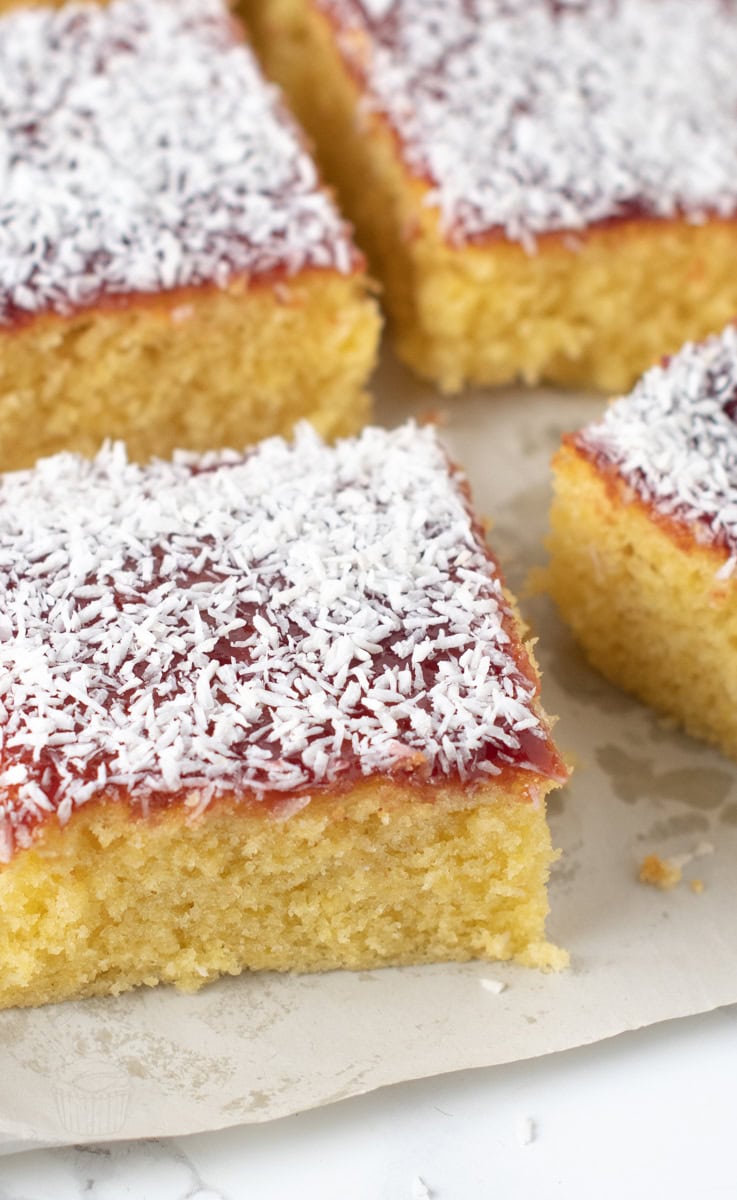
Tips for Jam & Coconut School Cake:
• Make the Sponge Ahead of Time: Bake your sponge the night before you require it. Leave it in the greaseproof paper, on a wire rack, then place it in an airtight bag once cool. Decorate with the icing and sprinkles in the morning. This will give your cake a better texture overall – trust me!
• Use a Soft Margarine: Sponge cakes are one of the few recipes that you can not only get away with using a soft margarine in, but are actually better when you do. A soft margarine creates a softer, lighter and more predictable sponge cake. Stork is, of course, the classic and obvious choice.
• Tap the Tin Before Baking: Once your cake batter is in the tin, gently drop the tin onto your kitchen counter a couple of times before putting it in the oven. This pops any hidden large air pockets and settles the batter completely level, ensuring an even rise.
• Don’t Stress While Spreading: Don’t be too concerned if your jam starts to pull crumbs along while spreading. By the time you add your coconut, no one will even notice.
• Quick with the Coconut: Scatter your coconut over the jam immediately after spreading it, while the jam is still warm and tacky. If you wait too long and the jam cools down completely, the coconut will just slide around on top instead of sticking to the cake.
• Clean Your Knife Between Cuts: For the neatest School Cake slices, wipe your knife between cuts. This helps each slice look absolutely perfect and irresistible!
Save this recipe!
Want to save this recipe for later? Pop your email below and come back to it when you’re ready to bake.
Jam and Coconut School Cake
INGREDIENTS
- 280 g Soft Margarine (at room temperature)
- 280 g Caster Sugar (Superfine Sugar)
- 5 Free-range Eggs (at room temperature – see notes below)
- 280 g Self-raising Flour
- 300 g Seedless Jam (Seedless Jelly)
- 100 g Desiccated Coconut (Shredded Coconut)
EQUIPMENT
INSTRUCTIONS
- Preheat your oven to 180°c (160°c for fan-assisted ovens, Gas Mark 4 or 350°F) and a line 20x30cm (12×9-inch) baking tin with greaseproof paper. Set aside.
- In a large bowl, cream together the margarine and sugar until light and fluffy.
- Add the eggs one at a time, ensuring each is mixed through before adding the next. If the mixture appears to curdle, simply add a spoonful of your flour to bring it back together.
- Sift in the flour and gently fold to create a batter.
- Transfer the batter to your pre-lined tin and bake in your preheated oven for 30-40 minutes until risen, golden, and a skewer inserted comes out clean.
- Leave to cool in the tin for a short while before transferring to a wire rack to cool completely.
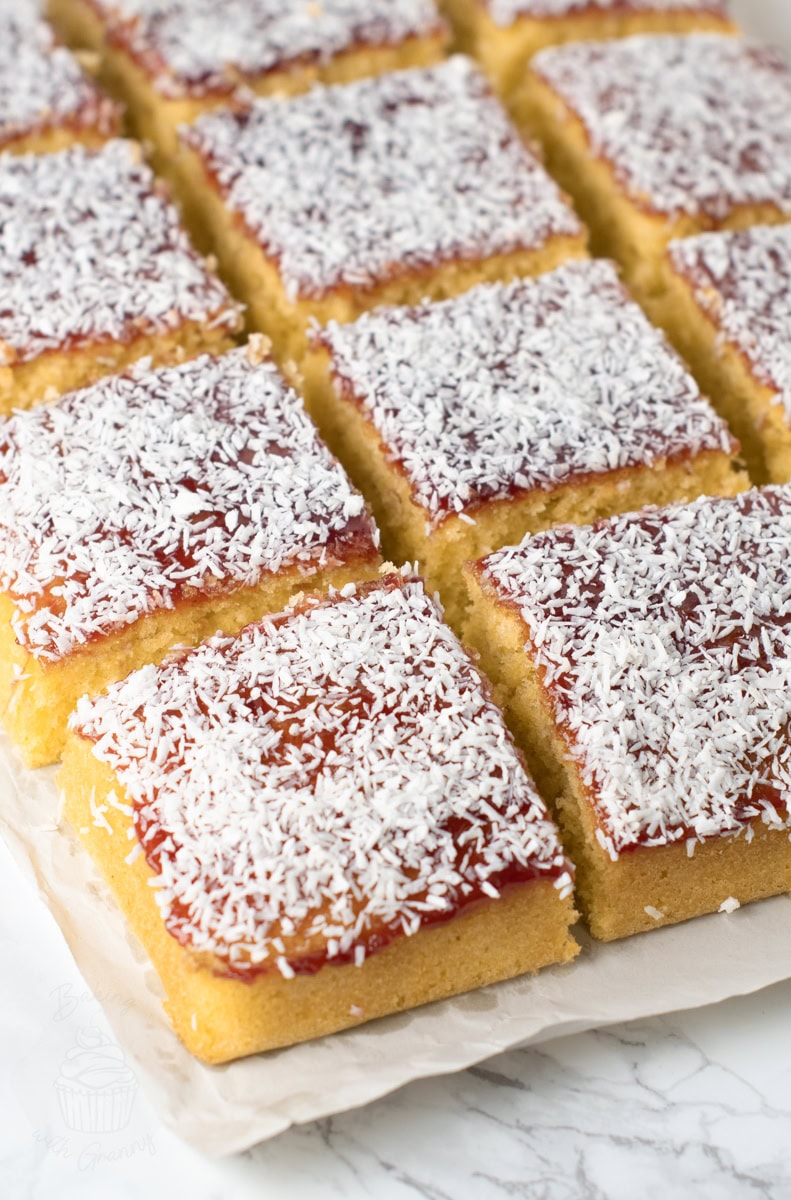
- Once your cake has cooled completely, warm your jam for about 20 seconds in a microwave (this isn't essential, but it does make it easier to spread). Spread your jam over the top of your cake, making sure to get right into the corners and edges. Sprinkle your coconut over the top of your jam to finish.
IMPORTANT NOTE:
All my recipes are developed using a digital scale and the metric system (grams and millilitres). Cup measurements are available as a conversion but these, unfortunately, won’t always be as accurate. For best results, I always recommend baking with a digital scale.
NOTES
Egg Size:
When it comes to eggs, I always buy the Mixed-weight Free-range Eggs. Generally speaking, egg size doesn’t make a huge difference in most baking, unless you are using sizes that lean into the extremes. But with that in mind, medium-sized eggs are probably the best option if you are unsure what size eggs to use.Substitutions:
- Margarine: I use a soft baking margarine in most of my sponge cakes because I find it to be easier & more predictable to use, while always giving a light, moist crumb to your cake. You can swap this out for butter if you prefer, but make sure you use a very soft butter for the best results.
- Caster Sugar: When it comes to sponge cakes, caster sugar is preferable as the finer consistency is ideal for mixing through the batter. In a pinch, you could swap it for granulated sugar. In terms of taste, it would be fine, but the texture of your sponge may vary slightly because less-fine sugars won’t dissolve into the batter as efficiently.
- Self-raising Flour: Although easy to buy in the UK, self-raising flour isn’t always available across the world, but you can easily create your own. For this recipe, you would use 280g of Plain Flour and 3.5 tsp of Baking Powder (baking soda). I always recommend both mixing and sifting the flour & baking powder together before using to make sure they are very well combined.
- Jam: I like to use a seedless raspberry jam (jelly), but you could use any flavour of jam that you prefer. I would recommend sticking with a seedless jam, though, for the best texture overall.
Storage:
Store your old School Cake in an airtight container at room temperature. It’ll keep well for up to 4-5 days, if it lasts that long!Freezing:
You can freeze the sponge, but this is best done before adding the jam and coconut. Wrap the cake tightly in cling film and foil, and freeze for up to 3 months. Defrost at room temperature, then finish with the jam and coconut before serving.Serving:
For full school-dinner nostalgia, serve with a drizzle of custard (pink or otherwise!).Tried this recipe?
Tag @bakingwithgranny or use the hashtag #bakingwithgranny!Frequently Asked Questions:
To make Jam and Coconut School Cake, you start by baking a simple sponge cake with self-raising flour, sugar, eggs, and margarine. Once cooled, you spread seedless jam (strawberry or raspberry, whatever you prefer) over the top of the cake and sprinkle with desiccated coconut. Finally, you slice it into squares and serve it just like at school dinners!
You absolutely can. I always prefer to use a soft margarine in sponge cakes as it makes them lighter in texture and more predictable in terms of baking. But if you prefer to use butter, you can swap the margarine for that, like-for-like. Just be sure to use butter that is softened.
Yes! You can absolutely use plain flour in place of self-raising flour in a school cake, but you will need to add the raising agents that you would usually find in self-raising flour. The general rule of thumb is to add 2 teaspoons of baking powder for every 150g of plain flour. So, in this recipe, you would use 3½ teaspoons of baking powder as there is 280g of flour.
Because this recipe makes a massive tray cake, it uses 5 large eggs. If you add them too quickly, the batter can split or curdle. To fix this, simply add a tablespoon of your weighed-out self-raising flour along with each egg to help the mixture bind back together.
Both my classic school cake recipes are written for a 20x30cm (12×9-inch) baking tin. You can use something slightly different, but keep an eye on the baking time, as it may vary. Alternatively, if you want to scale up/down the recipe for a different-sized tin, this school cake sponge recipe is very versatile – but again, you may need to adjust your baking time.
The secret to a perfect, clean jam layer is a cool cake and warm jam. Let your school cake cool completely before adding the topping. Then pop your seedless jam into the microwave for around 20 seconds just to loosen it up. This makes it much easier to glide over the sponge without tearing the delicate crumb.
Stored in an airtight container at room temperature, this cake will stay beautifully soft and moist for up to 4 days. Because of the jam layer, there’s no need to refrigerate it, as the fridge can actually dry the sponge out faster.
You can, but I would always recommend freezing it before you add the jam and coconut. This is because when it comes to defrosting the cake, the jam will melt into the sponge and you won’t have the same taste, texture or appearance. Instead, if you want to freeze it, wrap it tightly in cling film and foil before adding the jam and coconut. It will keep for up to 3 months in the freezer and defrost at room temperature before adding the jam and coconut.
Free-from & Vegan:
Gluten-free: To make this a gluten-free school cake, substitute the flour with a high-quality gluten-free self-raising flour blend. Adding ¼ tsp of xanthan gum can help the texture, especially if your blend doesn’t already include it.
Dairy-free: To make this a dairy-free school cake recipe, simply ensure your margarine is dairy-free.
Egg-free: You could experiment with egg replacers, such as aquafaba or flaxseed-egg, in this school dinner cake recipe. However, I haven’t tried this myself, so I can’t say for sure which option will work best.
N.B. Any advice or suggestions to make recipes “free-from” or vegan are purely that – suggestions. Please be careful to double-check all ingredients individually, taking extra caution when serving to those with allergies & intolerances.
For more info on common food allergies, please see food.gov.uk | For more info on coeliac disease, please see coeliac.org.uk | For more info on a vegan diet, please see vegansociety.com


What a treat ! Thank you.