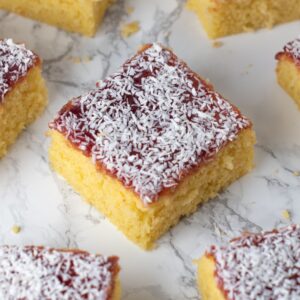
Jam and Coconut School Cake
An old-school British jam and coconut sponge made with a light, plain tray-baked sponge, topped with raspberry jam and desiccated coconut. Just like the classic school dinner cake, the coconut goes on top rather than into the sponge – perfect served with custard (pink or otherwise!).
PRINT RECIPE
Servings: 12 slices
INGREDIENTS
- 280 g Soft Margarine (or Butter) (at room temperature)
- 280 g Caster Sugar
- 5 Free-range Eggs (at room temperature; see Egg Size note below)
- 280 g Self-raising Flour (see Self-raising Flour note below)
- 300 g Seedless Jam (raspberry or strawberry)
- 100 g Desiccated Coconut
EQUIPMENT
INSTRUCTIONS
- Preheat your oven to 180°C (160°C for fan-assisted ovens, Gas Mark 4 or 350°F) and line a 23×30cm (12×9-inch) baking tin with greaseproof paper. Set aside.
- In a large bowl, cream together the margarine and sugar until light and fluffy in both colour and texture.
- Add the eggs one at a time, ensuring each is mixed through before adding the next. If the mixture appears to curdle, simply add a spoonful of your flour to bring it back together.
- Sift in the flour and gently fold until just combined, creating a batter. Do not overmix!
- Transfer the batter to your pre-lined tin, spreading it right into the edges and corners. Bake in your preheated oven for 30-40 minutes, until risen, golden, and a skewer inserted comes out clean.
- Leave to cool in the tin for a short while before transferring to a wire cooling rack to cool completely.
- Once your cake has cooled completely, warm your jam for about 20 seconds in a microwave (this isn't essential, but it does make it easier to spread). Spread your jam over the top of your cake, making sure to get right into the corners and edges. Sprinkle your coconut over the top of your jam to finish.
Start checking your sponge cake from around 30 minutes, as ovens can vary.
IMPORTANT NOTE:
All my recipes are developed using a digital scale and the metric system (grams and millilitres). Cup measurements are available as a conversion, but these, unfortunately, won't always be as accurate. For best results, I always recommend baking with a digital scale.
RECIPE NOTES:
Egg Size: When it comes to eggs, I always buy mixed-weight free-range eggs. Generally speaking, egg size doesn't make a huge difference in most baking, unless you are using sizes that lean towards the extremes. If you're unsure which eggs to use, I recommend medium eggs in the UK, which are roughly equivalent to large eggs in the US. That's what this recipe has been tested with.
Self-raising Flour: Don't have self-raising flour? For this recipe, simply whisk together 280g (2 cups plus 1 tablespoon) plain flour and 3¾ teaspoons baking powder instead. If you bake regularly, you can also make a larger batch to keep in your baking cupboard. For full instructions, cup conversions and answers to common questions, see my Self-raising Flour Ingredient Guide.
LIKE THIS RECIPE?
Leave a comment and rating below!