
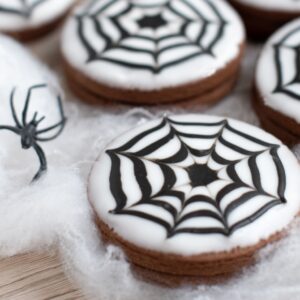
Spider Web Biscuits are a spooky twist on a classic Scottish Empire Biscuit. Chocolate biscuits sandwiched with chocolate spread, topped with simple icing and finished with black spider webs – and the decoration is much easier than it looks. All you need is a piping bag and a cocktail stick!

Spider Web Biscuits Recipe Snapshot
- Recipe: Spider Web Biscuits – chocolate Empire Biscuits decorated with simple black-and-white spider webs.
- Makes: 9 sandwiched biscuits.
- Prep Time: Around 15 minutes, plus decorating.
- Baking Time: 10-15 minutes, depending on biscuit size.
- Filling: Chocolate spread (Nutella), Biscoff spread, or cherry jam.
- Texture: Crumbly chocolate biscuits with a sweet iced topping.
- Decoration: White icing finished with black spider-web designs.
- Difficulty: A straightforward cut-out biscuit recipe with easy Halloween decorating.
- The Trick: Pipe circles of black icing over the white icing, then drag a cocktail stick from the centre outwards to create the spider-web effect.
Summarise & Save this Recipe on:
What Are Spider Web Biscuits?
Spider Web Biscuits are a Halloween twist on classic Scottish Empire Biscuits. They’re made with chocolate biscuit dough, sandwiched together with chocolate spread, then topped with white icing and decorated with black spider-web designs.
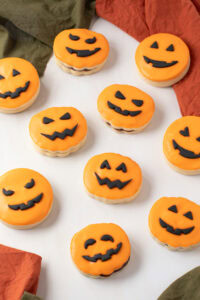
Here in the UK, we’d usually call these Spider Web Biscuits, though you may also see similar bakes described as Spider Web Cookies or Halloween Cookies. Unlike a lot of decorated sugar cookies, these biscuits use a simple icing rather than royal icing, just like my Pumpkin Empire Biscuits. And the spider web design is made by piping circles onto the wet icing, then dragging a cocktail stick from the centre outwards.
The Story Behind These Spider Web Biscuits
If I’m honest, these Spider Web Biscuits were a bit of an afterthought for me. I’m not particularly big on Halloween. Shocking, I know. But being a goth/emo at heart, every day is Halloween in our house! I literally wait all year for the spooky home decor to hit the shops so I can then use it for our everyday homeware 👻
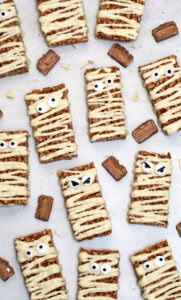
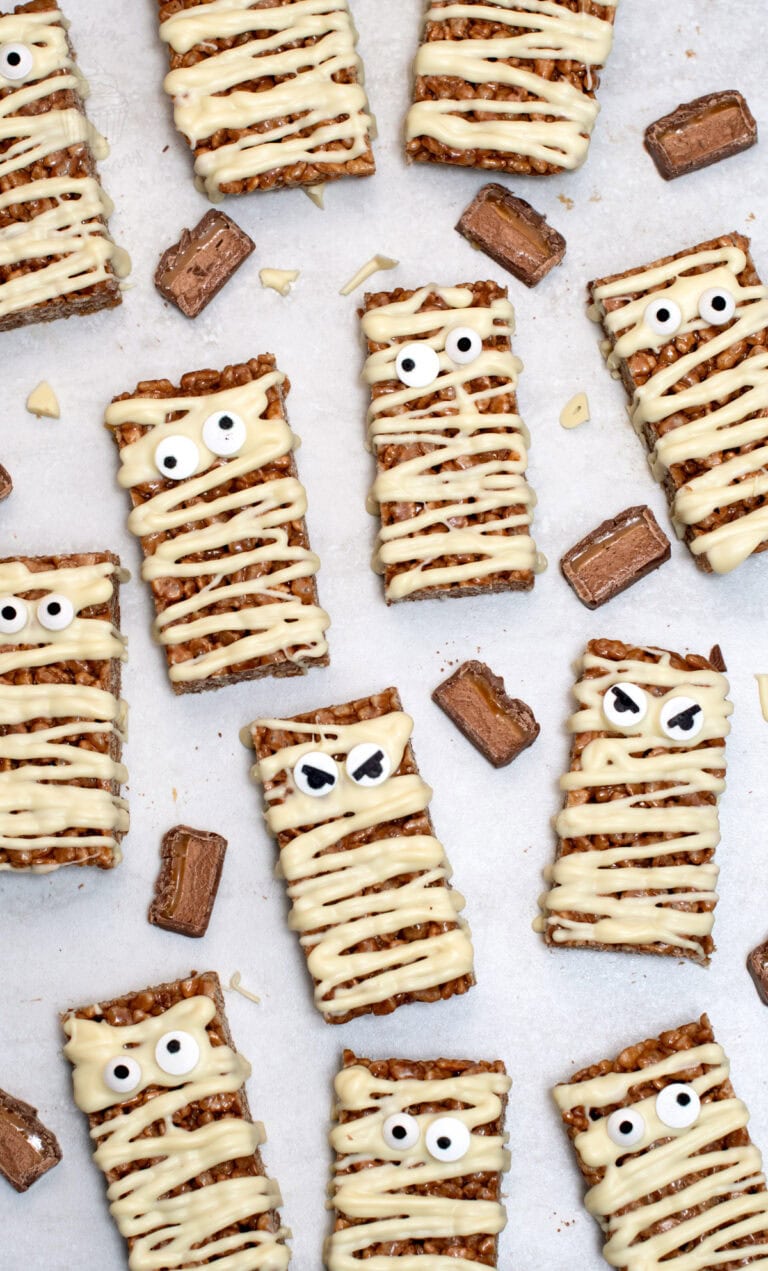
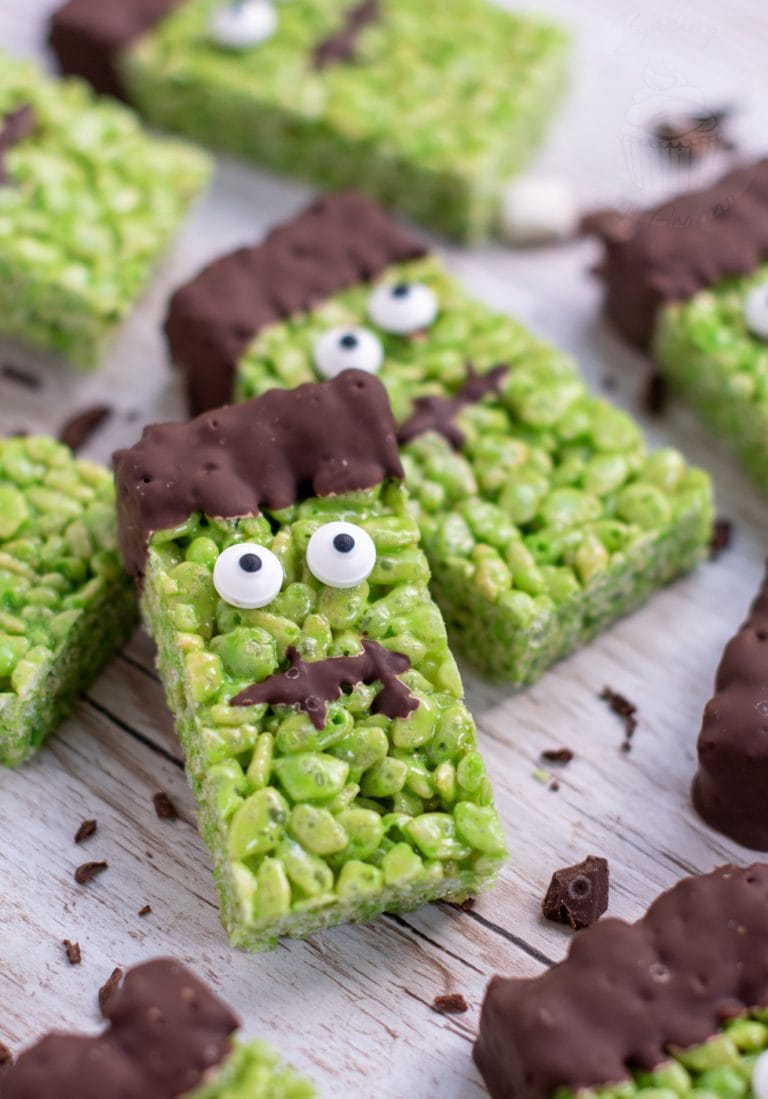
But the kids asked if I would bake them something spooky, so I wanted to make something that was simple but guaranteed to please my toughest critics – not an easy task when they already love my Monster Rice Krispies Squares, Pumpkin Empire Biscuits and Mummy Mars Bar Slices.
I based them on my tried-and-tested Empire Biscuits, adding cocoa powder to the dough, chocolate spread in the middle and a simple spider-web decoration on top. The finished biscuits are fun without requiring any expert decorating skills, making them another perfect Halloween baking recipe for getting the kids involved.

Key Ingredients
These Spider Web Biscuits use the same basic dough as my traditional Empire Biscuits, with cocoa powder added for a chocolate flavour and simple icing for the spider-web decoration.
See the recipe card for a full ingredients list, required quantities and cup conversions.
Substitutions & Additions
Cocoa Powder: If you prefer more traditional Empire Biscuits, you can omit the cocoa powder and replace it with the same quantity of plain flour.
Chocolate Spread: Chocolate spread is my favourite filling, with Nutella being the obvious option, giving the biscuits a lovely chocolatey filling.
Biscoff: I’ve also tested these Spider Web Biscuits with Biscoff spread, which works well if you prefer its caramelised biscuit flavour.
Jam: You can use jam instead of chocolate spread or Biscoff. This is more in line with the traditional filling used in Empire Biscuits, with cherry jam being my recommendation, giving them more of a Black Forest flavour against the chocolate biscuits.
Looking for dairy-free, gluten-free or vegan adaptations? See the Free-from & Vegan section below.
Free-from & Vegan
Amy recommends: If you regularly need to adapt baking recipes for gluten-free, dairy-free, egg-free or vegan diets, I highly recommend The Elements of Baking by Katarina Cermelj, creator of The Loopy Whisk. It’s a brilliant resource for understanding how substitutions work, rather than simply swapping ingredients and hoping for the best.
Gluten-free Options:
To make gluten-free Spider Web Biscuits, simply swap the plain flour for gluten-free plain flour. Some gluten-free flours can be a little drier, so you may want to use a little less flour or increase the amount of margarine/butter slightly if your dough is struggling to come together. Be sure to check all your individual ingredients, including the filling and icing, for allergens when serving to those with coeliac disease.
Nut-free Adjustments:
The biscuit dough itself contains no nuts, but be mindful when choosing your filling if serving to those with nut allergies. There are some good nut-free chocolate spreads, or simply use Biscoff spread or cherry jam instead.
Dairy-free Swaps:
To make these dairy-free Spider Web Biscuits, use your favourite dairy-free block margarine instead of butter. You’ll also need to choose a suitable dairy-free filling, as some chocolate spreads do contain milk. Plant-based hazelnut chocolate spreads are also a good option.
Egg-Free Adaptations:
To make this an egg-free Spider Web Biscuits recipe, you can leave out the egg and add a tablespoon of water to the dough mixture. The biscuits won’t be quite as rich in flavour, but they will still turn out perfectly well.
Vegan Substitutions:
To make vegan Spider Web Biscuits, simply follow the dairy-free and egg-free suggestions above. Use a vegan block margarine, replace the egg with a tablespoon of water, and choose a vegan filling – either a suitable vegan chocolate spread, Biscoff spread or cherry jam.
Allergy Disclaimer & Resources:
Any advice or suggestions to make recipes “free-from” or vegan are purely suggestions. Please double-check all packaged ingredients individually, taking extra caution when baking for those with allergies or intolerances.
For official guidance on food allergies, please see Food Standards Agency (food.gov.uk) | For more info on coeliac disease, please see Coeliac UK (coeliac.org.uk) | For more info on a vegan diet, please see The Vegan Society (vegansociety.com)
How to Make Spider Web Biscuits
Spider Web Biscuits use an easy-to-make chocolate biscuit dough and very simple decoration, making them a fun Halloween bake for getting the kids involved. Follow the step-by-step below, or head to the recipe card at the bottom for the full printable recipe.
- Prepare the trays. Preheat your oven to 180°C (160°C fan, Gas Mark 4 or 350°F). Line a couple of baking trays with greaseproof paper and set aside.
- Make the dough. In a large bowl, cream the margarine/butter and sugar until light and fluffy in both colour and texture. Add the egg and mix until combined. Sift in the flour and cocoa powder, and mix to form a fairly stiff dough – you may need to use your hands.
- Roll and cut the biscuits. Gently knead the dough, then roll it to around 5mm (¼ inch) thick. Use a circular-shaped cutter (around 7.5cm / 3 inches is ideal) to cut out your biscuits, then transfer them to the prepared baking trays.
- Bake the biscuits. Bake for about 12-15 minutes, until the tops appear dry.
- Fill the biscuits. While the biscuits are still warm, spread around a teaspoon of chocolate spread onto the underside of half of them. Place the remaining biscuits on top and gently press together. Leave to cool completely before decorating.
- Decorate the Spider Web Biscuits. Mix the icing sugar with a few teaspoonfuls of hot water until it’s a slightly runny but gloopy consistency. Remove a couple of tablespoons of the white icing and mix with black food colouring, then transfer it to a piping bag. Dip the tops of the biscuits into the white icing, then pipe circles of black icing over the top, finishing with a dot in the centre. Use a cocktail stick to drag lines from the middle outwards, through the circles and towards the edge of the biscuit. Leave the icing to set for at least 2 hours before serving.
Top Tips for Spider Web Biscuits
- The Dough Starts Crumbly: Don’t panic if the dough doesn’t come together, especially after adding the flour and cocoa powder. Once you get your hands into the mixture, the heat from your fingers will help bring the margarine/butter and flour together – just keep at it! Trust me.
- Roll Between Greaseproof Paper: Rolling the dough between two sheets of greaseproof (parchment) paper means you don’t need to add extra flour, which can end up leaving the chocolatey biscuits looking dusty after baking.
- Choose the Right Cutter: A 7.5cm (3-inch) cutter will give you around 18 individual biscuits, which become 9 once sandwiched together. Smaller biscuits are fine, but the spider-web decoration can be trickier to pipe onto them.
- Sandwich While Warm: Fill the biscuits while they are still warm. This helps the chocolate spread grip the biscuits together as they cool.
- Use Hot or Boiling Water for the Icing: Mixing icing sugar with hot water helps create a smooth, slightly glossy icing. Add the water gradually until you have a thick but gloopy consistency.
- The “Dip Technique” for Neat Icing: For the best finish, make your icing a thick, “gloopy” consistency. Hold the biscuit with your fingertips and gently dip the top into the surface of the icing. Slowly lift it back out, allowing the excess to drip off, before flipping it upright again. This is the same technique I use for my traditional Empire Biscuits and my Pumpkin Empire Biscuits. And as long as your icing isn’t too runny, it shouldn’t run off the edges and give you a lovely, neat finish.
- Make the Icing Black: For a deep black icing, mix a little cocoa powder into the portion you are using for the spider webs before adding the black food colouring. It is much easier to turn a brown icing black than a white icing (although you can use black food colouring on its own if you prefer). Even gel food colouring can require quite a lot to achieve a deep black.
- Don’t Worry About Perfect Webs: You’re not actually piping spider webs. Pipe a few circles on top of the wet white icing, add a dot in the centre, then use a cocktail stick to drag lines from the middle outwards. Each biscuit will look slightly different, which is all part of the fun!
Storage, Freezing & Make Ahead
- Storage: Once decorated and set, store your Spider Web Biscuits in an airtight container. They will keep well for 3-5 days.
- Make Ahead: If you want to prepare the dough ahead of time, wrap it in cling film (plastic wrap) and chill it until you’re ready to roll and cut it. You may also need to chill the dough for around 30 minutes if your kitchen is particularly warm.
- Freezing: I prefer to freeze the unbaked dough, but you can also freeze the baked biscuits before decorating. I wouldn’t recommend freezing the finished biscuits once they have been iced and decorated, as the icing will likely soften and begin to dissolve as they thaw.

Spider Web Biscuits FAQs
Yes. For plain Empire Biscuits, simply omit the cocoa powder and replace it with the same quantity of plain flour. You can also leave out the chocolate spread and make them as individual biscuits rather than sandwiching them together. This will give you 18 biscuits instead of 9 sandwiched biscuits, so you may need to make a little extra icing to decorate them all.
No, chilling isn’t usually necessary. However, if your kitchen is particularly warm and the dough feels too soft to roll, wrap it in cling film and chill it for around 30 minutes. You can also chill the dough if you want to prepare it ahead of time.
No. These Spider Web Biscuits use a simple water icing made with icing sugar and hot water, so there’s no need to make royal icing. The icing should be slightly runny but gloopy, allowing you to dip the biscuits and create a smooth topping for the spider webs.
For a deep black icing, mix a little cocoa powder into the portion of icing you’re using for the spider webs before adding black food colouring. It is much easier to turn a brown icing black than a white icing! You can use black food colouring on its own, but you may need quite a lot to achieve a deep colour, even with gel food colouring.
Dip the tops of the sandwiched biscuits into the white icing, then pipe a few circles of black icing over the top, finishing with a dot in the centre. While the icing is still wet, use a cocktail stick to drag lines from the middle outwards through the circles and towards the edge of the biscuit.
More Halloween Baking
If you loved these Halloween Spider Web Biscuits, here are some more of my favourite Halloween baking recipes for you to try next:


Save this recipe!
Want to save this recipe for later? Pop your email below and come back to it when you’re ready to bake.
Spider Web Biscuits
INGREDIENTS
- 250 g Block Margarine or Butter (at room temperature)
- 130 g Caster Sugar
- 1 Free-range Egg (beaten; at room temperature; see Egg Size note below)
- 450 g Plain Flour
- 50 g Cocoa Powder
- 9 tsp Chocolate Spread (such as Nutella)
For the Decoration
- 300 g Icing Sugar
- Boiling Water (a few teaspoonfuls)
- Black Food Colouring (gel food colouring preferable)
EQUIPMENT
- Cocktail Stick (Toothpick)
INSTRUCTIONS
- Preheat your oven to 180°C (160°C for a fan-assisted oven, Gas Mark 4 or 350°F) and line a couple of
baking trays withgreaseproof paper . Set aside. - In a large bowl, cream together your butter/margarine and sugar until light and fluffy in both colour and texture. Add the egg and mix until combined.
- Sift the flour and cocoa powder into the mixture and mix to form a somewhat stiff dough – you may need to use your hands to bring it together.
- Gently knead the dough on a work surface before rolling it to around 5mm (¼ inch) between two sheets of
greaseproof paper . Using a circular-shaped cutter, cut your biscuits and transfer them to your preparedbaking trays . - Bake your biscuits in your preheated oven for 12-15 minutes, until they appear dry on top.
- When still warm but cool enough to touch, add a teaspoon of the chocolate spread to the underside of half your biscuits, then top with the other half to sandwich them together. Leave to cool completely on a wire cooling rack before decorating.
For the Decoration
- In a small bowl, add the
icing sugar and gradually add small amounts of boiling water until you have a thick, somewhat still-pourable consistency – "gloopy" is a great way to describe it! Remove a couple of tablespoons of your icing into a separate bowl, and mix with your black food colouring. Transfer the black icing to a piping bag and set aside. - Carefully dip the tops of your biscuits into the icing to coat, allowing any excess to drip off before flipping upright again. (Alternatively, you can spread the icing on top, but this won't allow as even a finish.)
- While the icing is still wet, pipe a few circles with the black icing on top of your white icing, finishing with a decent-sized dot in the centre. With a
cocktail stick , drag around half a dozen straight lines from the middle dot, through the circles to the biscuit edge. This will make your spider web design. Allow them to set for a couple of hours before enjoying!
IMPORTANT NOTE:
All my recipes are developed using a digital scale and the metric system (grams and millilitres). Cup measurements are available as a conversion, but these, unfortunately, won’t always be as accurate. For best results, I always recommend baking with a digital scale.
RECIPE NOTES:
LIKE THIS RECIPE?
Leave a comment and rating below!Originally published in October 2022.










ABOUT THE AUTHOR
Amy Beth Reid
Amy Beth Reid is an award-winning food blogger, mother, wife and cookbook author. Inspired by her childhood in the kitchen with her Mum – a professional baker and her children’s Granny – Amy now shares her tried-and-tested traditional home baking recipes with bakers of all abilities around the world. She lives in Scotland with her husband, two sons and her small pack of Siberian huskies.