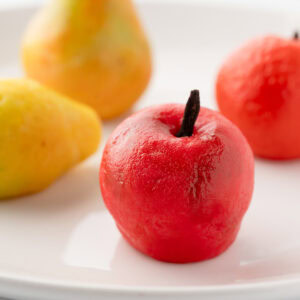
Marzipan Fruits
Make your own traditional Marzipan Fruits using shop-bought marzipan, food colouring and a few simple decorating techniques. Step-by-step instructions for making miniature apples, oranges, pears and lemons, with some optional finishing details to make them look even more realistic.
PRINT RECIPE
Servings: 18 marzipan fruits
INGREDIENTS
- 200 g Marzipan
- Food Colouring (gel food colouring preferable; yellow, red, green, orange...)
- Whole Cloves (for stalk decorations)
INSTRUCTIONS
Preparing and Colouring the Marzipan
- Take a small amount of marzipan and add a little food colouring. Knead it until the colour is evenly distributed, gradually adding more colouring until you reach the desired shade.
- Repeat with the remaining marzipan, preparing whichever colours you need for your chosen fruits.
If the marzipan becomes too sticky, leave it to rest for a few minutes before continuing.
Making Marzipan Apples
- Roll a piece of red or green marzipan into a ball, shaping it slightly to resemble an apple. Gently make a small indentation at the top, where the stalk will go.
Making Marzipan Oranges
- Roll a piece of orange marzipan into a ball, then gently roll it over the spiky, star-shaped side of a box grater to create the dimpled texture of orange peel.
Making Marzipan Pears
- Shape a piece of green or yellow marzipan into an egg-like shape, keeping one end wider and the other narrower to resemble a pear.
Making Marzipan Lemons
- Roll a piece of yellow marzipan into an oblong shape, gently shaping the ends to resemble a lemon.
Adding the Finishing Details
- If you want to make your fruits look more realistic, use a soft, fluffy brush to apply a little edible powdered food colouring, adding extra shading and detail.
- For apples, pears and lemons, remove the rounded head from a whole clove and push the remaining stalk into the top of each fruit. For oranges, push a whole clove into the top, leaving the rounded head slightly exposed.
- Leave your finished Marzipan Fruits at room temperature for 12-24 hours to dry slightly before storing or packaging.
IMPORTANT NOTE:
All my recipes are developed using a digital scale and the metric system (grams and millilitres). Cup measurements are available as a conversion, but these, unfortunately, won't always be as accurate. For best results, I always recommend baking with a digital scale.
RECIPE NOTES:
Quantity: 200g of marzipan makes approximately 16-18 small fruits, depending on their size. If you make larger fruits, you will get fewer; if you make smaller fruits, you can get more.
Cloves: These are purely decorative and should be removed before eating.
Drying: The fruits can be eaten straight away, but allowing them to dry for 12-24 hours makes them easier to handle and store.
LIKE THIS RECIPE?
Leave a comment and rating below!